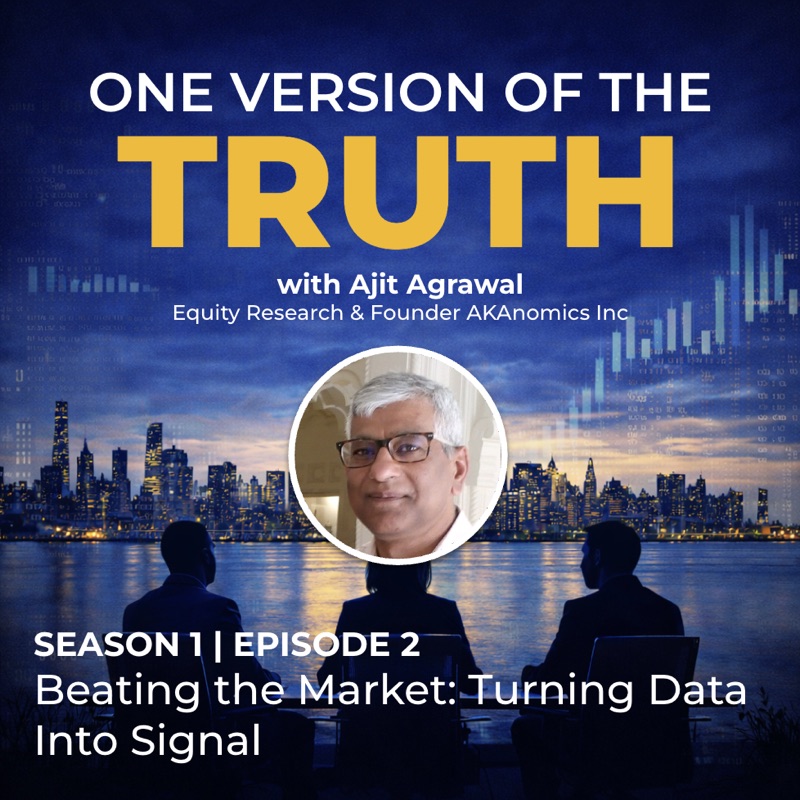
Ajit Agrawal, founder of AKAnomics and a former Morgan Stanley and UBS sell-side analyst, joins Taylor Culver to unpack how data licensing actually works in financial services, and why it rarely delivers the payday sellers expect. Agrawal explains that most data vendors find their biggest value in operational use cases outside finance, that raw data is not the same as an actionable signal, and that pricing a data license comes down to a rough rule: buyers expect a 10 to 20x return on what they pay, though nobody can ever fully audit the value delivered.
The conversation turns to why data-driven decision making struggles inside established organizations. Agrawal argues that trusting data over gut instinct is a generational shift, not a technical one, and that data leaders face the same uphill climb chief information officers faced decades ago. He closes with his outlook on AI: it will accelerate analysis and erode the edge held by big institutions, leveling the playing field for individual investors over time.
“The data is much more likely to be useful for operational things. If you can improve the operations of a company, it's likely to be a lot more useful to that company than selling to financial services. Financial services is just a sliver of where the value of data could lie for many of these data vendors.”
“The rule of thumb I've come across is that if you're going to charge them $100,000, they expect to make two million bucks out of it. At least a 10 to 20X improvement on that.”
Taylor Culver: Today we're sitting here with Ajit Agrawal. Today he's going to talk to us about what it's like doing data licensing within the financial services environment. Ajit, could you introduce yourself, please?
Ajit Agrawal: Yes, thanks, Taylor, for inviting me. I don't know where to start. My quick background is that I've been in financial services the last 20 years as a... cell site analyst at Morgan Stanley and UBS and that's really where I grew up with the role of data as it relates to doing stock and macro research. Prior to that I was a consultant in McKinsey and Company for six years and I have a PhD in computer science. I'm really an electrical engineer and computer scientist by training.
Taylor Culver: Very cool. And tell me this, how did you first get interested in the data?
Ajit Agrawal: It's a curveball of life. So was at Morgan Stanley, I was doing... business products related work and my role role got eliminated and I was asked if I wanted to get involved with Stock research and that's the role I was offered and I really got excited about the this is in 2007 or 2008 when You know new types of information with electronic markets and with people using the web as starting to come on and really the financial services were very early in that in that game and so I got into it and really got excited about it and started to build a team at Morgan Stanley to do this worldwide, to take a look at the data and how it could be useful for doing stock research. I myself, who had never done sell-side research or stock or macro research, got excited about it turned into an economist and started to learn about the US economy and tell people about how the data is performing and what it could inform them about the US economy. And that in turn could allow people to take positions in the in the short run. it turned out to be quite a change in my career path, but I have loved it.
Taylor Culver: And what have you seen change over the past 20 years or so? Do you think data is more integral to that process or has the abundance of data created more noise than signal?
Ajit Agrawal: Well, I think the whole world is moving towards a lot of data. think the role of the field that I got involved with, is trying to analyze companies, where they are and where they're going, and where they might be in the markets and whether they're going to go up or down. All of that field has been a field that's dictated by experts who try to understand a company from different angles, from whether it has good management, it has good strategies, it has good execution, has it been performing well, all of that. And they do help you understand where the company is going in the long run. But the markets, the way they are, short-term offering and positioning is quite important to every stock, because if a stock gets hammered in the short run, one when scratch their heads and think about where it's going to be in the long run, right? So the short term matters a lot and much of the data that we see today can tell you a lot about the short term, can tell you very little about the long term. Is it possible that you can tell about where? For example, the world and the economy is going to be five years from now. It's very difficult. But can you see where it is now and likely to be in the next two, three months? It's much more likely. So I think the data is very, very informative about the short run aspect of things. And one of the things that I've seen change in the last 20 years is more and more people understand that the role of data in positioning for the markets has rapidly increased in this 20 years here.
Taylor Culver: So when you and I first connected, we were in the process of trying to license a data set and we were looking to you for guidance on that. I think every organization has in their mind like, my data is worth so much money. And if I just figure out a product opportunity for it, it can be a significant pivot for our business model or an ancillary revenue line. Can you explain to... the people listening, how data licensing really works and what that real commercial opportunity is for most corporations.
Ajit Agrawal: Yeah, so I might have a couple of different answers for it. I think a lot of the times when we have looked at data from the financial services angle, we have looked at it from the perspective of how somebody who is taking a position in the stock market, whether it's a trader, whether it's an analyst, a hedge fund, a sell-side team, how they could use the data for their businesses. And the reality of it is financial services is very, very There's a very large book and there's a lot of value to be created there. But it's a fairly narrow field in terms of the use of the data. If a data, really the use of the information can give you an edge over the rest of the markets, then it's useful, otherwise it's not. So the use of the data is primarily towards trying to understand the stock movements of this. And that has a very, very special edge to it. So many of the times when I'm talking to the data vendors or seeing their businesses, financial services is only one piece of their business. And many of the time, the data is... are much more likely to be useful for operational things. If you can improve the operations of company, it's likely to be a lot more useful to that company rather than selling to financial services. So often, people who are selling to financial services are not really exclusive financial services providers, but they are exhaust from other businesses. And that really makes sense because financial services is just only a sliver of where the value of data could rely for many of the data vendors. I don't know if this is what you were looking for, but this is my view from having seen probably 100 or 150 data vendors over time.
Taylor Culver: Yeah, what I see at organizations is that the biggest benefit to implementing any kind of change related to data is productivity uplift, right? And then in my professional experience, when I've tried to license data, it's been maybe a six figure opportunity. The guidance to me has been, this is a piece of signal, not the signal. And by the way, if it were the signal, we wouldn't tell you it were the signal. because it's a very, it's not a very opaque marketplace for that matter. But it's it's it's it's
Ajit Agrawal: Yeah, I think the thing is like when it comes to moving stock market, it's really a game of lots and lots of people playing the marketplace. So there's not one piece of information that moves the market and you could take a range, right? know, an event going on around the world very quickly escalates and it can move the markets. A tweet from you know, influential in particular field can move the market. you know, when you have a very structured piece of data set, does not necessarily mean it'll translate into informational edge. But there definitely are places and there definitely are going to be systems that allow you to do that. And that's where the opportunity is for many of the data vendors as they relate to financial services and how they could be useful to them.
Taylor Culver: We were talking the other day and something that you said surprised me was that almost public data stats have more value to predicting asset prices than private ones. Could you elaborate on that?
Ajit Agrawal: I don't know if they have more value, but I think, you know, when you think about informational edge, which is what I think about all the time is there are two ways to get information. It's informational. One is you get very new pieces of information that nobody else has. And boy, that's, you know, that's that's going to be super valuable. And and can be quite useful in positioning for the markets. The other way is to take data that other people have, but you have better analytics. Most of the world competes on the second. It's really, if look at the stock market, are thousands of people. who are analysts at reputed firms or individuals, and they are competing with each other based upon analytics. They all have similar information. It's just, can somebody analyze a company better than somebody else? And so the role of information is not necessarily you have to have better data, but if you can do a better job with the data, that's certainly useful. And I think like how many new pieces of data that can you get? I mean, in the last 20 years, Yes, we have seen an advent of new types of information, whether it's credit card, it's location businesses. Each of us have cell phones so that we know where we are at any moment of time. You have satellite imaging. You have what you do online, application download. So there are new pieces of information that come about. But really, as soon as they come about, there is a... you know, there's a fight among everybody to try to get to that and try to squeeze information out of it. And after a little while, that information becomes common. So the differentiation does not exist in that. But people still, know, even after 20 years of credit card data, there are still many, many hedge fund teams that actually use that very effectively. And part of the differentiation is how they want to use that information. My expertise really, which is after having done this work for a decade or more, I realized that in addition to new pieces of information, the way you use existing pieces of information that is public, which is what I currently do in my current role in my startup company. It's, you know, it does offer a lot of significant value and we can show it both historically and otherwise. That's because the tools that have come about in the last 15, 20 years, allowing you to gather and assimilate large amounts of information. and turn them towards answering a question have really evolved. And so the ability to do all these analyses have also evolved. And there's much to begin from that as well. So that's the context under which I thought that the public information, public data, also there's a lot one could do with it. Of course, if you can get new types of information, that's of course great.
Taylor Culver: It's great. Well, maybe you can share with us how does a hedge fund or a financial services firm typically buy information and utilize that within their day to day analysis of equities.
Ajit Agrawal: Yes, so I have never been at a hedge fund. I could only take a crack at it from being a distant observer rather than being in there. But my observation is that really, I mean, among the funds, there are people who have become quite experts at using data. they have a slightly different approach than people who are looking not so much for data but for using for getting signals that they can use for their trading and they don't really focus a lot on how these signals have come about but the fact that they have come about and they do exist is valuable for them for their information and is the is the former guys who the people who are really you know data centric folks You know, they are doing a lot of analysis on exactly what the data does. They want to understand the history. They want to understand the quality. They want to understand under what regime does the data work or does not work? Did it work when COVID was there? Did it not work? What are the biases for that? What are the issues with that? And then given all of that, Can they use it in certain strategies that they currently have? And most of teams have fixed strategies. They want to be sector neutral. They want to be quantitatively oriented. They want to be fundamentally oriented. Whatever is their bend accordingly, can it supplement their thinking? Much of the work that I do today, really, I'm going after corn firms. They are interested much more in the signals. Can you say something about a company and a group of companies that you could not otherwise find without that signal, without that data set, or without that sort of analytics? And if that is the case, can it help them? perform or improve the performance of their quantitative strategies. So it really goes closer and closer to providing signals to them rather than data because it's very hard to convert data into signals in a complex environment.
Taylor Culver: So for people maybe not so familiar with signals or converting data to signals, do you have any examples? Obviously, this is probably very sensitive, but are there any examples that you could share or even if it's not, it's more direction.
Ajit Agrawal: Yeah, I think there's, you know, what's the example of single, one, a simple example could be like, if you look at how many people are searching for some item, right? That's data, you can search for any item and any group of cohort of people and you can go to, you know, find Google trends and understand that. That's a lot of data. Signal is where, when does that data turn into some meaningful information about a company? And one example that I used to do a while ago, is, Apple used to launch its products every year in October, November timeframe. And if you look at the relative, relative rise of the number of people who are looking for that product or in social media talking about it or the buzz on that. You can compare year after year and you can then make a pretty informed guess as to how well this product is going to do. So now you have taken that data, you have turned that into a time series, you've got rid of all of the noise that occurs because you know a web search is... not a very well defined thing. have to, other people could be searching for, you know, your name Taylor, it could be Taylor Swift and they might look the same, but you know, you have to differentiate between these things. But once you've done all of that, you can turn the data into some kind of an actionable item. The work I do today, which is even more, much more systematic than that, where I take thousands of pieces of macroeconomic data and I use that to which I think everybody's access to, but turn that into saying, will this company miss its revenue targets or revenue estimates for this quarter or not? So we take all of that data and we churn it, we churn it into indexes and there's indexes into the areas that the company is exposed to and then we combine it all together and say, will this company beat or miss their quarter? So that you have turned the data into a signal that's actionable because if it's going to miss the quarter, very likely the markets are going to move and you're going to make money out of that. So that's the transition from going from data onto an actionable action item. Now creating the signal itself doesn't mean actionable. You go to a hedge fund, they'll go, well. That's your signal. That's really not my signal because I'm going to do, I'm going to take away, know, but you know, you're talking about, but there's an, you know, this particular signal includes something about the sector, something about the macro. I'm going to include, you know, remove those factors, then see if it is really has an edge. So no signal is no signal until you are really... acting upon them. But for me, transforming the data into something, a well-defined set of informational disconnect with the market is certainly closer to a signal than not.
Taylor Culver: That's very cool. so it kind of goes back to what I saying earlier is that there's not this, hey, here's my data, figure it out, right? There's not a huge commercial opportunity there. And then if you have the data and then can define what the signal is, then it's a conversation over, well, I think it's this and I think it's that. And it comes down to those assumptions, right? And if anyone's trading equities, on someone else's signal, they're probably not doing their job as well as they could. They have to do that due diligence. I think one of the questions that it leads me to, and this is often what I talk about and we kind of started with, how do you figure out the economic benefit or the business value of that signal? How do you figure out what that?
Ajit Agrawal: Yeah. It's very hard for you to figure that out. You'll have to learn from the hedge funds if they're willing to share their economic information which they are not willing to serve. But I think the rule of thumb that I've come across is that, if you're going to charge them, you know, $100,000.
Taylor Culver: you Hahaha
Ajit Agrawal: that they expect to make two million bucks out of it. at least a 20, 10 to 20 X improvement on that. But you can do a little bit of back of the envelope calculation. can say, like if you had a good strategy, here's a type of a strategy, which is what we do. We say, you take our signals and you take a hundred million dollar portfolio, right? You can make every 10 million dollar sector neutral. You lever it. You make about 20 % on top of it. So you make $20 million a year on a $100 million portfolio. Not that goes to the investors, so the people who are going to buy our product are, two plus 20, so you're okay, they make $4 million out of it. Okay, so I can charge them, you know, $100,000 to $400,000. Listen, this is really very much a bag of the honor. the value that they create is really incremental. Most of the people who want to pay you or don't want to pay you is the incremental value. And none of us can know the incremental value because you don't know what assets they already have within the firm and are the 4 million that you can actually create that you think you can create. They may have other tools that already does 3 million and this incremental value is 1 million or it could be zero or all four. So it's a very, very hard game to play. And that's one of the things that gives I think the hedge funds and my clients are massive advantage in trying to squeeze people like us, which is they can say, I don't find any value, so sorry, I'm not going to pay you. Well, and you have no way to audit that they're not using it, they're not really making money off it. It's very, very difficult. So you're really at the mercy of the people who...
Taylor Culver: You
Ajit Agrawal: So you decide what you think your information should be valued at and you stick with that and see if somebody is willing to pay you.
Taylor Culver: I think it's a healthy gut check and it's a great entrepreneurial mindset, which is if your product is delivering 10 times plus the value that you're charging for it, you're probably doing well. So 10 to 20 times makes total sense to me.
Ajit Agrawal: Yeah, the only problem is you don't know what actually gets delivered when it actually hits the final trades that they're doing.
Taylor Culver: very interesting. So in my work, I spent a lot of time coaching and working with data leaders, right, effectively the senior most data person within an organization. What do you see some of the challenges for data people within organization as they navigate, you know, cross functional politics, maybe an executive who says, Hey, let's license our data, you know, how do they navigate that environment? And what kind of pearls of wisdom can you give them? so they don't end up in impossible expectations.
Ajit Agrawal: You know, it's, I think we were talking about it and you use the word, it's not a data problem, it's an organizational problem. I think that, you know, at least the years that I spent at these two firms, I also found that there was a very established approach to doing things. And when approached with data that might, challenge the existing thinking, which is what I encountered multiple times at the first forum where I started this. Really, most of the people who are so established, they are willing, they don't want to listen to data. They think that their gut is right. And often, very technically and very systematically, you can show that that's not right. But it's really for people or organizations to take advantage of the data. I think people have to learn to trust the data, which is not straightforward. That requires a generational change because people who have grown up, who are the outspoken leaders today in anything, and I'm talking about in stock positioning, people who are sell-side analysts, they've been doing it for 20, 30 years, they didn't grow up with experience in using data. And so for them, it feels like a toy that they cannot be comfortable with. So it's a really organization change. But I think as years pass and the younger generation is getting more, because they're coming in trained with the use of tools that other people didn't have. So it does take a generational change for data to become far more effective in its use in the firm. But the firm, they wanted to, any of the firms who want to do this, they have to make... very explicit decision that data needs to be an important factor in the way they conduct business. Otherwise, it just lies aside. I see even in like both the sell side firms I was at, where it is really a side show. know, it's, for example, I was doing data driven research in parallel with somebody else doing a similar piece of research, but without the data. and you let the marketplace decide. And that was the best position as opposed to, you know, the data driven outcome is going to beat the non-data driven. And so you should give it a higher prominence. But that, I think, will take a generation for it to turn. And even the hedge funds that I work with, I see that most of the data teams are central data teams. And they have very little influence in how other people are really taking risk and taking positions in the markets. They make their own decision and they're not really dependent upon what central teams on the data side are telling them. So it is a big change for every firm to have to go through and they have to make their own decision as to whether they want to embrace it more fully or less fully.
Taylor Culver: So this idea or notion of a chief data officer or a chief analytics, an AI officer being able to take the data team from the sidelines to the corporate priority to where the business ignores their own gut and story to make data-driven decisions almost seems a little Sys-o-ficien, maybe a little bit difficult of a path. I agree with you that in time data is gonna become ingrained as a skill with a lot of the younger generation. But in the meantime, I think there's a gap in leadership, right? So who's going to steward that change to the next generation and what kind of wisdom do you have for them?
Ajit Agrawal: I think there's a very good set of examples from like when technology like when I started working at McKinsey and Company and we were looking at the role of technology in businesses and then the many of the discussions were occurring is the Chief Information Officer and Chief Technology Officer is that a C role suite does that report to operations does it report to the president does it report You know, those discussions have, you know, by and large understood that technology is a core driver to most of the companies and, you know, they get a C-suite. We are at a place where data is starting to think about is having a similar role and, you know, it will have to get sorted. you know, having chief data officer or chief information officer or chief AI officer is a step towards that. Doesn't necessarily mean they get the same reverence as somebody who's running a business within the organization because it does not have the same need. But over time, people will tend to realize and that process escalates. So the stuff that you're doing to help with that transition is an important, you know, is an important. to companies to try to understand and say, hey, this really does require elevation, that it hasn't occurred so far.
Taylor Culver: And it's just the noble battle to fight for the next few decades. Tell me this, something we have not talked about at all today is AI. And I'm curious how you think AI is going to shape the market of signal? How is it going to create synthetic data sets? Is it going to be a real disruptor? Or is proprietary data always going to carry the value? What do you think about AI in today's world?
Ajit Agrawal: Yeah. Well, I think the role of AI in the area that I'm familiar with, which is stock research and Mac research, is going to be high because it's really, it's a place where experts thrive. And experts thrive and most of the time that they spend is on analyzing past information as a way to project the future. And that, analyzing past information, much of it is really public markets data is very, ripe for this disruption. So I think AI is going to really affect that. It won't affect the need for having experts to interpret and project the future. But certainly it will affect what they do in order to get to and how quickly how meaningfully, how broadly can they analyze the information more quickly? All that will get disrupted and get affected. The second part, I think, in the role that I currently have, which is trying to assess information and convert them into ways to think about the markets and use of it. That, I think, is also very much ripe for AI because a lot of the work I do today in my startup, which is trying to take information that is available publicly and by hand do many things to that in order to come up with a signal. And that process of doing it by hand is also ripe for disruption. So I think it will make the markets, I think a lot more efficient, the ability to... have a lot of unique information, unique signals is probably going to drop and it'll probably, at least in the long run, make each of us, including individuals, have a completely different information set than what, for example, institutions have today, right? You and I cannot have access to much of the information that... you know, somebody with a large firm does. And all of that could change with the advent of AI. it'll make the, you know, so the markets a lot more play, you know, the playing field will get a lot more even with time, which is a thing for all investors.
Taylor Culver: I think this is great. So as markets become more efficient, where will investors, financial institutions, hedge funds find alpha?
Ajit Agrawal: Yeah, I think it's a separate question. Should they be finding alpha? Should they have an advantage? they? I mean, I don't know if that's that should be the role of the financial markets to, you know, today they have alpha because of the discontinuities in the market. But really, the role of financial service should be to to offer the same level of playing field for everybody. Where will they find alpha? know, like I think in the world has shown us that people with money and access always outperform others. Where will they find alpha? I don't know, but you know, the history has showed us that they are never at a disadvantage, so.
Taylor Culver: Well, Ajit, I really appreciate you sharing your story today and your experience doing research, working with different types of financial institutions. If folks listening to this want to get a hold of you, what's the best way to?
Ajit Agrawal: Well, I'm certainly on LinkedIn. With my name, they can search me. I'm also running a startup called Economics Inc. where we are taking macroeconomic information and converting them into trying to analyze which company is doing well or not, I hope. My dream is that that product is on the hands of every person or just institutions at some point. So hopefully when that time comes people will know me. otherwise I can be reached at ajitagrawal@akanomics.com as well. Thank you very much.
Taylor Culver: love it. So anyone looking to get signal to get advantage and trading stocks, reach out to Ajit.
Ajit Agrawal: For sure if you're a quant firm or discretionary firm and you want to use The signals we produce which I think I've been I've done very well for the last few years So we are certainly available and happy to chat. So, thank you
Taylor Culver: Ajit, thank you so much for sharing your story today.
Ajit Agrawal: Thank you, Taylor, for having me.
Taylor Culver: My pleasure.
The only data leader in the room?
Have conversations like this with peers who live it. Free and private, for data leaders in the seat only.
One Version of the Truth