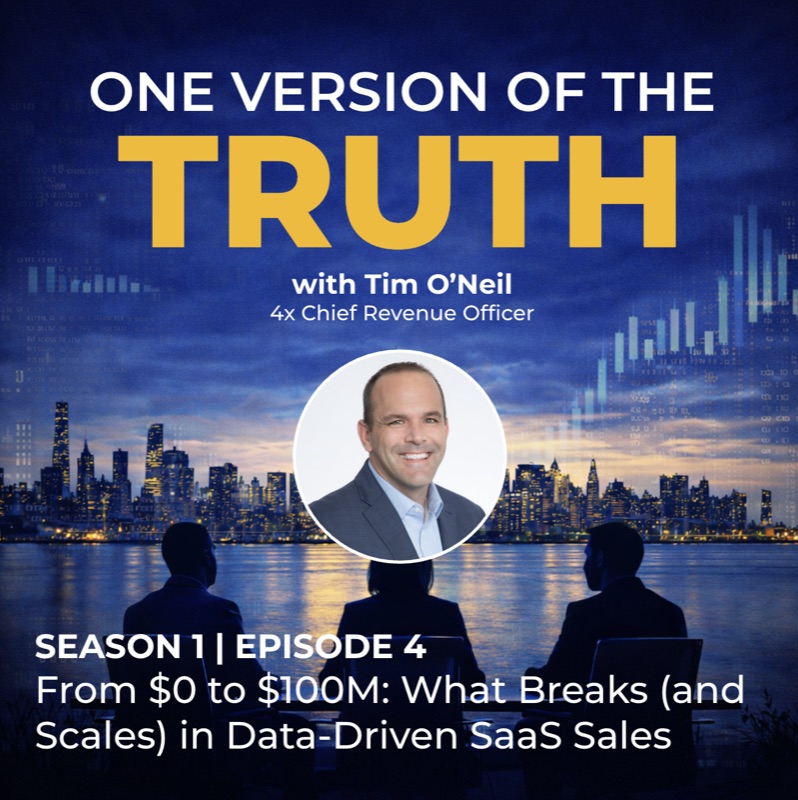
Tim O'Neil, CRO of Matillion and former CRO of Alation, joined Taylor Culver to unpack what it takes to scale a data and analytics company from zero to $100 million in revenue. Drawing on his early years at ThoughtSpot and his run scaling Alation, O'Neil explains how the ideal sales rep profile changes at each stage of growth, why partner ecosystems become essential past $50 million, and why most stalls are people problems, not product or market ones.
The conversation sharpens around what separates data leaders who become trusted business partners from those stuck as reporting functions: chasing good news or protecting turf loses influence, while agreeing on stable metrics and learning the actual business earns a real seat at the table. He closes with a candid take on AI: a powerful research tool, but no replacement for the trust that closes deals.
“A lot of times as people scale, it's a people problem that gets them in trouble more than it is a TAM problem or a product problem.”
“The intent isn't to provide data to make you look good. The intent is to get data to find out where the problems are in the business.”
Taylor Culver: Today we're here with Tim O'Neil. Tim, could you introduce yourself?
Tim O'Neil: Sure. Hey Taylor, thanks for having me. I am what some may call a seasoned sales executive in the SaaS world. I've been in software sales probably for the better part of 20 years now, but I entered the startup world probably 10 years, maybe even 15 years ago now. And I've now done four different companies, three at a C level. I've seen a lot of growth, also a lot of headaches. But in all scenarios, I've been in the sales world, mostly in data and analytics, and for the most part, focused on enterprise software sales. So, you know, seen a lot of journeys, seen a lot of growth, and also seen a lot of pain as well through the process.
Taylor Culver: Yeah, well, I think you're underselling yourself a little bit. Many of these companies that you've joined, you've taken from pretty much zero dollars in revenue to a hundred million plus in revenue. You know, when you're stepping into some of these data and analytics organizations, what was fundamentally broken?
Tim O'Neil: Yep. So, well, let's go like there are probably two that people know me most for. The first one, I wouldn't say was broken. The first one that I joined was a company called ThoughtSpots where I met you. And you were generous to be one of our early customers. So thank you for that. But so I wouldn't say ThoughtSpot was broken early on, and I'm not saying it was broken later, but my challenges early on were figuring out how to sell it. You know, and I think when you're at an early stage startup, you're selling an idea and you think this idea is the greatest idea in the world. But actually what you have to really do is translate that idea to pain for somebody else and a problem for somebody else. We, we used to joke at ThoughtSpot when we demoed the product that if someone said it was cool, we were in trouble. But if someone said, need this, then we're in a really good spot. And so. early on with ThoughtSpot, it was definitely focused on figuring out how to sell it. I joined Alation when there were about roughly 200 employees. when I became CRO, we went through roughly three years of over 50 % growth. And broken there, I actually would say kind of, I don't know if there was a lot of market. stuff because if you remember correctly when we first met you were actually a Calibre customer, right? And so I was actually getting introduced to the market a little bit through you. But I think where we pivoted Alation was we changed the profile of our sales reps a little bit. And so some of the first people that I met at Alation were very technical, like former SE salespeople. And we pivoted the organization to having value selling outbounding AEs with technical SEs in general. I think part of it is as you scale organizations, what you need from certain profiles, both sales reps, sales engineers, product leaders, sales leaders, it changes what you need from zero to 20 million is different from what you need from 20 to 50 million is different. than what you need 50 to 100 million and I don't know if it's necessarily quote-unquote broken as much as it is different phases of a company's growth.
Taylor Culver: What are some of those foundational changes on that journey from 10 to $100 million in revenue? And where do you see companies stall on that path?
Tim O'Neil: So I feel like there's, if we just look at a persona of a sales rep as a best way to do it, and then I'll hit the stall, right? I think zero to 10 million, zero to 15 million. you know, the persona of your sales rep probably comes from the space, you know, cause it's hard to figure out how to sell something. You know, I, when I was selling ThoughtSpot to you, I had already known BI had come from Cognos. I understood it. So I could actually understand the pain that that technology was solving. Cause I came from the space, you know, but I think for those first, zero to 10 million, what you're really looking for is common use cases and outcomes that customers are seeing in those first year, two, three years. And you need almost someone that understands the space to help you figure out what those outcomes are. And once you get to those business outcomes or use cases, then you can start to bring in a different profile of a sales rep that is value selling, outbounding, messaging, things like that. And sometimes the sales rep that was there from zero to 10 can make that transition. And sometimes you need to bring in other people to surround them and see if they can make that transition. And then, you know, once you get outside of maybe 10 to 50, you have to create an organization that's very partner centric too, because you can't just hire a sales rep for every time you want to get a dollar of revenue. Right. So eventually you got to have a product and a go to market organization that leans into partners to scale because both one It helps you benefit from a product perspective. And then two, you know, from a competitive perspective, if you're going to these enterprise accounts and saying, you don't need services teams, there's a services person in that account that is saying, excuse me, what? You know? And so it's also just in your best interest to partner with partners a little bit better. So I think there's just different phases and different types of salespeople that go with it. to where people stall, I think what ends up happening a lot of times is some of the people that you get into an organization early on, you look them in the eye and you're so super happy that they're betting on your company. So you'll say things like, Taylor, you come here and you can be the CRO of this company. And if we hit these numbers, you're going to be CRO. And what should have maybe been said is, hey, Taylor, if you come here and do well, we're going to keep giving you equity and we're going to give you these opportunities to grow. But maybe as we scale, we may need to bring in someone that's done this before that you can learn from. And I think the navigation of that truth early on is really important. And a lot of times as people scale, it's a people problem that gets them in trouble more than it is a TAM problem or a product problem, you know?
Taylor Culver: It's interesting to me is that you have a different kind of sales leader for every phase of that journey. And when you bring people in, it's, you're the head of sales now, but you're probably not the head of sales in 50 million dollars. And that might sting. it's like, I got you to 20. Like I should be able to get you to 50. It's interesting how you call it a people problem. I'm curious when it comes to running your sales teams, what metrics did you obsess over? I mean, you're in a data-oriented business. Are you a data-oriented leader?
Tim O'Neil: So it's interesting. If I had to say some of the benefits that I had in my career, would call out probably three people, right? And I'll answer your data stuff. know, a super, super benefit. you know, lucky to run into a G, you know, a G did founded Nutanix and then went and founded ThoughtSpot. And you don't think about how fortunate you can be from somebody that's seen the scale. like when you get into these problems, they're not as stressed as maybe somebody that hasn't seen it before. And then there was a gentleman named Brian Blonde who came in to ThoughtSpot as we started to scale. And he helped me with sales process, methodology and things to look for that you're asking about, you know, that you want as you scale. Then the third person, when I went to Alation, there was a gentleman named Dave Kellogg and Dave is notorious for he was the CMO of business objects from like 1 million to a billion in revenue and then a multiple time CEO. And one of the things that Dave did for me, Taylor, was we got into a room one day before we even like got into scaling the organization and we were like, Hey, how many, you know, what's our, what's our top line revenue number for the year? How many deals? does a sales rep need? How many MQLs does the organization need? Where does it come from? Does it come from partners? Does it come from sales? Does it come from inbound? Does it come from outbound? And it really, you know, Dave is a math background and it really forced you to be a numbers person. And I'm a firm believer that a CRO is an operator and a numbers person. They can do the sales thing, but the difference between a VP of sales is just in the deals and the CRO knows the data and the numbers, you know, and like perfect example, your VP of sales, nine times out of 10 can tell you every deal that gets them to the quarterly number. Your CRO knows their two and three quarters out pipeline, their win rates, how many deals they need, their conversion rates, their lot, like that sort of stuff. And it's just the outward focus of it. And a lot of times the CRO accepts that more likely than not, their quarter in quarter, right? It's going to fluctuate between five and 10%, maybe, right? But it's the work that you're putting in in Q1 is what's going to actually create Q3. Right? And so when you don't put effort on out quarter pipe, win rates, things like that, you end up just looking at deals and you end up really missing on the top, the top line metrics.
Taylor Culver: It's, that's helpful for me to kind of understand because did you find that certain data sets are overvalued when you were working with your teams? Like it is, is the CRM the gold standard or what, what, what was overvalued to you?
Tim O'Neil: Yeah. I actually would say there's two or there's a couple of things that are important to the discussion. One, one of the things that Dave and I agreed on was whatever metrics we agree on are the metrics we're using, right? And the, as you can appreciate this as a data person, right? But if you don't agree on the metrics and don't use the same metrics like for the next two years, someone who's really good at data comes in and goes, look at these metrics that I just made up that you guys weren't talking about, because you can make data say whatever they want, right? You can have actually really good quality data. People talk about quality data. You can have really good quality data. But if the person over here wants to talk about these metrics and the person over here wants to talk about these metrics, OK, you have two people talking past each other, you know? And that's why aligning on the metrics really matter, right? So like as an example, someone can say, hey, I need pipe. I need 5x pipe coverage. If your win rates are 10%, it doesn't matter if you have 5x pipe coverage, right? Okay. If your deals are 300 days, it may not matter if you have 5x pipe coverage because all 5x of that pipe coverage may be coming, you know, in 18 months. Okay, so you need to have stage weighted pipe. You need to have win rates. You need to see AE driven pipe to make sure your AEs are driving pipe. You need to see what marketing is driving to see your most valuable revenue engines with regards to the marketing organization. You got to see what partners are doing. And then of course, the fun part is once you even close a deal, cool, let's see how quickly they got on boarded to make sure they don't churn, right? And there's a list of 10 to 15 solid metrics that you need to look at. More likely than not are lagging indicators and you still need to look into the leading. But if you don't agree on them and you let someone change them down the road, you're never going to get to where you want to be.
Taylor Culver: So pretty much the challenge comes as when people start presenting alternative KPIs or alternative truths, right? And it kind of derails the narrative because it's about making progress more so than having the perfect metric.
Tim O'Neil: Yeah. And let me give you a perfect example. So like when Dave and I used to talk about this, you know, if you expect, you know, let's just say your partner team to do this much this month, your eight outbound pipe to do this much, your events team to do this much and you know, these sort of things, and you go in on a weekly basis and look, okay, did they do this? Do they do this? It's not in the, the intent to try to fire people. It's under the intent of trying to find out where your leaky your leak is in your bucket. Right. And a lot of people like to report good news versus search for like the red, you know, and. When you have an organization structure on reporting good news versus searching for the red, right? You got to embrace the red and have a culture that it's okay to have red and let's go fix it versus rewarding good news. And the best example I can give you is if you just think about that process that I gave you, okay, here's these revenue engines, here's whatever, right? I was in an organization one time that they were like, well, listen, the sales reps just aren't accepting the leads quick enough. So why don't we just change the definitions? And it's like, guys, we're not solving for trying to fix the numbers. We're solving for trying to find out where the problems are. And as soon as we change the definitions of whether it be an MQL or an SQL or whatever, right? Now, everything that we just tracked for the last three years isn't actually relevant anymore because you've just changed the definitions going forward.
Taylor Culver: Yeah.
Tim O'Neil: You know, and it's like the intent isn't to provide data to make you look good. The intent is to get data to find out where the problems are in the business, you know, and when you take that mindset shift to I'm looking for problems and problems are good and let's embrace the problems versus I'm looking for problems so that I can fire you. You know, it really changes the culture of an organization to embrace data, to not change metrics, to make yourself look good. you know, and to go after where the red is in the organization.
Taylor Culver: I love it. And tell me this, when you're running these different teams at all these different companies, were you primarily reliant on your sales operations team to provide you data and analytics, or was there a centralized data team that helped you as well?
Tim O'Neil: Both. So I would say, you know, shout out to Alec. Alec was one of my best ops guys and Alec knew the data really well and he had a data team underneath him and you could always talk to the data team and they give you insights. But to the previous discussion, the data team knew all of the data, right? So they could call you up with some insights that couldn't spin your head and get you really frustrated almost. I go, well, I need to go pay attention to this one thing that someone just told me. And someone like Alex, like your ops team is going, okay, like, listen, that that is relevant. That's not where our problem is right now. We need you focused over here. Tough guy, right? And that, you know, he kind of helps synthesize the noise for me a decent amount. And I think the other thing too, That Alec, you know, there's a, there's a funny story. We should probably have him on a, a follow-up podcast. But when he first came into the organization, you know, he had been trained pretty well on how to forecast, you know, to a really good level. So he calls me up and, he starts and we're excited about our relationship. And he's like, I'm going to help us forecast better. I was like Alec, forecasting is not my problem. And he's like, you haven't seen me forecast. I'm like, got it. Right now. Sure enough, I didn't have a problem for us. I was like 98 % accurate with regards to, whatever, because I had different methodology that I followed, but it wasn't, you know, just by the seat of my pants. Right. But I had other problems that Alec was a really skilled at being able to help me with. Right. But he thought. Oh, everybody struggles with forecasting, so I'm going to go fix that right away. And it's kind of like, no, no, no, go figure out our other data problems first before we actually figure out what our problem is. You know what mean?
Taylor Culver: So tell me this, I mean you've had the opportunity to work with a lot of different data people in your career. What's a good partnership between the sales team and the data team look like?
Tim O'Neil: It's a great question for Alec. I think it's a combination of two things, right? To the theme of the discussion, I think that as a senior level exec, my job is to not create thrash or destruction to my field. So if I create kind of a protective front, from things that get to the field and distract the field. And then say, hey, listen, all I care about is if you outbound, all I care about is win rates. And all I care about is say like AE productivity. Like those are the three metrics that I care about and that's all we're gonna do. And then my managers run behind that and my second line managers and my reps run behind that. Like that's really important that they don't get distracted by a new metric every week and a new metric every week and new metric every week, right? But then. That be able to have discussions behind the scenes with my data team on things that are like coming up in the data that are concerning that we can go start to dig into and have a relationship on that we can bring back to the field on a thematic basis, not in an ad hoc basis, maybe once a quarter at the end of a quarter to say, Hey guys, did a great job with the three things that we asked you to just something to think about was, Hey, our partner source pipe wasn't even though our win rates were average, our partner source pipe went down, right? So we need to do the following things next quarter to improve that. But if you don't kind of get in front of that, right, you'll create thrash for the field. But at the same time too, if you don't listen to the data team and show that you're embracing data and not bringing some insights to the field, they're not going to trust you either. So it's this world where you have to show that you're embracing data, but you also can't be so sporadic that every week is a new idea to the field.
Taylor Culver: I like it. Yeah, I mean, it kind of goes back to what you saying earlier is being more consistent about how you measure versus what you're measuring because it's what are you doing? What are you not doing?
Tim O'Neil: Yes. Well, and the other thing too is like, I mean, you've ventured into the world of sales now, right? The world's, know, sales reps want to wake up every day, know what to do, like how to do their job, not be distracted and how to make money. Right? They don't want to wake up every day to this new thing that they're supposed to do that actually doesn't make them money. But they have to go do this thing to appease their boss and their data person and their CMO and their CEO. And it's like, guys, I have a list of three hours of work and none of it's selling stuff, you know? And like once you get to that world and you may you may have gone too far on the data, you know?
Taylor Culver: I like that. Well, I think you've had a cool purview into data people given your career. You've sold to them, right? And you've worked with them within your organization, you're friends with a lot of them, and you work in the industry. know, something that I'm sure you have a pretty good pulse on is what signals to you that a data leader fully understands the business and is going to be a great partner?
Tim O'Neil: you know, it's interesting when a CRO joins an organization or I even give you a better, a friend of mine, give another example. I'll give you good example. When you go and acquire a company. Okay. One of the things people are gonna talk about, we did this much revenue. And by the way, this is our pipe for the upcoming year. Now when you're in acquisition process, that pipe for the upcoming year is BS. They're doing it to fluff the numbers so they can get acquired. And the best way you can go and find out about pipe is to go ask one of the sales reps in the field. And I think the same thing kind of goes for a data leader. If the data leaders looking around and saying, Hey, how do I make my exec peers happy and get them on my side? I actually think that they're in going to do it wrong. Right. And it's kind of like, and I'll give you an analogy and then I'll, I'll tie it back to the, to the, to the answer. I did a podcast with Sam crew. don't know if you know Sam or not. but Sam asked me, how does it, how does it BDR or SDR get promoted? And I said, the worst thing a BDR or SDR can do to get promoted is to ask for a promotion. You know? And I said, it's literally the only job in a company that it's okay to say, I don't want my job. You know? So they literally like enter their job day one and they're like, Hey, I want a promotion. I want to be an AE. Hey, I want a promotion. I'm being an AE. Hey, I want a promotion. be an AE. And in a lot of organizations and I'm giving it to them because they're just sick of hearing, I want a promotion. I want to be an ace. So they just do it. Right. And they don't want to lose them. But the best SDRs and AEs think about not what an AE is doing, but they look at what a sales manager and a second line manager is dealing with from a data perspective. And they try to take things off their plate versus trying to just be the squeaky wheel to get promoted. And it's those strategic ones that sit there and go, how do I take things off other people's plates? Right. That end up getting more opportunity and more scale and more responsibility. And so if you tie it back to a data leader, if the data leader thinks, Hey, how do I make my CRO happy? Or how do I make the CEO happy? All they're going to do is what makes their CRO or CEO happy. And they're just going to be like a reporting function. But if they go and learn the business and talk to the sales team, the second line manager, the product team, the engineering team, and like get into the business. And understand how data is either helping or hurting the company and find out ways in which you can enable functions versus just your C staff, right? And actually come back to the organization and take strategic initiatives off people's plates. I think you become a very powerful data leader. And there was an article that Scott Holden used to send out at ThoughtSpot back in the day. And it was a Harvard Business Review article. And the premise of it was use data to be on the offense versus to be on the And I think if a data leader works with data on an offensive perspective and the ways it can help different lines of business versus a reporting function in a defensive perspective, they become very valuable to the company.
Taylor Culver: And that's awesome. And tell me this, like when you were selling into data teams, what were some red flags that you were selling into people who probably weren't going to be challenging their business, helping them grow? Were there red flags for you ever or did it take time?
Tim O'Neil: When they didn't know the business, right? They just knew the data problems, you know? When they didn't understand, you know, what the company was trying to do and how data enabled that problem, you know? You're like, wait a second, I'm dealing with somebody who's getting budget pushed down to them. And as soon as I may or may not have a solution that can solve a problem for them, I'm gonna finish solving the problem that they have. But I'm going to struggle to get to this executive problem over here. Because all they're caring about is that I solve their day-to-day problem, but they're not actually aligned to the strategic problems over here.
Taylor Culver: And a data problem is like access to information as opposed to improving. Right.
Tim O'Neil: Hey, can you help me with this connector in order to get to this warehouse to get to this thing? Right. And it's like, whoa, like that is that is such a task oriented situation versus an outcome oriented situation.
Taylor Culver: What would usually happen to those data teams? Would they stay with the firms or would people move on? What would happen to those accounts?
Tim O'Neil: Yeah, I think the right answer is, from a sales rep perspective, they usually stalled. They may stay with the account, but they didn't get promoted. That deal, more than likely stalled, doesn't close because you're not to the right person in the organization. And more likely than not, another vendor's in place in general. And more likely than not, there's actually an SI involved because they don't trust their data team. They're using an SI to help them with strategic initiatives because their data team is not doing strategic work for them.
Taylor Culver: Yeah, it's wild. I think there's this... I don't want to call it a blind spot in the space in terms of orienting data teams that business value as much as probably a minimization of it. And I think it's kind of like how people minimize sales, right? It's like, it's easy. I don't want to do that. It's anyone can do that. I just go talk to someone and get their money, right? Do you see something similar with data leaders being dismissive towards the business? Do you think it's a mindset or a skill gap? What have you seen?
Tim O'Neil: You know what I think it is, if you're going to do a parallel to sales, right? When people think about a sales rep, they think of the used car salesperson that they see at a, know, other person that goes door to door, which... You know, God bless those people because that is really hard work. So whoever's doing that, like I'm not saying it's bad, but man, that's, that is hard. But the average person looks at a quote unquote sales rep. There's not even, there's very little sales degrees in college. Right. They look at sales as like kind of this sleazy function, you know? whereas, know, at the end of the day, I think Ajit was telling me one time that, sales reps and like comedians were considered to be like the quickest witted people because they have to always be on their feet. objection handling and all this sort of stuff, right? And there's just a lack of respect for the knowledge of business that a sales rep has to have in order to be able to sell software to that organization. But people see it as this slimy little thing. And I think if you were to draw parallel to the discussion we're having, I think the data person... looks at it and says, this data stuff's really hard and you all just don't get it. Leave me alone. You know, and what they should be doing is going, hey, as opposed to like, you know, this is slimy, this is hard. They should be more saying, wait, am I solving the right problem versus I'm you don't even understand my problem. Leave me alone. You know.
Taylor Culver: Yeah. And it comes across as I'm smarter than you, right? And, and yeah.
Tim O'Neil: Yeah, and to be fair, they probably are. It's just the wrong approach, you know.
Taylor Culver: So what's a blunt piece of advice that you could give to CDOs, data leaders, who really want to radically change their business, want to get more close to the business, maybe in their sales organization? What kind of wisdom and advice could you give them?
Tim O'Neil: There's a gentleman who's known for being probably one of the best sales leaders in the world by the name of John McMahon. He helped create Medic and all these great sales methodologies and sales tools and whatnot. And he wrote a book. And if you think about this person, he's probably had thousands, tens of thousands, hundreds of thousands of sales reps that have crossed his path, okay? And he speaks about one person in this book, and the best sales rep, I believe ended up being some person in Italy, okay? the reason why they're the best he ever met was because of how curious they were, you know? And how much curiosity... and understanding of someone else's business is what is key to a sales rep success. And I think that doesn't change for anything. Whether you're a data person or a CEO, when you think you know it and you've stopped being curious, Like you're in trouble. You know, there's this saying of like, when you're the smartest person in the room, you're in the wrong room. Well, if you're the smartest person in the room, you're also not being curious. Like you're kind of just, your ego has gotten in the way of doing your job, you know? And once you stop like asking questions and being inquisitive, like you're not doing your job anymore.
Taylor Culver: I love it. I love it. And that translates to so many different things in life. You know, stay curious, stay humble, even if you're an expert, right? Something we haven't talked about today is AI, right? And you've worked with AI firms and you've been in AI organizations. Where is AI genuinely changing how sales teams operate and where is it overhyped?
Tim O'Neil: Ahem. So I think there's, you know, if you think about a day-to-day function of a salesperson, I think the kiss of death for a salesperson is when they treat every meeting the same. When they go to every meeting and it's like the same pitch and the same stupid questions and, as if you literally could put any person USA in front of them. whether it be on a zoom or like they're just mailing it in right and and part of that is because they're mailing it in they're lazy right and the other part of that is you know whatever period of time ago access to information on these companies was somewhat hard to get right now it's easy right if you don't spend eight minutes and ask Gemini about the company that you're about to talk to and ask them to profile the four people that are going to be on your Zoom call and you don't structure a presentation based upon what you've learned through some research, like don't be in sales, you know? And to be fair, like... probably don't even go to work. Like if you're not gonna use these research tools to teach you how to advance your job, like what are you doing? It's right easily available, you know? So I think right away from that perspective, it will extremely benefit sales to use tools from a research perspective, you know? I think it's overhyped on tools that help. You know, everyone has these AI tool sets that, you know, is going to make your sales rep, you know, non-existent, you know. I appreciate that. But I actually don't think that will happen. I think they may make your sales rep more efficient, but I don't think we're going to wake up in a world where you don't work with the sales rep at all anymore, you know.
Taylor Culver: I mean, you think about it, for AI to take over leadership, communication, bridge trust between two people, I mean, we're a long way away from that. And sales is all about trust. And can you build rapport with the other person? Can you solve their problem?
Tim O'Neil: And just to be clear, you may want to interact with an AI agent, Taylor, to get a lot of information about a company yourself that you're thinking about buying the product from. And I'm not saying that won't happen. Organizations won't create AI agents that you can learn more about the company and the product yourself without talking to a sales rep. But at some point, you're going still get to that last mile in which, before you write a check for $3 million, you may want to talk to somebody.
Taylor Culver: Right. Right. So, you know, we see in the market, all these SaaS companies are getting crushed. I was looking the other day and HubSpot was down over 60 % in the last 12 months. Atlassian, you know, is getting crushed. I think the argument is that now people can go out and build their own apps, right, with AI. Yeah.
Tim O'Neil: I just built one right now. There's an app now.
Taylor Culver: Well, I mean, these are eroding tens of billions of dollars of value, right? And is AI going to disrupt SaaS or is it going to disrupt something else?
Tim O'Neil: So my answer to the question is very simple. One, if I knew the answer, I would be not on this podcast as much as I love your pretty face. It'd be on an island somewhere. But I do think there's financial principles and foundations that we still have to understand is that, know, SaaS was a recurring revenue model that created, you know, great profit margins and have a lot of different cashflow, you know, on a balance sheet, you know?
Taylor Culver: You
Tim O'Neil: And I mean, listen, you've got a better finance background than I have. But I don't know the last time in which someone had tons of cash on a balance sheet and they were screwed, you know? So I kind of feel like, do I think SAS is in trouble? I don't know.
Taylor Culver: Hahaha
Tim O'Neil: Sure, in some capacity, right? I think it's good for technology to force you a way to look at doing business, right? There's a new way of adopting software that's coming through this AI world, which I think is fine. But with that said, when these SaaS companies have these good financial principles, right? I look at it very simply as... If they are in trouble, they have a balance sheet in order to able to acquire an AI company and expand the TAM and do all these things. So in the short term, they may have to pivot, but they have done things correctly from a financial perspective that it's going to allow them to pivot. So I think the long game will still allow them to win, but the next 12 to 24 months is still unknown.
Taylor Culver: It's going to be interesting to watch and it's going to be interesting to see who steps out ahead. I was talking to someone about this the other day and I'm a big believer that AI is going to be far more disruptive to service firms than software firms and it's not priced accordingly. And that's what's interesting to me and I'll be curious to see how that plays out over time. But kind of bringing this all together, brother, you have grown several companies to huge levels of revenue.
Tim O'Neil: I agree. Yeah.
Taylor Culver: how should companies think about AI as it relates to growth and scaling from a million to a hundred million in revenue?
Tim O'Neil: I think AI is needed everywhere. And so I think it's just finding efficiencies in your business. know, like just like, let's just use the previous discussion. Do I need as many SDRs? Who knows? Does the SDR profile change? Cause now I can use AI to do something that my SDR is doing that maybe my, that now a souped up SDR could do as an example. Yes. Right? Does my profile change? Do I maybe need to pay my more, but have less of them because AI can do this thing over here in general. So I need a different type of AI that's more talented and more skilled, but they're going to leverage a different tool. And so I think you just have to accept that AI is going to create efficiencies in your business and accept that what was. the way we did business for the last 25 years in SAS. Very likely will change. But at the same time too, in all of what I just said to you, Customers are still buying from you because you're solving a problem and it's because they have a pain and it's because that you can get rid of that pain for them. And that part isn't going to change, but it's how you uncover that pain and resolve that pain that may be created efficiencies through AI. And so I think AI will be adopted everywhere. You need to have it in every part of your business, but the humans that you have in your organization will know how to leverage AI to be more efficient.
Taylor Culver: I love it. And Tim, thank you so much for your time today. If people want to learn more about your journey or get in touch with you, what's the best way to get hold of you?
Tim O'Neil: I think LinkedIn is the best way to get a hold of me. My kids wished that I was way more on social media, like TikTok and Twitter and all this sort of stuff. I'm working on it, but I'm actually trying to get off of social. It's kind of this, this, you know, fun dichotomy that's going on, but LinkedIn is probably the best way to get a hold of me.
Taylor Culver: I love it. All right. Well, thanks for your time today, Tim. Real pleasure having you on the show and keep doing your thing. All right. Cool.
Tim O'Neil: Thanks, Taylor. Appreciate it. And thanks for having me on.
The only data leader in the room?
Have conversations like this with peers who live it. Free and private, for data leaders in the seat only.
One Version of the Truth