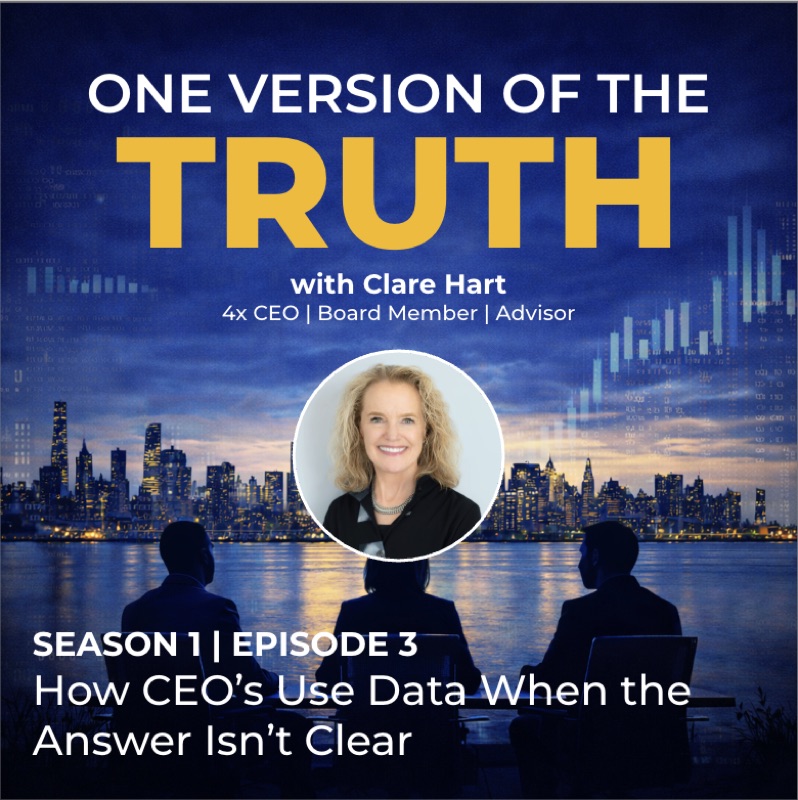
Clare Hart, a four-time CEO who led Factiva, Infogroup, Sterling, and Williams Lea, joins the show to unpack how executives actually use data to run a business, not just report on it. Drawing on her path from programmer to salesperson to chief executive, she explains why data must replace anecdote and opinion in leadership discussions, how she used data to override popular sentiment on issues like training compliance and transparency at Williams Lea, and why a single, trusted source of data across HR, finance, and sales systems is non-negotiable for any leadership team.
The conversation also covers what separates a data executive who earns a CEO's trust from one who does not: business fluency, curiosity beyond a narrow set of data assets, and a bias toward quick, focused wins over complaints about complexity. Hart closes with a clear directive for executives: ask your data team to help predict the future, not just report the past, and treat data as the foundation AI cannot function without.
“When you're making business decisions, you're making them based on data. You would never make an investment of a new product or service without having the data to support it.”
“If you're speaking in anecdotes, you're not conveying the confidence that the listener, the CEO, or the CFO want to hear. They need to hear data.”
Taylor Culver: So today we're talking to Clare Hart. Clare is a four-time CEO. Clare, can you introduce yourself, please?
Clare Hart: Yes, Taylor. great to be here. My name is Clare Hart and as Taylor said, I was the chief executive of four different companies. The first one was Factiva, a joint venture between Dow Jones and Reuters. The second was Infogroup, a marketing data and services company. The third, Sterling, which was a background screening company. And most recently, Williams Lea, which was a business support services where we sold services principally to law firms, financial services firms and professional services firms. All of my experience is based on tech enabled business services in B2B.
Taylor Culver: Well, tell me this, maybe not everyone knows this about you, but you started in programming, but you've also worked in sales. Tell me about the journey from technology to sales to CEO. How did that shape your relationship with data?
Clare Hart: Well, I started as a programmer and I have no idea why I had this epiphany when I was 17 or 18 years old, but I decided in college, I wanted to focus on computer systems management. So that was a dual major for me. And it was because just like finance, I felt like the backbone of any company is going to be technology. So I better understand the technology. So I went in as a computer programmer. And fortunately, I was able to go into different areas within the technology team. So I was selected as part of a small team to work on new technology. And at the time, that new technology was Windows. so really for Dow Jones, really looking at how can Windows technology help enable all employees within the company. Very similar to what people are thinking about now with AI. only that was a number of years ago. But I was lucky in a sense that then I was selected to be part of a product team. We launched a new product. And so I had some client experience, product experience and partnership, relationship. We called them Alliance Partners. And then my husband was relocated out to Michigan. So we lived in New Jersey. He was with a company that relocated us out to Michigan. And I had to find a new job. And that was actually a very good thing because it was a time to take a risk. And my husband and my best friend both said, you should be in sales. And one of our Alliance partners, News Edge was the name of the company, asked me if I wanted to come in and be a salesperson. And so I thought, okay, this is the time to try it. And it was a great, great experience. And so that was the transition.
Taylor Culver: It's cool.
Clare Hart: tech services, you've got to be able to, every salesperson in a tech enabled solution has to be able to talk about the technology. And I was lucky because I had the foundation to communicate the technology as well as the value of the products.
Taylor Culver: I love it. Not many people have both. what I find interesting is so many of these tech enabled services businesses are data driven. I hear so often people saying data driven, but when a leader says they want to be data driven, what do you think most of them misunderstand when they're saying that?
Clare Hart: Well, I think there's a lot of misunderstanding, not only on the leadership side, but also on the full employee population side. What does data-driven mean? And a lot of, from my perspective, it's very, very straightforward. When you're making business decisions, you're making them based on data. So you would never make an investment of a new product or service without having the data to support it. What's the financial opportunity the ultimate financial opportunity. What is the performance that has to be in place to drive that overall financial opportunity on a monthly basis after the product launches? And that's just a simple example of data-driven. But there are so many places, and I do focus a lot on the revenue side of the business, the cost side of the business, but above all, the revenue side. How are you using data? to inform your thinking about the growth of the company because every company has to be growing and you have data in your systems all over the place that if you're capturing it correctly, you can truly be data driven because you can tap into that data to help inform the investments of course, but also to help inform the performance of the business today, of course, and looking backwards. but how do you get it to be indicative of what's going to be performance in the future? And that's where I think data-driven, at least at a base level, has to come in.
Taylor Culver: of it. And in the past, you've said that data can be a catalyst for change and not necessarily just a decision tool. When did that distinction become clear to you?
Clare Hart: I think there are several examples, but I think the best example is when you're talking about a decision that has to be made, if you're speaking in anecdotes, Taylor, you're not conveying the confidence that the listener, the CEO, or the CFO want to hear. They need to hear data. They need to hear, here's the reason why This decision is important. And I think pretty early in my career, when I was in that product group that I talked with you about, and we were looking at doing things, you can come in all day long and talk about what you think and what the client thinks and what the client wants. But actually, if you support it with data that says, well, here's how the client's using our product today. And therefore we need to make it easier in this particular area of the product. And we need to invest. The conversation is a lot easier. It's a lot more substantive because you're saying, this is what they're doing today. And if we did A, B, and C, we think they would go deeper into the usage within the product. then just one example, but I think that was probably where the light went on. And then ever since there are just so many examples of where data just accelerates the discussion. You don't have a discussion because it's not opinion-based, it's not emotional. Here's what the data says. Therefore, we have these two or three options, and we should do A, or C.
Taylor Culver: Cool. Do you have an example that you can share of an organizational problem that data help surface where instinct or experience just wasn't cutting it?
Clare Hart: Yes. And in fact, it's one that I love because at Williams Lea, our business was putting people in an organization, a client organization, whether it was financial services, they were building PowerPoint presentations, or whether it was legal and they were working on documents, proofreading documents, copy editing documents, putting together table of contents. Our people were dedicated to a specific law firm or specific bank or specific consulting firm. Now, for a very long time, there wasn't as much reliance on data. And when I came in, it was clear that we needed to change that. And there were pockets that were using data very well. But as a general rule, we weren't really seeing the connection that we probably should have. But the most glaring example was when COVID hit in 2020.
Taylor Culver: Mm-hmm.
Clare Hart: A lot of the law firms and some of the banks, but particularly law firms felt like, well, we're not going to need as many people because we're not going to have as much volume. So we don't need to add any people or we might even take some people away. We don't need as many staff from you, Williams Lea. Well, some of our people didn't actually pay attention to the details when they actually should have been seeing that the volume was in fact growing, going up. and the number of people to support that volume was flat. And as soon as you highlight that with the data and the graph, and it sounds so simple, lights go on and people immediately think, I get it, we can't have this volume of work going through these 25 people. We're gonna have to add people if we want turnaround time and quality to stay at high performance levels. So that's a very vivid example of where the data just, everybody could see it.
Taylor Culver: I think there's this fantasy that every employee has that once they're CEO, things get easier because you can make decisions. And I oftentimes see with data people, once I'm CDO, I can make decisions and it's easy to get things done. think the reality is, is when you are CEO or running a company, it's really consensus built leadership and you really need to drive alignment. I mean, how do you use data? as CEO to align teams when opinions are obviously strong and incentives are inherently misaligned.
Clare Hart: Well, I think it's just, you have to talk in the context of everything must be fact based and not emotional, not anecdotal. So another example is HR and you know, what is our turnover? What are our turnover data points look like? How, where are we seeing turnover? What, what clients, what, what businesses, is it legal? Is it financial services? And then you have to show people that and dig into why. But if you're only talking about it from an anecdotal perspective, and this person left or this person left, then it becomes an emotional, well, he left because he didn't like this person, she left because whatever. But if you start to see patterns, you can't argue with the data. You have to say, there's something we must address here. And that's an example where I think you can get the organization around it. Just one example where you have to keep an eye on it. It's not like it's one and done. employees when you're in a human capital business, which Williams Lea was a human capital business, you need to be looking at that data. And we got to a point where we were looking at it every week, then we lightened up and it was every month. But the point is you have to have a line of sight on turnover, recruiting. How long does it take you to recruit a person? And all this is substantive data that supports the business. So if you have an issue with recruiting, how long it takes to recruit people, you go and talk to the people who are in your talent acquisition team and they have to figure out what do we need to do to make a difference. Sometimes it's compensation and we had a challenge there and we work through it, but again, you need the data. And this is an example, Taylor, where I feel strongly it's not only internal data. So you have to look at external data as well. So we had to look at our compensation. And then we had to look at comparable jobs. So what if somebody went to work at another company? If they went to Amazon or they went to pick the name of the company, could they get a better compensation? And if so, then we needed to look at what we could do to make coming to Williams Lea more attractive.
Taylor Culver: I love it. And sometimes you'll be in organizations where people use data to tell their story and every department has their own goals and objectives. And then here you are hearing everyone's version of the same data with a different story. How do you navigate those conversations and work people towards consensus?
Clare Hart: Well, I think I feel strongly a CEO has a leadership team and they have to operate as a team and they have to work together. And there's no ambiguity there in my mind. It's you, you've got to be part of the team. can't have shadow finance, shadow IT, any shadow organization. There's one source of the truth. And where does that data come from? It could come from an HR system. It could come from a finance system. It could come from a CRM system. But the owners of those data, that data has to have to be very clear about their ownership. And whoever is the chief data officer, chief data strategist, sometimes it's the CFO that takes on that role because there isn't a chief data officer, but someone needs to hold the people accountable. for the sales data coming in from CRM system. Is it clean? Is it reliable? The data coming in from the financial system, from the HR system, and then orchestrate a dashboard that the entire leadership team shares. And so there's one version of the truth. Do not come into a meeting talking about some other data. You're wasting your time because if you do, the discussion ends, you go work with your colleagues. Why is your data different from what everybody else is seeing and sort it out? But it's, it's, it's to me, one version of the truth in an organization is critical and I'm very corporate, but that would be true in any organization.
Taylor Culver: I love it. It's also why I named this podcast, One Person of the Truth. But tell me this, can you give me an example of a time where you've had to make a wildly unpopular decision where you may have had to override that consensus, but you were able to use data to do so?
Clare Hart: Yeah. Well, there's two examples. One is a very simple example. We had very clearly defined targets for training. So because we were human capital business, we were in regulated industries, the legal industry, the financial services industry. So our people had to have the right amount of risk and compliance training, HR training, cybersecurity training. So we had 10 training programs per year. at Williams Lea. So nine of them were mandatory. One was kind of an elective and everybody kind of groaned. And in the beginning, it all got snow plowed to October, November, December. And everybody was trying to catch up on all their training. And I said, no, we need to have it done on a monthly basis because it's too much for anybody to expect to do eight or nine hours of training in the last two months of the year. So if you're looking at the data, people can't hide. So of the sales team, what percentage did their training in January of technology, of marketing, of operations, of legal, HR, finance. So everybody could see how you were performing. And that did change behavior because nobody, nobody wanted to be the group, the functional area that wasn't getting over 90%. training done. And then the second thing is there was, we never actually implemented it, but there was always kind of the overhang of, well, maybe people don't get their bonus if they don't do their training. And sometimes you have to financially motivate people to get them to change. But again, it has to be supported by data. And then I think the other example I would give, and it was a harder one, Taylor, and you're aware of it, is when we rolled out our, data management engage our platform to enable our salespeople, our account managers, basically anyone in the company to look at performance. You know, that is how many people, what's the turnaround time, what's the quality, how many jobs are they getting every month? You know, there was a theme that you don't need to share all this information. You don't need to have it so easily accessible. And my view is I believe in transparency and I believe that this information should be available certainly to the account managers and to their leadership and to clients. And that was a cultural change that was much harder because the data is there, but the data is different for each client and every scenario is a little different. So you have to be prepared to work through, well, here's what the data is showing us and You know, we have higher retention with clients that use Engage, et cetera, et cetera, whatever examples you can give. So some, some challenges come right down to, okay, performance and you either do it or you're going to look like a fool in front of your, your colleagues like training. And then others are business fundamentals and a complete shift in the culture and the behavior of the company. So some, some. I raise both of them because I think some are pretty easy and straightforward. It's just management and leadership. Everybody does their training. The other is cultural shift on the day to day and how people actually operate and changing from, we've always done it this way to here's the new way of doing our management and the metrics for our clients.
Taylor Culver: I mean, so much of being CEO comes down to leadership, influence and earning trust. And, you know, as CEO, you're responsible or at least accountable for dozens of initiatives, know, finance, HR, technology, you know, data is just one thing. You cannot be full time talking about data. I'm sure you need someone to help you along the way. Tell me this, you know, from your perspective and your experience when you had CTOs or CTOs who are managing data, what separated strong data leaders who are helpful and who became true partners in driving change and who didn't?
Clare Hart: It's a great question because the fundamental piece is they have to understand strategically why data is important to the company and why transparency is important to the company. So I think understanding that at a technical and at a data perspective is critical. I think they have to understand the business. Taylor, so there's an element we can all get caught up in the data. It's so interesting. But actually, what is it telling us? So one of the great examples is what is sales performance today, historically? How can we start to forecast better than our salespeople based on data, based on actual data, years and years of actual data? How can we better forecast what the business might look like in three months, six months? 12 months. And so I think a true partner from a CEO perspective with a data executive is someone that understands the business, understands the importance of basically, it's almost predictive analytics. What are we doing here? And what is it telling us about where the business is going? So that's just one example of of how a partnership, but I think the best thing is when a data executive, kind of in a perfect world, would understand the data assets across the business. And they're not the CFO, so they don't understand the income statement, the balance sheet, the cashflow statements, and the way the CFO does, but they know that data exists. And know pieces of it are going to inform other decisions within the company. So knowing where those data assets exist and having a good collaborative relationship with the CFO, with the head of sales, I'm not trying to steal your thunder as a data executive. I'm trying to support you because data supports the business. Very much like finance does, it supports the business and actually every function within a company, but really understanding at a macro level, what's the business, what's the marketplace look like? And then how do I partner with the owners or the people that have the responsibility to drive closing so that we're not looking at finance data coming out on the 30th of the following month for the previous month. We're looking at trying to get it to six days or five days close. And I have to understand the financial data, where does it come from? How can I help the CFO? Same thing with sales data and predictive analytics and the list goes on and on. But I think it's like all executives, Taylor, you have to be curious. So the worst thing that a data person can do is get zoned in on one or five data sets. You have to open the lens, your lens and see the data assets internally, which are the most important. but then also be prepared to look at external data sets and say, how does that influence what's going on in our company?
Taylor Culver: I love it. And you know, I work with a lot of data leaders and they would kill to have a CEO on their side advocating for them like you are, right? And I'm sure you're sitting with the same perspective. Man, I would love to have a data person who could do all these things for me. What instantly makes your eyes roll when you're working with a data person, a data executive or a technologist, when they start talking about data? Where do they lose your sponsorship in seconds?
Clare Hart: Yeah. if they talk about how hard it is to aggregate all the data, then you're not ambitious, you're not hungry, you're not trying to solve the problem. So you've got to come in with a view that says, we have all these data assets, I'm focusing on these six, because that's all I can focus on at one time. I can get to the rest, but it's going to take months or years, but these are the ones that are going to have the most impact. That's what I want to hear. I don't want to hear about boiling the ocean. It's just, nobody can do it. So it's life, right? Small wins. So identify the areas where there's pain in the business and then figure out how to have a win. So I lose people if they talk about it in the context of how complicated it is.
Taylor Culver: So if I came to you and said, we need a data governance committee and data quality is 70 % and we can't trust the data and we need a data warehouse, you're probably gonna be like, I don't care.
Clare Hart: Well, no, I might not be like, don't care. In that case, I might say, okay, you've told me the problem. What are you going to do about it? Right? I mean, that's, I would listen to you I'd say, okay, you're probably right. But how do we get a data governance committee? And committee is always a loaded word, but how do we get that team that the chief data officer, the, you know, the person that owns data for the company, how do we get a team so that they have
Taylor Culver: Yeah.
Clare Hart: the team across functional areas that own the actual data to work together to figure out how do we leverage all these data assets and how do we get quality well beyond 70%.
Taylor Culver: Right. Well, tell me this. So, okay, we're working together. I'm your data executive. You're the CEO. How do we get buy-in with the rest of the executives? Because clearly we've got the same perspective on this. Does it start with aligning those data sets to problems within the business that are aligned to some of those metrics that we talked about earlier? What do you think the best way to start is?
Clare Hart: Well, I think that again, it kind of goes to quick wins, but it's what's in it for me. Everybody has to say, well, why am I going to spend time on data? I'm not a data guy. I'm a sales guy. do I need? What do I need to do with this data? Well, the sales guy probably has a sales operations executive, just like HR has an HR operations executive who know their data intimately. So the key is to find the... data elements or the data elements that should be there. And then the people that own them and then a small team to say, okay, this is a project we're going to focus on. Can't do everything. So pick the most impactful and then show value and show a win. And then if you show a value with the CFO and then everybody else enjoys the benefit of that data, well, then you go to the next place. Maybe the next place is head of sales and you say, okay, how can we improve? on data and data quality and what do we need to do? And that's a place where there's always been challenges, the data quality within the CRM system. So just making sure that people understand one version of the truth, that means it's got to be up to date. You can't let it go for a month. You can't get around to it. You got to do it right away.
Taylor Culver: I love what you're saying, which is find like a beachhead problem, right?
Clare Hart: Yeah. Yeah.
Taylor Culver: and go solve it. And then once you get the win, talk to someone else, bring the team from before and try to get those compounding wins. And I'm a big believer, start small. It's like, hey, our data is a problem. Let's throw it all in the data warehouse and build reports. I mean, that's going to be a couple million dollars and no one's going to want to use it. So how do you start small and focused and aligned with what metrics you're measuring that you actually care about and what different stakeholders care about? So tell me this.
Clare Hart: Exactly. Yeah. No.
Taylor Culver: Data leaders struggle with two things in my experience. And one is sustaining executive sponsorship and getting cross-functional teams to work together, which is hard for any CEO. Do you have any principles that you use to address some of those challenges? How do you manage your board? And how do you manage cross-functional teams that may not be incentive to be aligned with the corporate strategy?
Clare Hart: think the first thing I would say on the data side is the chief data officer, person in charge of data, they have to be very confident because above all, they have the data to support what they're saying. So they have to set their strategy working with the CEO, probably the CFO, to figure out, where are we going with this data strategy in the company? And then... Partnering with the CEO is critical. So when you come to an executive committee meeting, a leadership team meeting, the data person comes in, the CEO supports them by their words and the way they introduce them in the meeting. They don't cancel that session because that's easy to do. just, got a lot of things on the executive committee agenda. We'll put data off and we'll put data off. You can't do that. You have to, the CEO has to show respect. And the way they do that is the data executive comes in and has something substantive to say every time they come into the leadership team. And eventually they will be taken to the board because there's enough information in what they're gathering and what it means to the business that the, addition to the CEO hearing it and the CEO probably talking with the board about it, the head of data should be talking with the board as well. But it is a crawl, walk, run. You have to prove yourself. And I think the best way to do it is if you're aligned with the CEO on the data requirements of the company to run the business. Typically people get in line. The difficulty, and this is where communication with the CEO is really important. There are a lot of stakeholders and some people are more persuasive than others. So you have to make sure when you're talking with the CFO or you're talking with the head of account leadership or the head of HR that when you're talking about refining anything, when it comes to the data strategy, you're keeping the CEO informed because the CEO doesn't want to learn about it in a, you know, in a public setting or somewhere else. So I think open lines of communication are really critical and data people, chief data officer, they're in a unique position. because everybody needs that data. And if you're working in a company where there isn't respect for data, I'm not sure. I just would think hard about whether you want to bang your head on the wall there or find a new role where there's a real appreciation for data. And just a footnote on that, in the world of AI, data and information are the foundation of AI. It can't perform without the data. So it's even more critical today than it was two years ago. there's a data people should have a bounce in their step. They should feel really good about where they're going, but they've got to collaborate. It's like any job in a corporation. You can't be arrogant. You've got to be collaborative.
Taylor Culver: Yeah, I think one of the challenges for data people is they get so interested in the data and the solutions that they lose sight of that collaboration. And it's the 80-20 rule.
Clare Hart: Yeah.
Taylor Culver: And it needs to flip in that space, in my opinion. You had mentioned AI, and you and I have talked about AI a ton. I mean, look, we're in a world today where everyone claims to be AI-powered. So they've got an integration with Claude or JGPT. In your experience, where is AI genuinely creating value for organizations? And where may it be overhyped?
Clare Hart: Yeah. Well, I think it is creating value in coding. So everything I read, I'm not a coder anymore, but everything I read is there's, you know, incredible value in coding the application development. And that's fantastic because that's a pain point for most organizations. How quickly can we get the new product out, coded, tested, et cetera? And then for a lot of companies, especially companies who have acquired other companies and they're trying to integrate businesses, how do you get all this old technology onto a single unified modern platform? And that is where I believe AI is very good. I think it's overhyped in the context of how quickly it's going to change our world. I think it's going to be incremental. And, you know, I was reading the other day, I used to be heavily involved with competitive intelligence and very big proponent of competitive intelligence in organizations, because you have to know what your competitors are doing, what their products are, what their pricing, et cetera. And it used to be a full-time person, at least one full-time person. Plus you'd ask the salespeople to come in and give updates. We kept a database on the competitors. Now, AI is going to you. You can set up a table, basically say these are my competitors and AI just continually updates the competitive intelligence. So I think we're going to see more and more subtle changes like that. Is AI going to replace a salesperson? I don't think so. Is AI going to replace a CFO or some of the FP &A people? No, AI is going to support them in what they are doing. So we've all heard the expression, AI isn't going to take your job, but somebody that understands AI will. And that's why it's imperative for everyone to play around with AI. And I say play around because it doesn't have to be a project. In fact, it probably shouldn't be a project that you're starting and that's where you're learning AI. You should learn it on fun things and then apply it to actual business issues.
Taylor Culver: of it and kind of closing this out here, not every CEO or executive is data literate or is forward thinking as you on the topic. What should every executive be asking their data team that they aren't today?
Clare Hart: They should be asking their data team to help them predict the future. And it's not that everything, it's not that the past is an absolute indicator of the future, but we can learn a lot from historic data. So what are the signals that are in that data that we should know about? And it could be across sales, it could be across finance, it could be product development. I mean, I just mentioned product development in the context of AI. But there are a lot of companies that aren't using AI to develop software or applications within their organization. What's the velocity of the programming work? How much work are you getting per person? And it sounds, it makes people bristle because it makes people feel like big brother is watching. But actually there's an accountability. The CEO has to the board and to shareholders and actually every employee has to their colleagues. So I think. that a data executive within a company should be looking and collaborating with the CEO to say, what are some of the things that influence this business? What are our pain points? And how do we get a more predictive model in place to drive productivity, whether it's sales productivity, technology productivity, how quickly we can close the books every month. So data can influence that. It can't do the work. but it can put a mirror up to everyone and say, yeah, this is what's happening and we've got to look at it.
Taylor Culver: I love it. Well, Clare, thank you so much for your time today. If people want to learn more about you and your journey, what's the best way to stay in touch?
Clare Hart: LinkedIn is the best way, yeah.
Taylor Culver: Great. So follow Clare Hart on LinkedIn and thank you very much for listening today and Clare have a lovely, lovely day.
Clare Hart: Thank you, Taylor. I love the fact you're doing this. I think it's very informative for CEOs as well as data executives. So thank you. You have a good day too. Bye.
Taylor Culver: My pleasure. Yeah, bye bye.
The only data leader in the room?
Have conversations like this with peers who live it. Free and private, for data leaders in the seat only.
One Version of the Truth