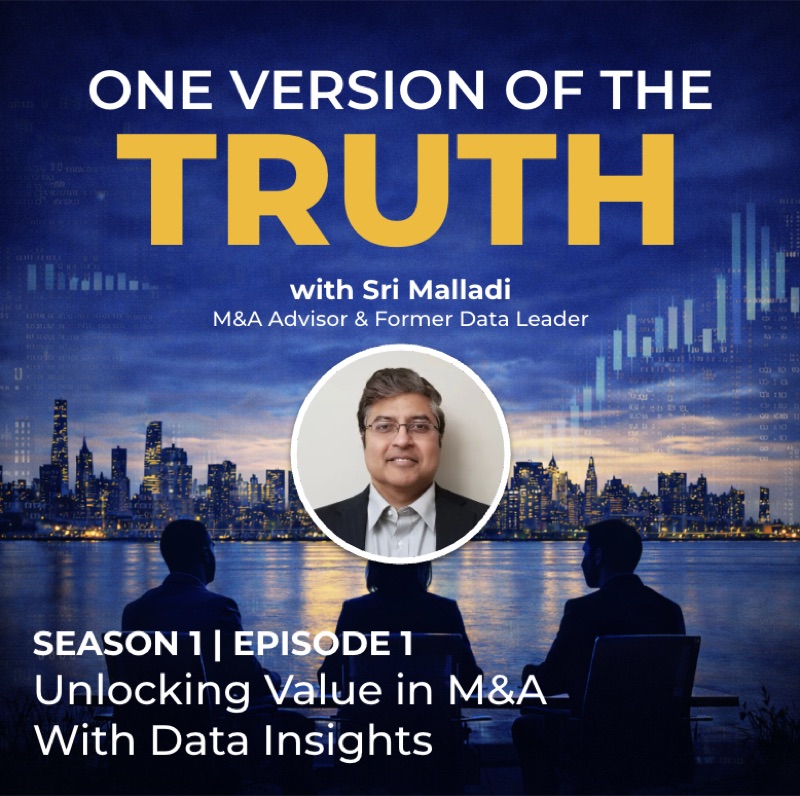
Sri Malladi, an M&A advisor, joins Taylor Culver to unpack how data and analytics function inside deal-making, not as a technical layer, but as the evidence base for the growth story a company tells buyers. He explains how financial due diligence works, why bankers curate which metrics to highlight rather than chase perfect data, and why organizations still struggle more with AI adoption than with core data management, which he says has matured significantly over the last decade.
The sharpest insight: data trust and deal value are directly linked. Malladi describes watching businesses that should command a 12x multiple sell for 8x or 9x once buyers stopped trusting the numbers, a cascading loss of confidence that spreads from the data to management to the growth story itself. He also argues data leaders earn influence not through roadmaps and slide decks but by building real relationships with stakeholders, and warns AI adoption will bypass any data leader who makes it harder to use than the shadow tools employees already reach for.
“I've seen scenarios where a business that should sell for 12 times multiple gets sold for an eight times or a nine times multiple simply because buyers could not get comfortable with it, and they had to price in the risk of bad data into the valuation of the business.”
“A good indicator is when a business leader asks the data leader to be at the table when a business decision is being made, not simply to implement a certain system or a tool or a process. That's when the data leader truly has the ear of the business.”
Taylor Culver: Today we're talking to Sri Malladi. Sri, can you tell me a little bit about what you do?
Sri Malladi: Sure. So hey Taylor, I'm an M&A advisor and we work with companies that are looking to kind of exit to sell themselves. So we help them to find the right buyer at the right terms and the right valuation. We also work with companies, largely strategics that are looking to make acquisitions, strategic acquisitions to grow. And we help them to find the right businesses. value structure and do the deals.
Taylor Culver: Cool. And looking back across your career, what kind of problems have consistently drawn you in?
Sri Malladi: I think what I find probably pretty interesting is problems with a great deal of inherent complexity. And think what I find enjoyable is to go into a situation. could be kind of helping to sell a business. It could be an operational situation. And then looking for underlying patterns and systems that govern that. that structure, so to speak, and then finding a way to kind of bring some order to that chaos and then to ultimately get the project or the engagement or the deal to a successful outcome.
Taylor Culver: In your career, you've worked across so many different domains. You've worked in software, you've worked in investment banking, you've worked in a strategic &A. You even recently, well, not so recently, worked in data and analytics. How does data and analytics shape the way you think about leadership and enterprise value while you're working through deals?
Sri Malladi: Yeah, look, I think data is at the root of a lot of the deal valuation that we do. When we are trying to sell a business, a big part of it is obviously telling the story of the business, making sure that it's packaged well, and making sure that we are explaining the growth story of that company to a potential buyer. So obviously the leadership part of it And the management is a huge chunk of it. But underlying that has to be the right financial data, the right operational data, the right commercial data. And ultimately it's our skill, I think, as an investment banker, to be able to bring together the facts of the business and then to bring together the people side of the business and then to connect the dots for a potential acquirer. Or it could be for a company looking to buy a business, to connect the dots between. the data and the numbers with the people to tell the right story to make the deal progress. So it's everything.
Taylor Culver: Love it. So tell me this. mean, M &A is a super strategic topic. You're going to see it at board level conversations. So you're directly working with CEOs, CFOs, and various other CXOs. When do data and AI, for example, matter at the executive level? And when don't they?
Sri Malladi: That's a good question. think. I truly believe that an executive team or a business leader who really fundamentally understands the business has a gut feel for the business drivers, for the KPIs, for the weak links in the chain. And so they have to have a very innate understanding of the business. And then... be able to supplement that understanding with what the data is telling them. Sometimes I've seen the right business leaders know that they have a certain hypothesis about how the business should work. They might get some financial data or some operational data that maybe contradicts that. And then they inherently know very quickly whether the data is the one that's at fault, that's maybe giving them the wrong indicators, or... if it's something inside the business that has to change because the data is the truth and the story that they have going on in the business about the business has to change. So I think it's a pretty complex interwoven set of kind of themes with both data, understanding the business and then also leaning on your people and your team to be able to... highlight things about the business that you didn't know existed that the data is telling you about.
Taylor Culver: Where do you see organizations struggle to translate data and AI investments to outcomes that leadership actually cares about?
Sri Malladi: I think there's definitely, so let's kind of like separate the data piece of it and the AI piece of it. I believe that in the last 10 to 15 years, there's been a lot of focus on data, enterprise data, data management, data governance. So the way in which organizations have been able to collect the data, organize it, analyze it has become vastly better over the past 10, 15 years. when it comes to AI, I think that's still very much a rudimentary area in terms of how organizations are truly adopting that and making it generate value at scale within the organization across the entire enterprise. So it's picking up very quickly, but it's not there yet. I think like where they have, where they probably struggle, at least on the AI piece of it is I think there's definitely a bit of a herd mentality. there are trends that are being, that in any industry, what kind of investments are happening, what competitors are doing, what AI products are coming there to kind of disrupt the industry, disrupt your workflows. So I think there's a little bit of raising the next kind of rainbow without really knowing whether that truly applies to your organization, to your enterprise setting. I think, but AI is catching up. And so I think that that will start to solve itself out over the next few months and years.
Taylor Culver: Well, what distinguishes data or AI initiatives from others? When are executives getting real initiatives that are driving business outcomes? Or are they just adding noise and perhaps even false confidence to the organization?
Sri Malladi: So I think it goes back a little bit to what we just talked about, is knowing the context and the granularity at which the data should be collected and analyzed is key. And just to kind tie this back to what we do in an &A process, There are, if you're running a transaction, we have to obviously present the financials, present the commercials, revenue growth and costs and things like that. And it is possible to analyze those metrics to death. We've seen analysis done on the financials and operations that could be a workbook with over 90 to 100 tabs, right? Which takes it to an extreme. So I think the true judgment of a strong executive team is knowing where to collect data with a higher degree of accuracy and where to zoom in and where to understand that that is part of the 20 % that won't move value and to kind of disregard it.
Taylor Culver: Makes sense to me. In the &A process, analytics is a huge part. When you go to price a deal and establish what the enterprise value is of the company, how do you think about these as decision problems rather than technical or analytical ones?
Sri Malladi: Yeah, I think it's all about decisions. think a lot of it, at least in the M &A process, to take a typical transaction, let's say if it's a sell-side transaction, and we're trying to sell the business, there's gonna be some financial due diligence that we get a third party CPA firm to come and do on the business. And then they prepare a lot of materials on the financials. They build what is called as a data cube that sort of breaks down revenue and costs and gross margins by locations, by skew, by products and things like that. So ultimately, I think that the judgment comes here between knowing which of those metrics we as the banker should pick out sometimes. pick the ones that show our client in the best light to the potential pool of buyers and which ones we need to be also thinking about areas to mitigate because we know the questions will come from from strategic, from sponsors on all these different topics. So knowing for ourselves which are the red flags and which ones we should be highlighting and being able to explain this to the management team. and to the vendors that we work with who are helping us to do this analysis. Essentially, it's basically connecting the dots across all these different stakeholders in the process to make sure stuff happens the right way.
Taylor Culver: So you're not in there worrying about what tool or technology you're using. You're not worried so much about data quality. What you care about is what information do I have? What information do I have? What information supports my narrative? What information puts risk into my narrative and preparing for conversations. And if you're selling it, you're going to be a little more optimistic. And if you're probably buying it, you're being a little more pessimistic almost. That's what it kind of sounds like.
Sri Malladi: Yeah, I think from our standpoint, we are typically the consumers of the data that somebody provides us. We are not creating data about a business. So in terms of the tooling and the technology and what's being used to collect it and organize it, that is something that we, it's a bit of a layer of abstraction. So we might work with a company that's using, you let's say QuickBooks to store their data. One might be using NetSuite, right? And there might be much more complicated BI tools that sit on top of it and provide dashboards and KPI and analytics and all of that. But ultimately, as the party responsible for getting the most value for the business, the tooling and the systems are just something that have to work and produce the right data with the right quality. I'm not saying data quality or data accuracy is not important. It's supremely important. It's just that when we look at it, we are like, use the solutions that make sense, but just be prepared that if somebody asks a question about why is this number a certain way, we would essentially put this back on the company or the vendor to be able to dig deep and then go bottoms up and then provide the data, provide that backing to the other side. So we know that those questions will come. We know that the data accuracy is an extremely important part of it. But when we are running a process, we don't often have time to go so deep at that level as we run the process. And sometimes we let the buyers sort of dictate what they want to go deeper in on.
Taylor Culver: Interesting and what happens when you lose faith in that process? For example, you start getting inconsistent answers or conflicting answers. Maybe that hasn't happened before, but has that happened before in your experience? And what did that do to the deal process?
Sri Malladi: No, it's happened. It's happened, unfortunately, more times than I would care to have happened. And it's definitely not a good outcome. Sometimes this happens when we are in the preparation phase. So before we take the company to market and we are getting this in front of acquirers, we just uncover themes or we uncover challenges that we can fix preemptively. So then we might advise the company to go bring in an outside vendor to help them with some part of the business because that will definitely be kind of a focus area. But sometimes we go to market and then we might have a private equity buyer go deeper into the business than the business has ever done themselves. And when that happens, and especially if the data is either inconsistent, or doesn't support the story that kind of the management team has told us. Or if it's hard to back up the data, right? It becomes a pretty tricky process. And I think to a certain degree, acquirers will live with that risk, that the data is not perfect. But if this happens too often, or if it's a magnitude of this error system. is too high, they lose trust in the data. Then they start to lose trust in the management team. Then they start to lose trust in the business. And then they start to lose trust in the growth story. So it's a cascading effect. And it can be stopped earlier on, but it can go too far. And then ultimately, I've seen scenarios where a business that should sell for, let's say, 12 times multiple gets sold for an eight times or a nine times multiple simply because buyers could not get comfortable with it and they had to price in the risk of bad data into the valuation of the business.
Taylor Culver: So you're saying if a company were selling for $120 million at a 12 times multiple, it would go for 80 million because people lost faith in the data. And that's wild. Well, tell me this, and kind of thinking about data people who might not have access or participate much.
Sri Malladi: It will. Yeah.
Taylor Culver: in the &A process because it's largely controlled by finance and who are usually the domain experts for that kind of information. But you've had the opportunity to be a data leader. You've had the opportunity to work with data leaders. What signals to you that a data leader truly understands the business that they're supporting?
Sri Malladi: That's a good question. I think a good indicator of this is when a business leader, say, let's say kind of the GM or the CEO of the business that the data leader is supporting, if they ask the data leader to be at the table when a business decision is being made and not simply to implement a certain system or a tool or a process. That's when I think the data leader truly has the ear of the business and is truly connected and plugged into the business.
Taylor Culver: Interesting. So what do you think that a data leader most often underestimates about the executive team and how they think and decide on information?
Sri Malladi: I think like all other functions and all other specialists, think data leaders, and I think I was guilty of this at some point as well, think that the whole world revolves around them. They think that their three-year plan or their five-year plan, their enterprise roadmap for implementing a certain data architecture or a certain set of tools and systems. is essentially why they are in business. But I think what they get wrong is ultimately data is an, data IT is an enabler. And it's no less so than finance or human resources or operations are legal, right? All of these functions are enablers to drive the business forward. And so I think where I think data leaders, get it wrong is just wrapping themselves up in their own world and not really thinking about... what it is that they're really there to do and how to drive the business forward.
Taylor Culver: You know, it's probably not the first back office function that's guilty of that. You know, you've seen HR teams or finance teams overreach, trying to dictate what the business strategy and so quickly do they alienate themselves from the business? The business ultimately works around them. So it's ironic. They go to establish controls or governance for lack of a better word. And then before you know it, they're getting bypassed, ignored, and probably taking a lot of political heat, right? And you find yourself trying to push your agenda, but no one wants to work with you. I think a hard place a lot of data leaders end up in is no one wants to work with me, right? And it's probably after that three year plan or the five year plan or pushing for what obviously makes sense to them and is right in principle. How can a data leader do a better job getting buy in? from their stakeholders, especially disengaged ones, do you have any tips or tricks that served you in your career?
Sri Malladi: Yeah, think one of the things that I saw during my time at the Fed, at the Federal Reserve Bank of New York, where I was driving an enterprise transformation, I came into the business cold, meaning that I didn't really understand what it is that the group was doing. I didn't really understand the roles of people. I didn't completely understand all the different stakeholders. so I think one of the things that I did was the first thing I did candidly was to do exactly what I thought I should be doing, which is here's what we know and here's a three-year roadmap to do A, B and C, right? And then sort of quickly came to realize that though the vision might have made sense to me and to even my team. It was a far cry from being adopted by the organization because it was not co-built and co-developed with their inputs. So we put forth a plan that made sense, I thought, but since the stakeholders did not have inputs into it, there was resistance to it. So we had to take a step back and then go and sit down. with the people who did the work, attend kind of like team meetings, sit down by the desk of people who were actually doing the work day in and day out, understand what they were doing, understand the tools they were using, what wasn't working, and then actually build some credibility for myself and for my team within the organization for them to trust that one, we understood the business. We cared about the people. We knew what their real pain points were. And then whatever solution that we were kind of proposing was built step by step with their inputs instead of just giving them one big 50 page PowerPoint deck of the stuff that we would do. So that seemed to help a lot.
Taylor Culver: I love it. And you know, it's interesting to me in this example, right? And I'm kind of combining different things. And this is probably not untrue of several organizations, right? And sorry, my phone's going off now. It's not untrue of many organizations, but you've got an executive team. who can't get the data that they need to tell a story that can have a Forex multiple impact on a transaction. And at the same time, you've got the data team that can't work with the business to get that information, right? Because they don't have the buy-in of their stakeholders. So everyone's trying to do the right thing, executives by their shareholders and their equity owners data team by just trying to empower other people with insights, but they're stuck. Right? And I think what happens is you get so caught up in that friction that you miss out on, hey, if we can actually get past these interdepartmental, interpersonal challenges, these political issues, right? And focus on a common problem that we can all get behind, that's going to radically change the way organizations are managing and looking at their data. And it's simple pivots, right? As opposed to like in your example, you said, hey, here's a roadmap, right? Everyone's guilty of that, right? Instead it's like, hey, what's your kid's name? What kind of coffee do you like to drink? Do you like the local sports team? Right? It's all that misses because here's what I heard from you, right? And it's the word that keeps coming up is trust, right? And if a... Acquire doesn't trust an executive team. There is a quantifiable value miss, right? And if the business doesn't trust the data team, it'll never progress, right? And how do you overcome those issues? It's interesting. If you were looking back at it, and trying to coach, for example, a senior data leader who wanted to have more impact, where would you push them to focus? How would you help them build that trust?
Sri Malladi: I think one of the things I would say, maybe a couple of things. The first is... at least for at least for one or two days a week or maybe for half a day a week to start, right? Just forget that you are a data leader. Just just go and talk to talk to your business stakeholders. Try to really understand the business problems that they are grappling with and and what's really on their mind. It could be growth. It could be it could be something around pricing. It could be something about something that has no significance at all to what you do day in day out. But that's really what's taking up sometimes 80, 90 % of their mind share. so once you understand that there's a set of priorities, and obviously it's not just one executive, it could be multiple executives on the team, and each one of them has their own set of priorities, the stuff that matters to them. And I think oftentimes what I was surprised by and am still surprised by is sometimes the things that I think should matter to a certain executive are not really the things that do matter. They're focused on something that's more urgent that might have a tangential impact in the business, but the reality is that they are focused on it at this moment. So I think having those kinds of broad conversations across a swath of the team. on the business side and maybe even talk to some of your other counterparts in different functions. If you're in IT, talk to somebody in finance or HR or operations, just go have lunch with them and then understand what it is about the business that's on top of everybody's minds. And then you sort of almost like create a mosaic of this information in your own head and you create a mental map of the organization that goes beyond what's on paper. That's one. And I think the second piece of it is, it goes back to what you were just talking about in terms of trust. how do two people at senior levels in an organization really trust one another? So that trust can be maybe pushed and forced a little bit through hierarchy and those kinds of connections. But to truly have the ear of somebody, you have to know them as a person. They have to know you as a person. And so I think it's just important you don't. It doesn't have to be about a business. It doesn't have to be about anything that you do. But as you said, just go have coffee with them, have lunch with them. Just tell them about what's going on in your life here, what's going on in theirs. And then once you do this for a couple of times without any work context in mind, I think the information flows more easily. People start opening up. You can open up to them and you can have kind of a more honest conversation about challenges that... then start to connect the dot into what your day job is.
Taylor Culver: Yeah. Well, I've seen it before firsthand where the data person goes out and says, tell me all your problems. And they're like, what? Right. And looping it back to &A, if a buyer came in and said, tell me all your problems, the executive team would be like, no. You know, you immediately close the conversation really quick. So how you do it is a little bit touch and go, right? So kind of thinking forward, you and I talk about AI all the time. And everyone is saying it's, you know, transformational. It's going to be awesome. you know, from your vantage point, you know, in the and a process, where do you think AI is genuinely changing how organizations are operating? Or where do you think expectations may be ahead of reality?
Sri Malladi: I do think AI is transformational. I think in the next two or three years, it's going to transform entire industries and functions. And I truly believe that. And I see that happening across a bunch of kind of clients we work with, as well as our business processes. And so think if you're asking about where is AI going to sort of... transform and where is it lacking. think where it has come a long way and where we use it in our own business is I would say around understanding and synthesizing information, aggregating information, presenting information, presenting insights, because a lot of what we do in our day-to-day job is really understanding the business, making sure that we tell the right story and then we take it to the right acquirers who understand the story. So it's a lot about making sure the information goes back and forth the right way, right? So we use it extensively and we have many of our clients also who use it extensively. So for example, we might get a data room that has literally thousands of documents. so instead of maybe two years back, me or somebody on my team would sit down and essentially go through every single document, open it up. read it, note down something about it, and then move on to the next one. So there was literally no way out but to literally have read it or pay somebody to read it. But now with the help of AI, we can have a bot that runs on a data room, and many of these providers already have it, where it gives us about, I would say, 80 to 90 % good enough view of the key issues. And so basically in the span of let's say about a half a day, we can understand issues about the business that would have taken us days to understand. So that it's been very helpful. I think where it has some ways to go is in terms of how decisions are made and how operations are conducted at companies. And what I mean by that is I don't, I'm sure it'll get there very quickly, but at this point across many industries, there still has to be a human in the loop. I don't think a lot of business leaders have the confidence that AI would make the right decisions. the processes are designed so that AI might make a strong recommendation or might do the analysis that leads up to a human, but there still is a human in the loop. I do think that in the next two or three years, just like anything else we've seen, it is going to start making more decisions, doing things, and just having humans check-in occasionally versus pause at each decision.
Taylor Culver: What advice would you give leaders looking to extract this value from AI and be able to hop on board? Because sometimes what I find is that data leaders are getting bypassed because they're dealing with the political war wounds of trying to launch data governance committees, trying to push analytics technologies and you know, Business leadership can now go directly to AI, learn how to write SQL, figure out how to connect to a database, and build a CRUD app if they wanted to even get into engineering a little bit. How do you think data leaders can get on board the AI train?
Sri Malladi: I think it's like, first of all, it's admitting that AI is here to stay and admitting that just as you said, the business teams will start using AI. And if you don't make it easy for them to use AI in the environment that you've designed for them, they're going to find some shadow way out. So I think the most important thing is to recognize that you are there to enable the business and people have started to bring consumer applications into the enterprise world and they expect more and more that they have that same speed, the same ease of use. so I think it's really, it's a really, think like how do I enable my business stakeholder? to do what they're doing better or to do better things with their time. And that's literally the job of the data leader is to enable the business users to do their job better and slow. So try to figure out the systems and the environment and the constraints that have to adapt to the business versus other way around.
Taylor Culver: Yeah, it comes back down to the same principles, which is work with people, figure out their problems, right? And try to ultimately solve them if you can. And if you can't, you know, let them do what they need to do or stay out of their way. Cool. Well, Sri, this has been a really great conversation and I appreciate everything you've shared from &A to your time at the Fed, you know, what it's like to be a data leader, coaching those data leaders. and your thoughts on AI. Tell me this, if people want to reach out to you and get a hold of you after listening to this, what's the best way to contact you?
Sri Malladi: I'm on LinkedIn, so can find me at SriMalladi. So hit me up and I'd love to speak.
Taylor Culver: Perfect. All right. Thank you very much. Bye.
Sri Malladi: Thanks, Taylor. Good talking. Bye.
The only data leader in the room?
Have conversations like this with peers who live it. Free and private, for data leaders in the seat only.
One Version of the Truth