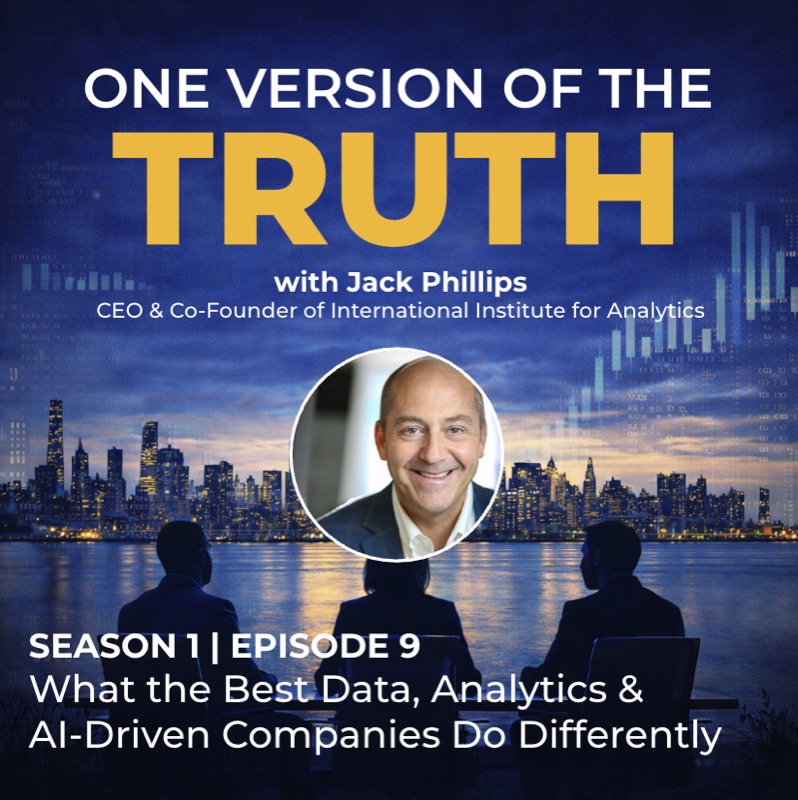
Jack Phillips, CEO of the International Institute for Analytics, joins host Taylor Culver to unpack what separates the data organizations that create lasting value from the hundreds he has advised over the past twelve years. Phillips frames maturity as a balance between the supply side of data (infrastructure, governance, quality) and the demand side (business stakeholders who consume insights), and explains why most enterprises still overlook the commercial opportunity sitting inside their own proprietary data.
The conversation turns to how AI has scrambled that balance: demand has become nearly limitless while supply-side technology is now cheap and accessible, leaving data quality as the real bottleneck. The sharpest takeaway is that competitive advantage rarely comes from flashy AI rollouts. It comes from unglamorous, high-ROI use cases and CDOs who evolve into organizational sociologists, since the companies that win over the next five years will rearchitect the whole business around data, not just the data team.
“We think about high maturity when it comes to both data and analytics as when the needs of the demand side, that is business side stakeholders or the consumers of insights, are in balance with the supply side, those that are in the business of provisioning data, cleaning data, and generating insights. We call that balance, to use an economy metaphor, the information economy within an enterprise.”
“Most firms have taken what I'll call a fire ready aim approach to this AI trend. They've said, let's just start executing, spending money, and what's happened is most are recognizing our data quality and our data capacity are not keeping up with the expectations on these new tools.”
Taylor Culver: Today I am here with Jack Phillips, C E O of the International Institute of Analytics. Jack, pleasure for you to be here today.
Jack Phillips: Taylor Thanks, I'm excited.
Taylor Culver: For for those of us who don't know much about IIA or Jack Phillips, you know, could you introduce yourself and tell me a little bit about your business?
Jack Phillips: Sure, so a background really is in broadly in information publishing and research. So I've started a whole series of of information businesses over my career, and about thirteen years ago now I came across Tom Davenport, having been in a in a prior industry, and he had just published his second what I would call very important book in our industry. this was Analytics at Work, and that followed Competing on Analytics. And so as an entrepreneur who knows how to put businesses together, information businesses, you know, I said, Tom, I don't need to tell you you're onto something here in terms of competing on analytics. Well, jump 12 years forward, and obviously it's now kind of competing on AI. So the most current business was really just hatched in the back room candidly of my prior business and there was just this following around how do you compete on analytics and I said let's put a business together that supports this emerging leader, the CAO, the CDO. So that's where we are today.
Taylor Culver: That's cool. Well tell me about this. I I mean research businesses are information businesses are data businesses. You're effectively selling information. It seems like it's it's almost natural for you to go into a data focused research business.
Jack Phillips: Yes, and I mean it so if you if you go back to my background, I you know, I was an economics and st sort of statistical sciences major in college, but primarily economics, and and so I've always been in the stats and data world. and as we then, you know, and I sort of have a background again in building research, content, benchmarking type businesses. So you're exactly right. y you know, our customers sometimes joke with me about, well, if IIA were to take its own assessment, where would it score, right? and probably not as good as many of our our large enterprises, but you're exactly right. It is v always very interesting to the extent to which we are actually following the advice that we give many of our clients.
Taylor Culver: Yeah. Yeah, it it's it's super interesting because i w I I've even seen in the past ten years or so that I've been in data that data leaders have started more on kind of the data quality, data governance side of front. And probably in the last five years especially, you've seen a big shift to more of a commercially minded data leader. Selling data is not a new concept. And you've got companies like Experian, TransUnion, they've been around for a very, very long time. And information services for that matter have been around for a very, very long time. And it's almost interesting because the first use case I hear data leaders try to solve for is how to monetize their data within an organization as an information services provider. Do you ever run into that before and help your clients navigate that use case?
Jack Phillips: all the time. And and and you know, I I I would say again, I'll use twelve years as as the the life here of IIA and and it it really didn't emerge as a as a key area of our focus until about halfway through where I I would I would argue that most of the li data leaders that we work with actually their first priority is let's get our own house in order. Let's make sure that the the broad ecosystem, the broad economy of how information flows, let's get that figured out. Out, that's kind of job one. But immediately, as you point out on the heels of that, is boy, we're sitting on some really interesting proprietary assets. Now, of course, we'll use them for our own competitive advantage, whether we're in the manufacturing space or financial services space. But what is the market opportunity for our own information? It I I think jumping forward, it's surprising how few enterprises make that a priority. and I by enterprises I mean those that are not in The information industry, that is the traditional, you know, auto manufacturers who have reams of data coming off of their vehicles, for example, or you know, manufacturers in the tractor space who have reams of intelligence that come off these big fat sensors that roam through the fields, you know, all over the world. how do you turn that asset into a real competitive advantage for yourself, but also a commercial opportunity? I'm surprised at how few actually.
Taylor Culver: Buying data is a big business. I mean, if you think about it, every time you click Price my insurance policy, it's hitting Lexus Nexus or whoever, and it's a tens of billions of dollars a year, maybe hundreds of billions of dollars a year industry. And it's it's interesting because you've got all these enterprises like, well, how do I monetize a dashboard or how do I monetize AI? And it's like, no, no, no, no, no. It it's not about taking the data, modern data stack and turning that into a product. It's literally looking at it through a commercial lens and how can you apply your information to To commercial use cases. It's interesting how how that hasn't caught on as much as it could. Because I found that not only are insurance and financial services big buyers of this information, hedge funds especially, are using this information for macroeconomic signal. I did an episode a couple back where I spoke to a macroeconomic researcher, and and and they're using data to predict the future, to create signal, to create alpha, and they're taking a piece. that with their clients. So there's real opportunity here. but sometimes I feel like we're like talking we're talking around it. Do you do you ever find that the organizations you're working with or data leaders you work with are too oriented to you know should I pick data bricks or Tableau or Snowflake? Or is it truly like hey I've got this sensor data that could be used for for weather forecasting or something like that.
Jack Phillips: It it's such a good question. And I think it really comes to, you know, what's our core business, what's our primary business, and what's what's perhaps considered a secondary business. And I'm afraid in the large enterprises that we work with, the Fortune 2000s, it's very difficult to move something that looks like a a secondary business into a priority position to fund it. And and so I I think you're on it. First CDOs and CAOs, they're just maxed out in terms of their own time so it's pretty hard to to to actually ask them to do both of those things but But you should invite me back on this topic. We should have a whole episode on the monetization trend. And you're I think you're really on to it. We're we're we're partnered with a very interesting company in Pittsburgh that is onto this sort of marketplace and and and and trying to work and help large enterprises A, both purchase but also B commercialize their own assets. It's a it's a fascinating topic. It's a market that is here is coming, but you're pointing to why isn't it larger? And I think change is hard. So anyway.
Taylor Culver: It it as people are people in. So so tell me this. You you've been working, I don't know, a would you say a hundred organizations, two hundred organizations over the past twelve years?
Jack Phillips: You know, it's probably more like three hundred and fifty.
Taylor Culver: Yeah, no big deal. Yeah. So across those 350 organizations, what separates organizations that are creating sustainable value with data from those that don't?
Jack Phillips: Yeah. It's it's a great question and I get it a lot and I I think I'm I could not have answered it until probably the last say two or three years of this twelve year journey. I'll try to keep it simple. We we think about high maturity when it comes to both data and what you do with the data. I'll call that analytics. W we think of that when the the needs of the demand side, that is business side stakeholders or the consumers of insights are in balance with The supply side, those that are in the business of provisioning data, cleaning data, and and and and generating insights. We call that balance, kind of to use a you know an economy metaphor, the information economy within an enterprise. And so what separates the the winners is it from those that are that are not as far along is when those two worlds are in balance, and that is when the dem and and that doesn't necessarily Mean that the companies that have the greatest data infrastructures, that is, max out on the supply side, are the winners because if there is maximum supply side capability and nobody on the demand side, if you will, cares about it. That's a low maturity organization. And the opposite is also true. When demand side stakeholder sales teams, supply chain teams, HR teams are starved for the kind of intelligence that some of their peers get at, say, other companies, and and they have very high expectations and the data capacity is quite low, you're out of balance again. And so those that have figured out how to keep those two sides of the economy in. balance are the highest maturity because and again so you can have low capacity or medium capacity and medium expectations and be a higher maturity, higher functioning organization when than when these other these two are out of balance.
Taylor Culver: Well, I I and I like that that analogy there, kinda like the supply chain of data. It there there's there's and the value is ultimately dictated by supply and demand, right? If you look at it economics. Tell me this, what what's the root cause of low demand? What's the root cause of low supply?
Jack Phillips: Stock. Well I c I I don't think so let's start with low demand. Candidly, it with the current you we have to put everything through the AI lens these days. So there is no such thing as low demand anymore. Right?
Taylor Culver: Yeah.
Jack Phillips: And unfortunately, low the demand is so far out ahead of its own itself that that it's out of control. So so really now the challenge it used to be let's train and stoke demand, okay? But now it is how do we actually just bring down into reality the expectations of the demand side. On the low on the low data side, if you will, the low supply side, I think with So t I'll broadly j answer this. Technology innovations have allowed laggard organizations, traditionally companies who didn't really care about their data infrastructure, to make leaps and bounds if they want to. I won't get into all the flavors and all the brands today. But if you're a laggard organization, you know, a traditional manufacturer, a traditional you know, player in a given industry. The ability is there to cataport for catapult forward with moderate expense and moderate time. So there's really no excuse, I would argue, today, for low infrastructure capability. Now, you and I have talked a lot about governance and about the quality of that commodity that flows through the technology infrastructure. That continues to be a problem, right? That continues to be. the big problem. So this leads to, I think, our conclusion in 2026, our open position here is that most firms have taken kind of what I'll call a fire ready aim approach to this AI trend. They have said, let's just let's just start Executing spending money. And what's happened then is most are org recognizing, gosh, our data quality, our data capacity is not keeping up with the expectations on these new tools. And so we're moving back to the ready aim stage, which is, gosh, I you know, leadership, we understand now what you on the data side have been talking about for decades, right? We've got to have high quality commodity running through our pipes in order for our demand side to have to to to to be able to generate good insights.
Taylor Culver: I love I mean, sitting outside in, you you've sold millions of dollars of data product throughout your career across four businesses. Do you ever sit outside these organizations and just be like, guys, it's right in front of your face. All you have to do is blah. Like what what is that what is that aha moment? What what do you what do you need to express to these organizations so that they can connect that supply and demand for information and get through some of these challenges that you kinda walk through?
Jack Phillips: Yeah. Yeah. And and and you know, I think the answer is is it's it's simple, really. Y it and it's but perhaps it's expected. you need w one juicy use case from a near competitor I'll make this example up. You know, if if United Airlines is doing something that has gotten attention for flyers and it's a data product, and flyers are saying, I'm gonna fly in United rather than American because of the data that they have and the way that they entice me and so on. that gets the attention. of leadership. Right? So, gosh, okay, competitive advantage. Now let's Double click and and reverse engineer, what does it take for us to have the same kind of data product or intelligence in our shop? Well, we'll tell you leadership. A, it comes back to infrastructure, it comes back to data, we have some training and so on and so on. So I think you know, this has been true in the analytics era, era just as it is in the AI era. Nothing like a really compelling, simple, high ROI use case. To get the attention of leaders and say, whoa, we're missing out. How do we change so we can take advantage of that?
Taylor Culver: I I draw so many parallels between entrepreneurship and what it takes to be a successful data leader today. And it's start with the problem. And then a use case is just an elegant way to frame the problem with a solution that other people can sponsor. And and it's it's it's the I we call it the beachhead use case. you know, and and and we've talked often about, you know, the the the Cortez method of burning the ships once you establish that beachhead to force the change, because you do get resistance even to good things within organizations. organizations. But I I I think that's such a good principle is it's not a big data strategy about what a data strategy should be and why AI is important and why we need AI governance. It's hey if we invest in AI, we're gonna solve this for this person, it's gonna get this result. And if it doesn't work, we should stop or try this, which is a little bit easier and we should do this because our competitors doing this already a little better than us. I I I I love that. T tell me this I I mean you're privy to working with some of the biggest brands in the world With some incredibly successful data leaders, you know, your whole business is all about informing them so that they can run more value-added data programs. But they're coming to you with questions all day long, whether it's through your community, through, through your conferences, or through your expert networks. You know, how are those questions changing in today's world of AI and where are they staying the same?
Jack Phillips: Yeah. okay, so I'll answer one as a generalization that you know, I'm again I'll use the twelve year metaphor. When we first started the business, the majority of our questions were really on what I'm gonna call that supply side, to use that metaphor again. The idea being and that this was pre-big data, this was early, early days, the idea being, well if you If you simply build it, that is build a box and capability and you put data in it, it it that's maturity, right? So the majority of the questions were all technological. Sure, they were data governance, but they were largely supply side related speeds feeds. Okay. Now jump forward and the aha for the for I think I think leading CDOs is gosh, that part actually, I'm not gonna call it easy, but but I'm But I'm gonna call but there is a clear pathway, as I mentioned earlier, to get to a level of maturity on that side that is sufficient. So the leading CDOs now are almost sociologists, if you will. They are trying to understand how do we get the demand side to consume. All of these great insights and all of these great data assets that we're provisioning. And that's a hard thing to do. Now we layer on in the last 36 months a very intimidating trend, which we're calling AI, a whole new set of tools, whole new set of software layered on top of the media, scaring the pants off of, you know, big swaths of the workforce saying your job will be eliminated because of this tool. And so the training
Taylor Culver: Yeah.
Jack Phillips: The emotional awareness that is needed now among the demand side. So most of the leading CDOs I speak to have put their attention on that side. And you know, we refer to this becoming a socio-technical challenge. The technical's already been always been there. This is a socio one. And you know, we did some research about two and a half years ago where we we we you know characterized what are the key, if you will, the key behaviors of a modern CDO, a successful CDO. And I can walk you through the high points of that. And majority of those are are more personality driven. They're more emotionally driven than they are technical.
Taylor Culver: It it's such a huge pivot, right? Because you're effectively asking someone's career path to go from a technical apprenticeship to EQ influence. And it's so funny. Everyone thinks they're good at it, but honestly no one's good at it. Even the best people aren't good at it. you know, and it's one of those things. It's like, yeah, basketball is easy. And it's like, sure, it's easy to pick it up and dribble, but go play against someone who's good at it.
Jack Phillips: Yeah. Yeah.
Taylor Culver: And it's not so good anymore. And and it it you've got this whole generation of data people looking at a cliff and they're like, whoa, I have to radically change who I am. And you you know this as an entrepreneur. A lot of people say they want to be an entrepreneur, or but once they start being an entrepreneur, they don't want to be an entrepreneur anymore. It's it's you have to wanna be that person. How do you coach data executives to y you know, it's easy to say, hey, business value, be a sociologist. I completely agree with you, but when they're f they they might be willing to hear it, but fundamentally their values are so against it, how do you how do you coach through that narrative? Or or is it an easy cliff for them to get across?
Jack Phillips: Yeah. No, I don't think it is an easy cliff and it and it you know, the cliff really separates those that are in it for the long duration and those that that perhaps won't last. And so y I I often come back to to roles that are that are more hardened, that have been around, you know, inside of an enterprise for a long time. It's easy to pick, you know, let's say the CFO or the CIO. And and and this role and and again we're st we've we've now had a a a whole new Era of of job title acronyms that have popped in because of this AI space. But the first the first is yes, there is a long-term career path here. So but it is going to be that word long, right? And you are going to have to have a variety of skills. Again, let's take the CFO for a minute. I know a fair number of CFOs and I don't mean to generalize about them, but if you take the idea of technology with the data leader, you take the idea of finance with the CFO, and they can, you know, that obviously has to be a sixty, seventy, eighty percent of the role. You've gotta understand how things work. but there's the portion, the twenty percent of the role where y you know, are is beyond that set of skills. And I that's what we're pointing to, I think, with the CDO role. So so specifically, of course You know, within the CDO role, there are technological underpinnings you must understand. You must understand what I'll call quantitative, right? So as we interviewed, you know, 50 CDOs for this piece of research, clearly those are the cornerstones. But then if you march up into really maybe it's the softer side, the coaching that I would give CDOs is you need to be ready to be a student of the business. Okay, duh, of course, but that's easier said than done, right? How do manufacturers make money? How do financial services make money? You have understand that. You have to be a student of organizational dynamics. Right, okay, yeah, that makes sense. You have to be a student of leadership, not only of the folks that of the community that you oversee, but you know, there is an opportunity to be a leader right about now. Boards are saying, hey, get in here. Because we want to make sense of this AI trend. Okay. And so and then lastly there are a set of personal you know personal behavior stats slash characteristics that I think really don't necessarily fit everybody. I mean so a couple of them are you know patience, determination, stamina. tenacity, a real passion for what you and I are doing right now, conversing and storytelling. That, you know, humility, empathy, you've got to be curious. these are all overused phrases, and yet and yet if you if that's not kind of in your DNA, pause. I'm not sure necessarily that leadership role is for you.
Taylor Culver: But you you're you're you're I'm totally with you, but Jack, what you're describing is a CEO.
Jack Phillips: I know you were gonna say that. I knew it. I knew you'd say that. Right? So y you're right. And that is so you know, that is the dilemma here because if if you talk to the modern enterprise and you talk to CEOs who get it today, they will admit, gosh, okay, isn't data the blood, the very blood that runs through the whole enterprise? Well, it is. You understand all the nooks and the crannies and and all the behaviors and the hoarding of data or the sharing of data, it becomes power. It is
Taylor Culver: Yeah.
Jack Phillips: really the lifeblood and therefore you know CDOs who I I'm sorry CEOs chief executives who I read about and I respect who who understand when they need to know what's happening right really they will watch data flows and they will talk to data leaders so the inverse of this Taylor yes is gosh it sounds like a CEO and that's a dilemma because there's a lot there so I don't know how to solve that But you're right, it the good news is it's vital. the bad news is it's not one of the six or seven up at the table yet. So
Taylor Culver: Yeah. It it's interesting. I and and it's it's something I wrestle with myself and and I I was a former head of data, worked for the CEO. but over time I I I see the CDO fall out of favor. I I I see it becoming more of a skill than a career path. And I see the business bypassing the data team because they can. It's like, I can it's it's like the matrix. It's like I know Kung Fu, well I know SQL now, I know but no, you don't, but you know, they think they do and and good luck arguing with someone who thinks they're right, right? And And and and you and I were connected by a a very thoughtful CEO in the the data space originally, and I've talked to CEOs, and they don't see the data person as the leader of innovation within the business. And I I think this is very interesting because you and I run different businesses. I'm usually hired by the executive because the data person is not performing. You're hired because the from the from the data executive because they're disconnected from the executive sometimes and they You know Where where does the dust settle here? Does does does data move back to the business and we truly get business ownership of data? I'm I'm seeing data executives leaving the data field and going back to the business because they can use AI, they can use analytics, they can use dashboards. by the way, they're a CPA. You know, watch them go on the fast track to be CFO versus someone who doesn't have those technical skills. I I don't know. Are are we seeing a drift of the career path to more of a skill or I w what's going on? Yeah.
Jack Phillips: You know, I have to admit I I don't know I I I know the potential outcomes, but I don't have a definitive answer for you. I I ag I agree with what you're observing, and yet every week of every month I'm I am speaking with
Taylor Culver: Me either. And if I
Jack Phillips: organizations and leaders who are embedded, who have been there in that role for ten, fifteen years, and the enterprise continues to believe it in it and fund it. And so you know, we When asked about what I'll call you know if ultimately we're looking at a firm's overall performance, I I would argue that those that continue to to fund it and and make it a unique competitive attribute will win over time. We have d we have you know research that that actually that supports that connection between a focus in data analytics and AI and and And and out competing your peers. So I think that the evidence is there. I just again, I think if you if we could snap our fingers and this AI distraction hadn't happened, I I continue to think that that that you know the DO would have been on an upward path. It's now confounded though. and so I but I don't have a good answer for you.
Taylor Culver: I I don't know either and I I joke all the time. If I if I could predict the future, I wouldn't be in data, I'd be running a hedge fund. and I'd be much, much richer. and it's it's something that kinda I wrestle with all the time is, you know, what what what what is going on here? And you you've got you kinda talked about how the field of dreams, if they build it and it will come model, didn't work, and now you've got data people saddled with trying to push products that were built without customers, which is much harder than finding a customer and then building the product for them. And you've got the demand side, which is feeling annoyed and defeated, being like, hey, I've got Chat GPT. I'm now a a expert in law coding, data management, medicine. you know, and it people feel very strongly that way. So so it's kind of like, okay, where where does this kind of collaboration settle? What is culture look like? So to your point about, you know, sociology, organizational cultures are shifting radically. It's not, hey, we implemented AI and now we can fire X people because we've automated all these processes. It's the way we work is radically changing. And and it's at any size enterprise, you know, how do you see this playing out with data and AI within Fortune 2000 companies?
Jack Phillips: Well we are predicting that our foc that that Let's see, I guess the first point I think is that that we are predicting that this this unique isolated fascination and focus with LLMs and generative tools and and AI generally will settle out. And we point to a number of of of occurrences in the past, you know, say 20 years where the the easiest one is that we you know where is the big data trend where it felt like we we we were working in data and then all of a sudden everybody said, Well wait, what what's the world look like when we have big data? Well then the technology simply was able to hold to handle big data and we back we went back to talking about data, right? Will we always be as as a society and as enterprises so fascinated with this unique this unique new element. I we believe not. We believe it will fade, it will become part of our workflow. Okay. So if you believe if you don't believe that, it does seem that the AI trend usurps what we did in what we have been doing in data and analytics. And that organization, as you say, gets gets sort of fractionalized and moves into the organ into businesses and it it it's not a unique thing anymore. But if you believe that we get back to fundamentals, I again I don't I I can't answer the first question, but I think it emerges as still a function and an and an area of focus. so again I feel like we know the pathways but I don't know the precise answer or timing as to how this is going to shake out.
Taylor Culver: That's fair. It s something Malcolm Hawker shared with me once, and and I I or I just heard him say once that really stuck with me, is that and and this is my interpretation, so if I misquote you, Malcolm, sorry. but was LLMs are gonna start to be a lot like Excel. a desktop tool that people use to solve problems. It won't be this radical, how do we, you know, everyone use this and there we save all this productivity. It's just people are just doing a little bit smarter work, or a little more organized, can present more sophisticated things. and people will hit their ceiling because I think a big part about AI, it's like sure it can give you all this information, but you need a certain level of expertise to be able to process that information, let alone apply it. so it it the the the I th I think you know to your point everyone's very very excited it's not what people expected and and but at the same time it's still incredibly valuable. and it's interesting. So so tell me this. When you walk into organizations, let's say you walked into a billion dollar company tomorrow, you know, where do you generally see the untapped value as it relates to data and AI?
Jack Phillips: Yeah. So it's it's not on the sexy stuff. I mean this is an answer that I think listeners would would are are not gonna be surprised by. Most of again, most of the large enterprises that we work with are, I I'm gonna I use this in a in a charitable way. I do not this is not a a a a negative term, but they are you know large organizations who have built massive businesses in in traditional industries and are are Constantly trying to think about, okay, what am I doing five and ten years out, which should be the case. And yet sitting around them, all around them are these you know, to an overused expression, these untapped, low hanging pieces of fruit that that have such small I and such large a R, if you will. And so so as long as, you know, David Ditman, who used to be at PNG and is now at Disney, would always say, okay, you you know, you've just got to march up the tree and make sure that you've you've you you're first looking at the lowest lift, highest return. And and this is such an overused expression, I understand, but but every time we we think about, okay, you know, next best call, next best action. I know it's overrated and we've heard about it forever, but are your salespeople do they know exactly who to call next? Do you do you know exactly where to put a new store? Do you n that's still basic essentials and I think that has the still the highest lift, than, you know, distributing five hundred copilot licenses and act expecting everybody to, you know, get fifty percent more productive. so I think that's my answer.
Taylor Culver: I know I I I like it. It's it's i as humans our brains gravitate towards complexity and tend to not like the fundamentals because they're boring and they don't fire off dopamine and the slow, small compounding wins, like with anything, getting healthy, you know, trying to learn a new skill. People shy away from these things because there's not that intrinsic reward. Organizations lack that same level of discipline, which is like, whoa, whoa, whoa, whoa, you want me to go into our cash management process and change the the way we format our invoices because if we just did this we could pull in the data more and automate this process. Come on. Yeah you know yawn. You know it's no thanks. I I see that all the time. It's you know but honestly if you have a portfolio of 10 use cases that are delivering five hundred thousand dollars each
Jack Phillips: Right. Yeah, exactly. Yeah. Yeah. It's pretty good.
Taylor Culver: That's pretty good. You know, that's that's pretty good. so I I I I know I've pushed you on predicting the future. I'll keep pushing you on predicting the future. But but but looking five years ahead, what do you think organizations are gonna be doing with data and AI differently than the ones that are not?
Jack Phillips: Well, I think the leaders will y years ago, Mark Schaefer, who is also at Disney, in one of our early conferences, we called it the Chief Analytics Officer Summit or Chaos, he s he he he he described something that I that I think is still true today that The highest performers will fundamentally reorganize, re architect how they do business and how they organize themselves and who does what based on on data and and the a and AI technologies. And so so that doesn't mean I'm not speaking about how we distribute and how we organize data and analytics teams. That's not what I'm meaning. I'm meaning that fundamentally how we go to market and how we operate our business will change. Now that didn't happen much until all of a sudden, again, I'm gonna point to the last 36 months where you know all kinds of smart people Malcolm Hawker and others have have talked about this future of what will the firm look like. So I think that and I and I mean again literally where where and how do we manufacture things? Where do we produce our products? How do we sell our products? Those that take that wholesale kind of view and say fundamentally, how will we architect the whole business? It's so different. Then how do we organize data analytics, right? But those will be the winners. And so those who are starting to point in that direction, I think, are fundamentally gonna be the winners. And they're doing it because of this, of these assets that they have, that is, these data analytics assets they have.
Taylor Culver: It and i i mean you're nailing it. It's not about optimizing the modern data platform, it's about radically shifting the business to leverage data to improve productivity, drive innovation, create opportunities for growth, and and it really takes a strong CEO to do that, and it it will be interesting to see how CE CDOs are data leaders cross that divide with their executive team, and vice versa. It and where AI plays a role.
Jack Phillips: Yeah. Yeah. Yeah.
Taylor Culver: role in all this. This is great. Thank you so much for sharing your your thoughts and your experience. if if someone wants to get a hold of you or learn more about the International Institute of Analytics, what's the best way to to get a hold of either of you guys?
Jack Phillips: Yeah. Yeah, it's pretty simple. Two eyes and the wordanalytics.com. So Ianalytics.com and you know, you'll see me there on the website. There's a video of me, but it talks about everything that we do and the the kind of firms that we support and the work we do. So two eyes and the wordanalytics dot com.
Taylor Culver: Perfect. Well thank you for your time today, Jack. Always a pleasure.
Jack Phillips: Taylor, thank you. Thanks for what you're doing.
Taylor Culver: Awesome.
The only data leader in the room?
Have conversations like this with peers who live it. Free and private, for data leaders in the seat only.
One Version of the Truth