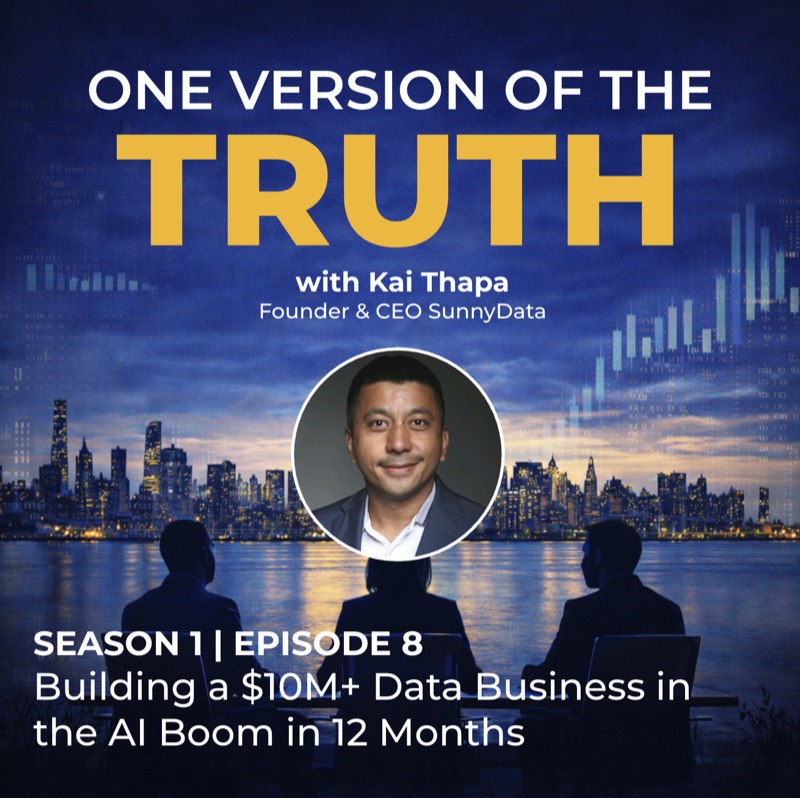
Kai Thapa, CEO and founder of SunnyData, a Databricks consultancy he built from zero to nearly 200 employees in two and a half years, joins Taylor Culver to unpack how his engineering and sales background shaped his approach to running a fast scaling services business. The conversation traces a familiar failure pattern in data organizations: teams that fixate on semantic layers, data quality, and governance buzzwords while losing sight of the actual business problem, and the executive who has to approve the spend.
Thapa argues AI has compressed the old multi year modernization roadmap into six to eight week iteration cycles, and that engineering is no longer the bottleneck, prioritization and business context are. He is candid about the hardest part of his own business: closing eight figure technical deals is comparatively easy, while getting organizations to invest in people, culture, and change management is the real fight. The sharpest takeaway: trust and genuine curiosity about the customer's process, not the technology stack, is what actually drives adoption and growth.
“Technology is the easy part in all this. It's the people that's the hardest: the people, the culture, and the processes. The coding is the easy part.”
“The bottleneck shifts to what is a product backlog, what is a priority, what can we solve for, and iterate really fast. Engineering is not the bottleneck anymore.”
Kai Thapa: Yeah, absolutely.
Taylor Culver: So today we're here with Kai Thapa. Kai, I I don't even remember how how did we first meet? I've known you for so long now.
Kai Thapa: yeah, I I think going back to when I was living in New York City, all goes back to data and a sales cycle. I think you were my customer back to What was it selling? Snap logic, I think, is the as the ETL tool back in twenty fourteen. and we had actually a mutual friend in common. So we've always stayed close, conversing, and you know, I used to talk to a lot about your entrepreneurial journey, which which finally gave me the, you know, the the the excitement to like finally take the jump off the cliff and and start my own journey, right? Two or three years ago.
Taylor Culver: Okay. Yeah. I think it was so cool when when I first started in the data space, I didn't know anything about technology. And and so like I just put my tentacles out to speak to people and I I met with a ton of I learned quickly to bypass the AE or account executive to get to the sales engineer because you could learn so much from the sales engineer. And and I think that's why when we first started working, I don't I don't think I could have even spelled ETL. and then by the end of it, like I was a judo ninja getting getting through some of the stuff because you know it's it's kind of the some of the technology, there there's a little bit of a learning curve to it. and then people throw these things around like like they mean something. It's an anachronym that literally is extract transform load. I think it's ELT now or something like that, but
Kai Thapa: Ha ha. Yeah, yeah, yeah.
Taylor Culver: It it's it's funny that that how it kind of goes along the way. I'm curious. I mean, you started as a sales engineer, you're you're crazy technical, you can build software, you can implement probably some of the most complex data platforms on the planet. you were doing, you know, MPP before it was cool, now you're in with data bricks. tell me this you know, you started as an engineer, so you're a technical guy, but now you're a CEO and you've built a rapidly growing business business and you have I have a n I have enormous respect for the success you've had in such a short period of time. But tell me this, you know, how did your engineering experience shape how you're thinking about business as an entrepreneur today?
Kai Thapa: Yeah. I you know, I I think the the root of it goes to two things, right? One, being an engineer, to me it's all about focusing on the problem, right? you know, my problems as a as an entrepreneur growing scale, really focusing on the what is the core problem that we're trying to solve for the for the for the customer, right? And two, I think early stage, you know, when I was the first even the first job I was at, right, being an engineer, being very close. It was a startup, so I you I got to experience the sales cycle, right? The being the account management, being very close to the customer, what do they really care about? You will make mistakes along the way, whether it's software, services, right? Really owning the problem, communicating the problem to the customer. And and being transparent and coming through, right? You may not always be able to solve it, but putting in the effort, you know, coming through on your commitments, that has really helped me today, you know, to start the business and and the growth. but really at the end of the day, I think, you know, to me, you know, you have to really understand the problem, right, that you're trying to solve. Whether it's a business process problem, I think in technology, yes, have so lots of technologies, we get enamored with the technology versus, you know, really the the core, the crux of what we're trying to solve for the customers is the problem. Right.
Taylor Culver: Yeah. I I mean I mean in my opinion it just comes down to clarity and trust, right? It is that if if people don't trust you, they're not gonna work with you. And if they don't understand you, they're not gonna work with you. And if you can't deliver on what they say, they're not gonna wanna work with you anymore. And and and that's true across so many different things here.
Kai Thapa: Yeah, and the other thing I would say I I think I missed is, you know, and I pivoted my career, right? I was an engineer at a startup, building out a product engineering team. And and and I'm so thankful. I'll give a plug, you know, the first startup I was at, you know, they've been good friends and mentor, right? They allowed me to kind of be close to the customers, right? Pat Ballum and John Prangy are their names. I'm so glad for that early experience I got that a lot of engineers may not get to, right? Being close to the customer, being able to experience that, learn from those hard lessons. also, you know, I got my MBA just like you.
Taylor Culver: Yeah.
Kai Thapa: I was like, I'm gonna be a management consultant, right? I did that for a few years and it was it was a lot of assessment, strategy, decks, right? You would do readouts and plan, which you know, today, right, Claude and these Gemini can do it in like five, ten minutes. and that wasn't for me. And that's when I got into enterprise software sales. Loved it. and that really I think prepared me, you know, with the right team, the right founding partners to to start a journey being an entrepreneur.
Taylor Culver: That's really cool. So tell me that I mean, we kind of talked about trust, clarity, being clear on what the problem is. What happens when a S E or a consultant doesn't clearly diagnose the problem? What does execution look like?
Kai Thapa: Yeah, I think, you know, whether it's you know, you're trying to, you know, On the sales side, right? We're trying to sell a solution or you're trying to deliver a solution when you get too fixated on other things beyond the core of the problems, right? It's easy to get distracted with all the bells and whistles, right? In the data space, you start talking about, you know, buzzwords around data quality, semantic layer, governance, right? But you're not hitting the mark on the core problem that you're trying to solve for the customer, the end business user. Right. Sometimes, you know, the as data folks, technologists, you're like two or three Steps far removed from the actual problem, right? And and that that's I think when you miss the mark, you're focused on too many other things that are not related to. how this solution, right, does it really solve the problem? Does it make the life of the business user better? Right? Does it improve? Does it reduce hours? Does it reduce costs? Right? Does it does it, you know, make a customer happy? I think everybody needs to be fixated on that, number one, right? Versus just like, hey, we're gonna improve data quality or like, my God, the semantic layer, you know, we get too wrapped up around the axle in that.
Taylor Culver: Well, I I think you kind of call that out pretty clearly is that people get hung up on data quality versus value identification and hung up on the semantic layer when no one really cares, right? I you know, tell tell me this. You've been doing this for twenty years. People are still talking about data quality and semantic layer as the hill to die on, yet at the same time we've seen the ascent and possible decline of the CDO. The
Kai Thapa: Right.
Taylor Culver: you know, AI removing the relevance of the data leader as a translator to the business, yet people are willing to die for these principles. I I think they're willing to lose their jobs over data quality and semantic layer. I I mean how how many dozens of data leaders have you worked with that even if you hit them over the face with a two by four
Kai Thapa: Yeah. I know.
Taylor Culver: they're they're still going to stand by those principles and and punt, the business doesn't understand value, right? They don't understand. I mean, how often have you seen that cycle and and and do you have an example you can share with a either a a former customer or
Kai Thapa: Yeah. a hundred percent. I mean th this still happens to this day, but to your point, I think, right, the the longevity of the the C DO, and I think today, like, you know, Look, I think executives, you know, we talk about data literacy, right? Data literacy has just gone up, whether good or bad, right, due to AI, right? executives can get a lot done with their smartphones today, right? They expect the same thing, other enterprise technology. So gone are the days of a three year data maturation, modernization, roadmap, right? If you if you go to your executives with a two year roadmap, it is going to get shut down immediately, right? So with AI, executives expect Fast ROI, iterations, faster time to value, right, than ever before, right? Six weeks, eight weeks, ten weeks. yeah, there are lots of examples still, you know, in my business where right people are too hung up on look, there's a time in place for governance, you know, from a risk audit, all that perspective, absolutely. But I think getting too hung up on on on sort of you know theoretical exercises around semantic layer and this and that, I yeah, th those things still have a time in place, but I think business leaders, data leaders you know, need to be thinking about execution, you know, getting a use case executed and delivering you know real impactful use cases versus just theoretical exercise, right? And still happens to this day. In fact, I think we've got we've got the landscape has sort of evolved, right? Now, now the same group of you know cohorts of architects and leaders are, you know, MPP and right, all the agentic new buzzwords that are being thrown out, which at the end of the day you're I hope, right, most leaders are trying to solve for real business use cases. With these technologies versus just right theoretical exercises around the latest buzzwords that that that that are getting picked up in the industry.
Taylor Culver: You you know, one of the things I see working with my clients, and it's not all of them. But I could pay them a thousand dollars to go talk to the business and they wouldn't take me up on it. They shy away from it. They'd rather talk about the data warehouse and why you know the technology's inefficient, not optimized. And meanwhile, they have twelve people using architecture that's costing the company a million dollars a year. And then the remaining two hundred people using data in the business are going to reports that were in place in the nineteen nineties, right? Because it's reliable, fast, and consistent. It it's tough to influence them to be able to kind of look past their comfort zone. How did you get past that? I mean you're you're super technical. I'm super technical. Like what w how did you get over needing to control the technology, letting go of that and focusing more on the problem than the solution?
Kai Thapa: Yeah. No, that's it's a great question. You know, I I go back to my business consulting days where, you know, I think you have to think about the business process, right? use any framework. You know, you I've used something like SciPock in the past. It's basically grounding yourself in a in a framework on in a day in the life of a business user, right? A claims processor, a clinician, a service person picking up the phone. What does their day look like, right? How do they intake work? What does that work look like? Where are the bottlenecks? And and think about that process business. process, what are the bottlenecks and what are you trying to solve for? If you if you think of this these you know use cases from a business process flow perspective and which problem are you trying to tackle, then we can layer in the technology, right? It could be a data technology, it could be a process technology. They're all kind of blending now. so I think I think I and queries on my team and the engagements that we have with our customers that think of it that way from a really from a business process perspective. Right. Then you can instead of leading with technology all the time, right?
Taylor Culver: Yeah, but why why do you even care, Kai? Like i i I I I think that for you to wanna understand the process, are you curious or do you want to help? Are you seeking impact? Like, why why do you even care to have that conversation? Like what's your motivator?
Kai Thapa: Yeah, I I think all those things. Number one, you want to have impact, right? At the end of the engagement, you know, self as you for my company and my brand, it's like, did we make the impact we said we were going to? Now, is it always successful? No, right? You still have projects where we're like, hey, we're doing a migration, we're trying to get this out there for X, Y, and Z reasons, right? The ROI is, you know, technical imp operations improvement, right? Technical s you know, savings from the dollars and cents from moving to the cloud. They are those use cases, absolutely, I get it. But I think you have to at least push the customer to think that way, right? If you're if you're a data technologist in a large, large enterprise, you know, many layers from the actual business users, right? Like have we thought about it? What is the impact? The why, right? Like why are we doing this? What is the impact? you have to push, you know, your team, the customer teams towards that direction because at some point questions are going to ask, right? We did all this and what is the impact? What is the benefit?
Taylor Culver: Yeah, I I'm for me, I I always felt like when I'm looking at these business users who are already talented and and they're pretty smart with data, especially the ones who are involved, it's like, can I make someone who's already really good at their job one percent better? Because that one percent compounds to their team. Right. I I I think there's this mindset like that the business is illiterate, so I need to educate them on the semantic layer and how to profile. They don't give a shit. Like it it really comes down to, hey,
Kai Thapa: Yeah.
Taylor Culver: You know, how can you help me be more efficient and productive in my role? How do you enable them? And I I think you need that like intrinsic motivation because I think it's easy to say business value, but I think an uglier color that comes out is where I've seen data leaders literally go to the business, explain to them with data why they're wrong with their process, how to do their job better. And it's just like, my God, like it you know.
Kai Thapa: Yeah.
Taylor Culver: Data isn't the answer all the time. You know, I I I I really stress the importance of relationships and trying to build build build trust and and help identify that problem. But it's
Kai Thapa: Or the other thing is, yes, you know, you may get like a two percent improvement, but it just isn't in their priority, right? It it's the you know business has, you know, five or ten priorities for the n the next quarter, the next year, or this year, and it just isn't in the priority list, right? They've got bigger fish to fry. Then it's a business decision, right? but at least you've laid out the business process. There's awareness of what the bottling th th those exercises are amazing if you can kind of put it in a you know, these a lot of these business processes, business departments probably haven't gone through a process exercise like that, right? What does your process look like? Maybe they did one, you know, five years ago and it's changed over time, right? So that process in itself elicits a lot of bottlenecks in areas of opportunities for the business.
Taylor Culver: I think the best job opportunity for technological savvy executives looking for these like change management jobs, whether it's like head of data or AI, is looking at the process and building bespoke enterprise analytic solutions using things like Claud Code or whatever to build analytic and AI capabilities for their organizations in-house. And and I'm not talking about, hey, let's replace our ERP system with with our homegrown solution. It's no, hey, we've got this.
Kai Thapa: Right, right.
Taylor Culver: quality monitoring process that's you know 25 Excel spreadsheets and and it's like the stuff that RPA couldn't get at that that people wanted and and data warehousing couldn't get at, but like to your point, like getting into the process and building bespoke solutions, I don't I don't think there's a better opportunity than now for a data person to jump in there, roll up their sleeves and start building enterprise products with embedded AI and analytics versus just socializing dashboards. I think people have moved beyond dashboards. People need automation. Yeah.
Kai Thapa: Yeah. Hundred percent. And I will say this, Taylor, right? Like the macroeconomic conditions, you know, what AI has done, the world of sort of data and apps are collapsing, right? From just operational model, you know, capabilities. and I think where the services consulting services industry is also hit it with like forward deployed strategies, everybody's trying to take a page off Palantir, right? Which is really, you know, understanding the business process and mapping engineers to be able to kind of iterate and solve for those problems very quickly, right? Like you know, engineering is not the bottleneck, right? You know, you're coding agents can do that, the bottleneck shifts to what is a product backlog, what is a priority, what can we solve for, and iterate really fast, right? Nobody's saying, hey, I need a data engineer, I need an app engineer. You know what? Everybody can do everything, right? It's just you need an engineer that really understands the business. Let's embed them in the business and let's solve for that faster. Right. So I think it's it's it's the way we work and deliver these capabilities, adjusting to where the industry is headed, where the demand is, right? engineering is It's not the bottleneck anymore.
Taylor Culver: I and I think it's so cool. I honestly I I I was probably like I've we've been around long enough to see a couple hype cycles. I was super excited about parallel processing for analytics because it used to be super slow. I I was super excited about cloud, right? Because it democratized how people can get access to information and build apps and and now
Kai Thapa: I remember that, yeah.
Taylor Culver: what LLMs are doing, especially around coding, is absolutely incredible. And and that's probably the third coolest thing I've seen other than like social media and the internet in my lifetime. and I'm super excited about this. You know, it's funny because in this conversation I'm I'm picking on data leaders a little bit, which I do at like it from time to time, just because I really want to see them be successful and sometimes they need a good shake. but
Kai Thapa: Yeah yeah.
Taylor Culver: You know what's crazy? And this kind of bothers me about your business is that your engagements probably have an extra zero or two zeros after them, and you're selling a technical solution. But when you and I talk, you're always like, it's the people and change stuff that matters. And getting the customer to buy in on, like, hey, let's solidify your operating model before you make an investment in improving your Databricks environment.
Kai Thapa: Yeah, that's the hardest part.
Taylor Culver: I I I I'm I'm literally having this conversation right now and and for them, like I I like taking quarters from them is like stealing their children, but they're dropping eight figures on parallel data warehouses. Like so like your economic buyer as a consultant is also tech focused, they're not business focused, even though they're trying so like wrap wrap your head around that. Like how do you how do you coach a customer who's already convinced that it's a solution oriented problem versus trying to change the enterprise?
Kai Thapa: Yeah. A hundred percent, right? Everybody kinda the thing is like with org change org man change management, enablement, everybody agrees. But you know, when the when the CFO or whoever's got the money, right, has to, you know, open up their wallet and really like, we're gonna spend all this because this is so important, right? Like people's feelings and skill sets, all this, it is a tough sell. Versus
Taylor Culver: Yeah, it's crazy.
Kai Thapa: versus if you put together an ROI and a proposal right around data quality governance, you know, faster analytics self service, that typically gets the dollars, right? Just just from a from a from a approval perspective. yeah, it is yeah, it is kinda interesting.
Taylor Culver: It yeah, it's easier to show the ROA. It's like, hey, if you're spending ten million dollars on Snowflake, you can spend eight million dollars on Databricks, hypothetically, right? ROA's crystal clear. It it it's
Kai Thapa: And look. Technology is the easy part in all this. It's the people that's the hardest, right? The people and the culture and the processes, right? The coding is the easy part. And y you know what? It's automated. Like we've seen this in the last it's gonna get better, right? Like, whether you use people, assistant coding or or you know, headless agents going around doing all the coding. That's the easy part. It's the people and the process that's the hard part.
Taylor Culver: Yeah. Yeah. Well then how come no one buys political solutions? How come no one buys solutions to those problems? Why? Why what help me understand that.
Kai Thapa: Yeah, and if if we had magical agents that could just go and, you know, solve for the org change management people part, right? Like getting approvals for a document across, you know, twenty different faces of, you know, organization, right? Like, yeah, that'd be awesome. I think that's
Taylor Culver: What what's the I I'm curious, I do you have like a horror story in your your experience working with people who are either blocking change management initiatives or making it difficult to do the obvious even after the ROI's been established? Excluding me. I don't count when you we were working together
Kai Thapa: Yeah, I mean Yeah. boy. lots, right? a lot of times, you know, what so you know, what happens sometimes in our engagements is you have, you know, changes in leadership, right? So whoever there's new people that show up, ha all the time, and this is common, human nature. where they come in and they were brought in to make a change in charter, you know, midway through an engagement, right? And then, you know, they have their own charter, right? Like, hey, the old stuff was bad. Like I'm here, here's my new charter. And so they have a different set of you know, their sort of understanding of the world the world needs to get to from the based on their learnings, right? Their s current understanding. And then what we, you know, charted out to build does not align with their objectives, right? So, you know, you start getting into a lot of questions about who approved this, why was this designed this way? Why was this built? lots of sort of, you know, goalpost shifting happens, right? and so we're like, you know, seventy, eighty percent of the way there. So aligning to, you know, what the goal is, what the understanding of the problem is kinda sh you know, i is important in these engagements and sometimes it shifts and it's beyond our control, right? 'Cause we have new leaders that came in that have their own agenda, own perspective. Not agenda so much a perspective on what the realities were. Yeah.
Taylor Culver: no, there's definitely an agenda. You're being nice. It's
Kai Thapa: I mean that that is the reality that, you know, we live in in this in this business, you know, not just us, every consulting company, every engagement, right? it happens even in the software world right now. So
Taylor Culver: It's cra it's crazy because I I I see a lot of data executives want to go down the the like the fractional CDO route, which I don't think is like a real thing. I think it's just happening because a lot of data executives are out of work. to to be honest, like you're still subservient to those politics outside an organization. It's not like as a vendor you're you're not participating that anymore. And in fact you're probably held hostage to it more and have less influence over the situation because the decision will be made without you in the room. And it's like later, you know.
Kai Thapa: A hundred percent, you know, and and I always coach my people, right? Like it's easy, just the the first thing, you know, the the the two things that get blamed when things go sideways. Number one, the consultant, number two the technology, right? It's like and I've been part of both, you know.
Taylor Culver: And and you're a good guy trying to do the right thing for your customers, like anchor to ROI. I I've I've had examples with customers where they've agreed to take on parts of a project, but they didn't have the skills to do it, and then own that after you're six weeks into the project, and then all of a sudden it kills all the trust and the initiative, right? And and I've also had instances where executives have thrown their own teams under the bus to sabotage product projects to protect their own their own turf. And and it's unbelievable because a lot of these efficiencies and poorly run processes exist in these organizations because of weak or absent leadership. I think it's nice, and this is me saying I'm not trying put words in your mouth, but I I think it's nice to say like, hey, there's always a revolving door of managers. But you know, in that transition, the problem n rarely changes, but a a political operator is gonna sit in there and be like, everything the last guy did that no one likes is bad and therefore everything I'm going to do is good. Resume the project. Let's just call it, you know, Project Vanilla over Project Chocolate. It's it's it's it's wild. And and and that kind of thrash i is really hurting organizations, be efficient, capitalize on value from AI. I don't know, do you agree with that or
Kai Thapa: And yeah, I I hundred percent. I I think you know, when we, you know, everyone, right, like when we enter into this sort of with good intent on like here's what good looks like, here's what's here's what the real problem we're trying to solve, right? This would make an impact. I think everybody has good intentions. Collectively, maybe we didn't do a good job of kinda really, you know, documenting and identifying the root of the problem, right, what we're trying to solve for. And then it just becomes yet another data project, right? Like, hey, we build these pipelines or these dashboards and then you go to business and like meh like, you know There's nothing different. Like how does this make my life better? Right? Like so I think that that that part went missing, right? Like collectively.
Taylor Culver: Yeah, who cares? Yeah. Well Well how does how does AI change any of this? Or is it all just another
Kai Thapa: I I think here here's here's the the impact, yeah, right. It does not have to be a six month, twelve month exercise. You can iterate on this in six weeks, eight weeks and look. And we have engagements like that. If we don't hit these gates
Taylor Culver: Less.
Kai Thapa: Okay, let's let's move on. Let's find another project, right? Like you have to hit this quality threshold. What I think executives and business leaders, I think sometimes, you know, fall into the trap of thinking, you know, AI is just magic. You just drop in a solution, right? I think if they have to they have to commit to their resources giving the context. Context is very important for AI, right? It is highly, you know, human in the loop, right? Yeah, yeah. Yeah. That's the end of the word.
Taylor Culver: the semantic layer?
Kai Thapa: So con even for semantic layer, absolutely. For semantic layer to work, right? Business has to be closely involved in sort of feeding, tuning, you know, human in the loop, whatever you mean, like humans, you know, the context contextual context about the business process, the meaning, semantic layer, right? It is all very important to be able to for AI to hit the mark on the solution, right? The quality the business needs. Sometimes that's missing
Taylor Culver: Yeah. But this is where we I think this is what like racks data leaders' brains is like they're sitting there like, hey, the semantic layer, which is the context that is required to make AI work, but then the business is like, no, no, no, no, no, no. You know, it it's funny because like i we we're falling into that same trap in this conversation where the same kind of fundamentals apply. You know, where where is that balance? Like, how do you get a customer to to be like
Kai Thapa: Yeah, yeah.
Taylor Culver: Hey, we have to do this context exercise to make the R ROI possible, or is it is it just hidden in the process or?
Kai Thapa: Yeah, yeah. And it it sometimes it can be hard because I think, you know, business leaders maybe, you know, they're trying to protect their team, right? That there there's fear and it's it's it's absolutely real. Right? First it was just the business, now it's data leaders, right? They're engineering teams. You have to be more efficient with less because a gentic coding is real, right? So I think you know business leaders sometimes have that fear and maybe don't engage enough as they should. so I think getting their commitment up front, right, in that process of testing out an AI solution. But my point being like it doesn't have To be a six month exercise, a project anymore. You can iterate on things much faster to figure out, you know, what's real, what's not, and then hey, the business really not engaged and give it the feedback and the context, right? then let's iterate on that, right? Go to the right level of leadership you need to get their buy in for the next phase, next iteration of the next project. so I think that loop cycle is much faster and compressed, right? back to my point. yeah.
Taylor Culver: Yeah. I'm with you there. I I I think there's a bad habit in organizations with trying to eat the elephant or solve too big of a problem. I small compounding wins are are the way to success. And I I love what you're saying about like short little sprints, like let's do six weeks here, four weeks here, and let's stop and take what we learn and pivot. And I you know, when we first started in the field, when you'd start on any kind of systems or analytics project, you'd basically reverse engineer the schema. you know, build the context layer, build the application schema and then go implement it and it's all wrong and then you need to redo it two or three times before you either abandon the project or just accept the mediocrity that it delivers. And and i you know, we're in a world today where that cycle used to take years and now it takes weeks to get moving. So
Kai Thapa: Yeah. I mean just just think about You know, the old sales cycles that we used to run in software, right? Hey, Mr. Customer, we'll have a discovery meeting, more discovery meetings, deeper cycles. We'll come back, you know, three or four weeks from now, we'll show you a bland solution, and then we have to make the case internally to show you a demo of a custom solution, right? Today, right, Databricks teams are doing this, we can do the same. Within the same meeting, we'll take the discovery notes, we'll show you the art of the possible demo, right? A true business process demo. Not just a dashboard, like here's what you you know, solution. could look like. You know, it's like fancy HTML, interactive HTML, but that's a great starting point, right? The business is like, aha, I could just do this in like one interface without having to go to Salesforce and ERP and you know workday, right? That's amazing, right? And then you take that and then from there it moves on to a prototype that we give it to a data engineer that builds this out on top of their data stack. in hours, right? So you you know, moving from like out of the possible to a demo and then that's like, hey, can we get to a POC in four weeks? Absolutely, right? The in the old days, the the demo cycle alone would take six weeks where the customer is so frustrated, like you've thrown all these buzzwords, you've talked about all these things. I don't know what the solution looks like, right?
Taylor Culver: There you go. Yeah. Well here here's the MVP, right? We all agree. Here's the ROI of the MVP. Do we build it or not? The end. No? Okay. Yes. Okay. Let's do it. And I I I think that's gonna be so cool. Like I'm I'm seeing like like startups, not like startups in the sense of startups, but like entrepreneurs, especially early stage entrepreneurs, just Google business sites and looking at their websites to see if they're dated and their whole sales process is Hey, here's a brand new website. It's free. Just have it. If you want more, let's talk. You know, and and it's it's pretty cool how much value you can deliver up front and and then get into the media problem. And and that early identification of value also gets alignment early, which helps address some of the political challenges. And to your point on on leadership churn and and transition, the faster you get stuff done and embedded in an organization, the less likely. you you fall hostage to you know organic organizational change that's outside your control.
Kai Thapa: Hundred percent, hundred percent. yep. I think adoption and sort of you know, being you know, I I think it's also like reskilling, upskilling, right? Helping helping your true stakeholders and and users and and I think for the most part, you know, everybody that we talk to and customers, right, like whether they're data savvy or not, they they I think most people get it. AI is coming, it's here. We need to adapt and we need to change and and these new tools are critical for us to be successful. yeah.
Taylor Culver: I love it. I love it. Well tell this. I I'm curious about Sunny Data and and kind of what it's like building it because we met, I think, three years ago for coffee or something like that, and you were just getting started. But since then your business has experienced remarkable growth. Why?
Kai Thapa: I mean I I'd like to say I think it's all me, but you know, it's like timing is everything, right? yeah, yeah, it's all me. Time timing is everything, right? Number one I think I wish we'd start the business sooner.
Taylor Culver: It's all you're
Kai Thapa: We we hitched ourselves the right wagon, right? In in this case, the Databakes platform, right? We're we're pure play focused on one thing. it's that. the market for, you know, AI, right? is hot in terms of everybody needs it, it's here, it's upon us. and I think what's happening at a macro level, right? The the large SIs are all getting disrupted at the top layer, bottom layer. right. So I I think timing is great. Customers looking for nimble boutique partners. So there's tremendous demand that we're fulfilling. And so I think also, you know, I found the right group of founding partners that, you know, each person brings the right skill sets and a competency. And then the chemistry was very important. So and then we have an amazing, you know, board team of board members, right? That that have that that have given us a playbook that we're executing on a quarterly basis that guides us. So the growth has been phenomenal, really, really thankful to a lot of pastors.
Taylor Culver: Hundred percent.
Kai Thapa: Past customers that have trusted me, us, right? Relationships. That's what it's all about at the other day. You know, take care of your customers, come through on your commitments, do the best you can, and also your your employees and consultants, right? You gotta hire the first set of cohort of technical leaders that people can rally around, right? From a recruiting perspective. That's very important. You have you have the the sales pipeline, you have the talent pipeline, right? So yeah, that has allowed us to grow. you know, rapidly in the two and a half years, we're closing in on two hundred employees and we have delivery centers in you know we started out Uruguay, we have Argentina, Mexico City now and also we just started Nepal about six months ago. We're up to ten consultants there.
Taylor Culver: Yeah, so so let me just run that back. Two hundred employees globally started the business, what, three years ago?
Kai Thapa: Yeah. two and a half.
Taylor Culver: Two and a half years ago. Okay. Like that's incredible. And and one thing I want to highlight here, and and it's it's funny, is it not funny, it's amazing, is I work with a lot of people like yourself. Like I've talked to a lot of different entrepreneurs, and a lot of them have been like, hey, Taylor can do it, so I can do it. I feel like that's that that's kind of the the catalyst. But but what's wild is I've seen people like yourself and other friends who have literally gone from being high performers within organizations making hundreds of thousands of dollars a year to to building multi million dollar businesses in a matter of five, ten years. And and it's wild to see the success. And I I think that people are so scared to to leave that like corporate
Kai Thapa: I know.
Taylor Culver: security and and it's not everyone says it's not really security, but it's really hard to make that decision, you know, and and it's nice seeing other people who've done it and been successful like yourself. You know, t t tell me, you know, if if someone else out there right now is facing a similar jump or is, you know, in the first 90 days of their journey and it's seeming bleak, you know, w what kind of
Kai Thapa: Yeah, yeah.
Taylor Culver: What kind of words of wisdom would you give that person?
Kai Thapa: No, it I I I would say look, you you gotta find the right partners to to start this journey with, right? in the first six months it is going to be a slog. It is going to be difficult, dark days, right? Am I am I going to be able to meet payroll, right? Am I so, you know, the founding capital is important, you know, whatever model you're you're doing is a solopreneur, right? Is it is it you're taking some investment money? But really I think you focus on the core thing that really differentiates you, right? For us we had a story to tell. because we have over nobody, Databricks has thousands of partners that are much bigger, right? Why would they trust me or my story to to break into this market, right? You have to tell a differentiating story and then really focus maniacally into you know getting the first one or two customers, making them successful and building upon that, right? I I think it and then and then you have to in the background constantly thinking about scale. How do we scale this out? Whatever your growth plans are. We had pretty aggressive growth plans, so thinking about scale from all functions of the business. is is is is is really important and also complementary skills right like you know i'm i'm lucky you know been very very fortunate to have been an engineer been pre-sales right and and then sales and then you have to have if you know if you're the technologist who's going to sell for you right a lot I think sometimes you know a lot of technologists make the mistake of like selling is easy you know I am yeah I built this solution I'm gonna go pitch right like it's it's not right sales is really really really hard unless you've done it or you've got somebody that's done it. so I think I think a lot of sometimes technologies just don't have the appreciation for how difficult it is to sell and sell as a nobody, right? Like you you know, you're starting from ground zero as a startup. That is really, really hard. So it can be hard, but I would say, you know, stay true to your gut, right, to to what your core offering differentiator is and constantly, you know, ask people for advice, right? Like I'd come talk to you, I'd come talk to other, you know, mentors and friends in the industry. Hey, would you listen to my pitch? Help me, you know, like give me Seek feedback like you know, met you know, like all day, every day, right? Seek to get better. Yeah.
Taylor Culver: I love it. And tell me this, it it is as your company has grown, right, and and through this rapid growth, how important is data to your day to day decision making and what kind of principles have you let go to remain nimble, customer oriented, and problem focused?
Kai Thapa: Yeah. Yeah. This is so important, right? As we like as we've grown, like today, close to two hundred employees, we already have twenty five SaaS systems, Taylor. I just did the math, right? Like I was just looking at the bills and like, you know, from all the companies. It adds up. The complexity increases because we're putting in functions and processes for, you know, six months, a year, two years from now, right? For that growth. As you do that, and then you'll get into these meetings, you'll have functions, you know, as you're rapidly growing, new people come in. We'll we'll we'll talk about, you know, where the business is headed, what decision needs to be made. And and you people throw like anecdotal evidence like this happened, right? And I think you've got to be able to cut through that noise and really encourage everyone, you know, with the discipline of looking at the data that we have today and making decisions, right? And so it's funny, like we have our own enterprise metrics project today, like to bring in all numbers, right? typical numbers, utilization, you know, per head revenue, bench time, all these things. and even for a company that does this for a customers for a living, it's you just have to get past that. Is it like ninety-nine percent accurate? Right? Like is it and so we we we've we ground ourselves in using data to make decisions. Like you know we always start out meetings with like, okay, what does the data tell us, right? Actual versus plan, right? And then what do we need to course correct or what do we need to do for the next three to six months? so you have to constantly like every meeting has to be led with, you know, let us look at the data, make decision making data 'Cause it's so easy to fall into the trap of like, this thing happened last week, right? It's like is that an you know, like a an anecdotal evidence of something that happened, right? So I think that's really important.
Taylor Culver: I love it. And you've done so much in your career so far. And it seems like you're on a rocket ship just off to, you know, an incredible potential journey. And I'm really excited for you. You know, tell me, kind of paying it forward to the people who are listening, what's one lesson about whether it's entrepreneurship, leadership, data that you wish you had known or applied? earlier in your career? Because like you said, you wish you had started your business earlier than you did, and who knows where you'd be then. But what's that one thing that you kind of think about that would benefit other people in your position?
Kai Thapa: Yeah, I I think trust is everything, right? Trust. With your employees, you know, be who you are. Like your your your genuineness, your your passion for the technology and what you do speaks through, right? Like I had this, you know, I was doing this preparation for a pitch with a large data bricks sales team, you know, talking about this solution, that solution. And and somebody stopped me and said, Be passionate. Kai, you are passionate about what you do. You know your stuff, you've been there, you've done these, you've seen all these technologies, you build these data warehouses. Like passionate comes out, like your passion comes through. So you know, be genuine, you know, build trust. And no matter you know, these technologies come and go, right? Yes, AI is the new frontier, it's gonna change all our lives, it has, but I think at the end of the day people still wanna do business with people, you know, and work with that they trust, that they like. So I think being genuine, and then, you know, let your passion speak for the work that you do.
Taylor Culver: I love it. And tell me that I mean for people who want to get in touch with you personally to learn more about your journey or who want to, you know, enhance their Databricks environment, you know, what's a good reason to reach out to you? What's a great way to get a hold of you?
Kai Thapa: Yeah, it's very simple. Our website is sunnydata.ai. we should probably buy the dot com domain too. We haven't. and then my email is Kai at Sunnydata.ai. we have our c sales contact information at on the website as well. I'm on LinkedIn. if not, you know, Taylor has my cell phone number he can share at his discretion.
Taylor Culver: Yeah. I l I love it and and it will be at my discretion. Kai, thank you so much. Your journey is incredible. I admire what you've accomplished and I'm really excited to see where you're at in four years and hopefully you still return my phone calls by then.
Kai Thapa: Anytime, man. Anytime. No, this was really fun. Taylor, thank you so much for having me. it's exciting. It was it was fun to chat and just, you know, talk about all things business, data and tech, right? so awesome. Thank you. All right, thank you.
Taylor Culver: My pleasure, brother. Take it easy. Bye. Cool.
Kai Thapa: Is the recording stopped?
The only data leader in the room?
Have conversations like this with peers who live it. Free and private, for data leaders in the seat only.
One Version of the Truth