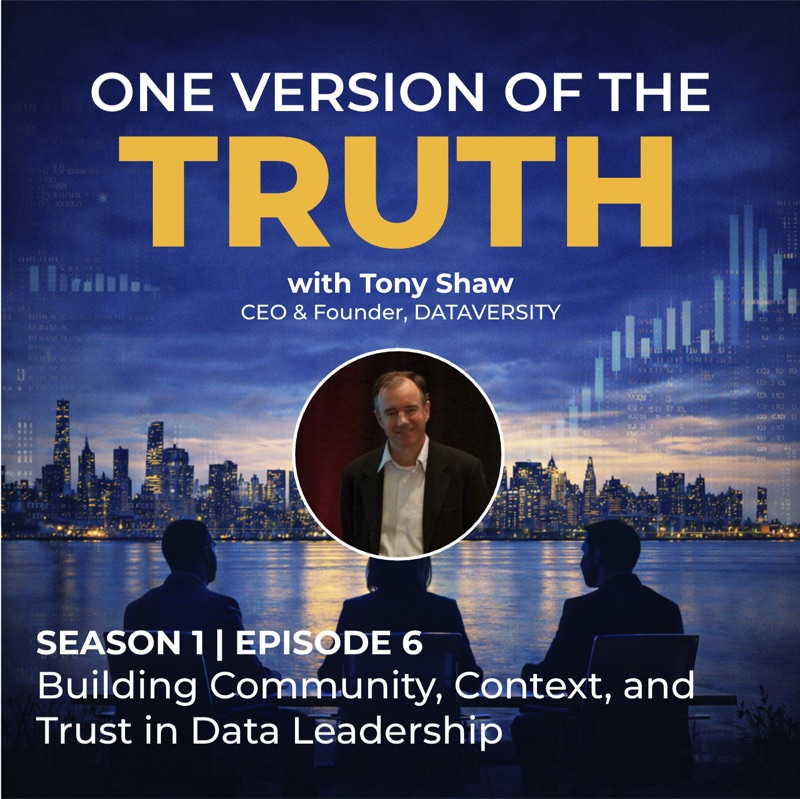
In this episode of One Version of the Truth, Tony Shaw, founder and CEO of Dataversity, joins Taylor Culver to discuss how data governance evolved from a compliance response to the 2008 financial crisis into today's AI driven surge of interest. Shaw, who has run data conferences and training since 2011, argues that while practices must keep evolving to serve new technology, from big data to AI's demand for semantic context, the underlying principles of good data management have stayed remarkably timeless.
The conversation turns to what separates strong data leaders from the rest: not technical depth, but social capital. Shaw contends that leaders who lead with pitches rather than listening struggle, while those with real business context and interpersonal trust earn the influence to get things done. His sharpest advice is to never offer unsolicited advice, wait to be asked, and build relationships before proposing solutions. Shaw also previews Dataversity's November AI governance conference in Providence, Rhode Island.
“The ideals of great data management have always been somewhat idealistic, and rightly criticized for being too idealistic or too rigid. Even once reality catches up, the idea has to keep evolving, because the world is going to continue to move really fast.”
“I think that's a vastly underappreciated asset for any individual: how well they relate to other people, both up and down. If you don't have that social influence, it's just so much more difficult to get things done.”
Taylor Culver: Today I'm really lucky to have Tony Shaw on One Version of the Truth. Tony has been running the Dataversity conferences for over a decade. He's been a major part of the data community, supporting many of the initiatives of DAMA, and has been an integral voice in the development of data leaders for quite some time now. Tony, could you please tell us a little bit about yourself?
Tony Shaw: Yeah, first of all, thanks very much for having me on your podcast, Taylor. have always enjoyed our conversations and our relationship. so I started Dataversity in twenty eleven. it was the evolution of a another company I had called Wilshire Conferences, which was very much focused on running one major event per year. It was the enterprise Data World Conference. we did some other things after that in the areas of semantic technology as well and eventually in data governance. But Dataversity was the sort of growth from that singular con focus on conferences to a broader community oriented organization with a digital presence and products in the the data training areas. So at this point, yeah, we're we're a bit more diverse. in fact, since COVID we've focused much more on digital delivery. But we still do our conferences. we had a major conference a couple of weeks ago, the DGIQ and E DW conference with about six hundred people. So that side of a business still exists and it's very much part of our identity as a company.
Taylor Culver: So you you've been leading a fairly large community now through some major cycles. You you've started just after the financial crisis, saw us through big data, are now seeing us through the advent of AI. What's changed since you first started and what's kind of stayed the same?
Tony Shaw: yeah, it's funny that you mentioned the financial crisis. 'cause I think that was really the kick start and this I I I don't mean this to sound sarcastic, but it it might come across a bit that way. You know, that was the kick start that data governance r really needed. when Sabayans Oxley and i you know, some of the the really egregious examples of bad reporting, egregious corporate behavior became apparent when when that that's what started to drive data governance specifically in the financial services sector but but much more broadly than that as well. and so We we sometimes joke that you know, we really need another crisis to give our sel give our business a another new reason to exist, but or to boost the interest in it. but yeah, I mean there have been subsequent issues that have driven data management. I think actually AI, I certainly wouldn't put it in the crisis category, but it has created a real surge in interest now around fundamental good data practices. you know, now we're into the the year of context, you know, as Gardner would Gartner would describe it. yet another thing that that needs good data to be properly executed or or to be fully executed, fully effective. So yeah sometimes sometimes the drivers behind data management education are are a crisis or a problem, other times they're an opportunity. Right now we're in that that world of opportunity, I think.
Taylor Culver: I like that. I you know, it's it's one of these things where AI is top of mind for every executive that I talk to, and shortly thereafter it's well, we're not seeing the value from it quite yet. And I was at a conference, the innovation and imagination and action conference at MIT a couple of weeks ago, and almost every speaker was speaking to the hype around AI. And in its own right, that might become the next crisis which is the disconnect of value and AI, not diminishing the value of the technology, but to your point the importance of the contextual or the semantic layer to get value from that technology becomes critical for it to produce value.
Tony Shaw: Yeah. yeah, I'm especially tracking the semantic layer conversation. as I mentioned, you know, we did a a series of conferences a around semantic technology goodness, almost twenty years ago now. There were twenty years ago, and there are a lot of the same types of conversations then about how to get you know, information to be understood by machines and to gain a level of of efficiency and reasoning and inference and and efficiency from all of that. But we didn't have everything else that needed to exist in order for that to happen at the time. so it is really interesting to me now, see that now that we have the amount of data, the level of processing, you know, the the the capacity to do this type of contextual under have this kind of contextual understanding that didn't exist before that you know a lot of those those people and organizations who we worked with even twenty years ago are now at the forefront of what's happening in the world. Because back at the time it was like, my God, this is too hard to understand, this is too complicated, we don't want to learn this. there's no payoff there. but it just kind of took some time for the the rest of the world to catch up, I guess.
Taylor Culver: So the data people have always been ahead of the curve. You know, t t t tell me this.
Tony Shaw: goodness, I'm not sure I would agree with that statement, but we can run with it.
Taylor Culver: No, how how how so so kind of in that same vein, The burn Yeah.
Tony Shaw: Well to to to answer that to to give it context, I mean, yeah, look, I think I think the ideals of great data management are have always been somewhat that have always been somewhat idealistic, and have I think rightly been criticized on many occasions for being sort of too idealistic and not practical enough, or too rigid and not practical enough and so I I th I think a lot of those criticisms are are true. and yes, in some cases they were ahead of of the trend or or or pardon me, ahead of reality and reality finally caught up. But by the same token, y you know, I think even once once the reality does catch up to the idea, you know, the idea has to keep evolving because if you sort of sit on your laurels and say, okay, well that you know, that I that thing that we have always talked about is here now and it you know, isn't it great? And but y you know, the world is going to continue to move really fast. And so, you know, there are a lot of things let's just say around data governance or data stewardship, for example, where you know, we we get inquiries from Customers saying, you know, we want to do training on data stewardship, but we we want it to be about where data stewardship will be in a year or in two years. We don't want it to be based on these kind of legacy concepts of what it was to do good data quality or or data governance. so yeah, and and yet you know, I I see people sort of stuck on this idea that they that they've always had. and you you've really got to keep everything moving forward. so yeah, that I it I I guess that's where my observation about not always being ahead of the curve would come from is I think there's a lot of folks and it it's not typical it it's not specific to data management people. I mean I I think unfortunately it's kind of a human trait. you know, especially when you get to a certain point in your career or in your life where, you know, the things that have always served you well, maybe aren't the things that will serve you well in future and it's it's kinda hard to let go of them.
Taylor Culver: Yeah. It it's almost like would it be better said that the principles are timeless, but the practices need to evolve to serve modern technical needs?
Tony Shaw: Yeah, I I think most of the principles have been pretty timeless. Yeah. Yeah, I would agree with that.
Taylor Culver: Yeah. They so tell me this. And you're you're a CEO of a data business. You know, I I wouldn't call you a data leader, but your cohort is thousands of data leaders over the years. You know them quite well. At which point did you realize that the conference business that you had started wasn't just a conference business, but it was a content business. And in addition to that, you're building one of the world's largest communities of data professionals.
Tony Shaw: Yeah, well, I mean I think from the start it was always it i i it was a content business. I mean you don't start you don't start a conference just because you think you want to run conferences. You you run it because you think y you have value to provide in terms of educating people or bringing them together or connecting, you know, buyers and sellers or whatever. that objective might be. I mean there's a business objective behind the conference itself. but yeah I I think for the first half of our life I considered us mostly a content business. You know, this is a place to come for world class education, to learn from Europeers, to the the learning part was critical. and it still is But I think at this point we are as much a community as we are a content business. And the reason that's critical is you know, most of the content that you could hear at one of our events is probably available in some other format, some other way for a lot less money. an article, a podcast, y you know, some webinar that somebody's what really makes the difference is the interpersonal connection and learning directly from your peers. personally I've always found that for the type of learner that I am the most valuable way for me to discover new things, and you know, everybody talks about the value of the lunchtime conversation or the the corridor conversation. I mean, that really is where a a substantial portion of the value of being at a conference is. And we in particular, I think, cultivate the idea of openness, sharing, You know, if you have a question, ask the person next to you or go up to the speaker afterwards. Or and don't be intimidated by the fact that they've written five books and you know, and your first day on the job. I mean so that's the culture of the event that we create. and that's the first thing I talk to people about on the first morning of the the event. It's like turn to your left and your right and Say hi to somebody you've never talked to before because you I I want the event to have that that kind of energy. I think I've forgotten your question now, but content to commun yeah. I mean we are still a content business. I mean I've at the conference we did a couple of weeks ago, there's a s a lot of stories that had not
Taylor Culver: Yeah. Yeah.
Tony Shaw: been told before outside the walls of whatever organization there was. but like eighty percent of the the talks that are there are case studies or their practitioners talking about what they've done, what they've learned. In some cases what they're doing is is cutting edge. In other cases they're just getting off the ground and, you know, talking about some failures. But there are people at all those levels who are attending the conference. So you know, those stories are valuable. And yeah, that's so we you know, that content is still important, but it's the culture in which the stories are presented and shared and followed up on and that's just as important at this point to the success of our particular conference business.
Taylor Culver: I I what I've always loved about your events is how accessible people are. and I I I had dinner with you and some pretty senior people that were chief data officers around very different organizations, and the conversation was candid, was authentic, and no jargon was being used. They're talking about some hard truce. And I think that's really special. And I I I work with a lot of data leaders individually and they just don't have that community because there's usually one of them within an organization. And it's so amazing that you can find someone in a completely different organization at any seniority experiencing the same challenges and limitations of what the responsibilities come with with that role.
Tony Shaw: Yeah.
Taylor Culver: And it's really a special thing and and it's something I've very much admired about what you've built.
Tony Shaw: Well, I I appreciate that. so one of the guidelines I give to the people who are conducting panels at our events is treat it as a dinner conversation or you know, a a pub conversation. If it's y you know, a question being asked and the four panelists all get a chance to answer it, my goodness, that's just that ends up being awful. It has to be where the panelists can can kind of jump on something that the last person said and and take it just like it happens in a real i in a dinner conversation. You know, panelists are asking each other questions. The moderator's role is just to kind of guide us back on track if we if we get off topic, and then you know, bring out the dessert at the at the end of the meal so that we we finish off nicely. But yeah, the learning you get from conversation is so much more productive, and stays with you so much longer than the learning you get from recitals or you know, just being spoken at.
Taylor Culver: You know, it it's funny you say that because these are some principles that I think data leaders could employ in their day to day. 'Cause it's not uncommon for a data leader or a CDO to be like, hey, come use blah blah blah technology because it's the best or we're going to do data governance because we have to. You know, the analogy I always use like use with i the people I work with is, hey, take out for coffee. Go get to know what kids they have, what sports they like, get to know them as a person, and then it talk about that. And and I I it may seem intuitive for for someone like yourself, but I don't think it's as intuitive for for sometimes for us within organizations to put aside our own agendas to kind of build community outside our own comfort zone.
Tony Shaw: Yeah. Yeah. yeah. I I agree with you. It's not necessarily in intuitive. so the label that I would put on that is social capital. I I think. and actually when I was reading through some of the questions and I I told you beforehand, I I didn't do any preparation for this conversation, but I I at least read the questions in advance. And there's a gentleman who's is CDO who I have just the utmost respect for. guy called Curtis Mischler over at Delta Dental of Michigan. And I actually I I sent him a note we I saw him a couple of weeks ago and we I sent him a note afterwards. I just said, you know, he's a very socially articulate person. you know, he's not overly serious, he's and his boss Toby, they're they're like two peas in a pod. and I said, you know, ha to what extent do you think your longevity 'cause these guys have been in the same roles for for I d I don't know how many years, but long enough that their portion of the business, the data portion of the business was actually spun out as a new business.
Taylor Culver: Wow.
Tony Shaw: Yeah. And it wasn't that they took it out, it was that the corporation they worked for said, Okay, we need to make your business a service to all the other insurance companies. so you know, we can we can talk about that if you like, the importance of being so business focused that you become a new business. But y you know, you can just tell that these folks are
Taylor Culver: Ha ha ha.
Tony Shaw: They they have a lot of social capital with their stakeholders. and I I think that as an misunderstood or misappreciated or or underappreciated asset for an individual is well, how I'm I'm not stating that in quite the words I want to to use. I just think that is a vastly underappreciated asset for any individual to have is you know how well they not just communicate and speak, but how well they relate to other people. both up and down. You know, if if you don't have that influence, that social influence It's just so much more difficult to get things done. conversely it's so much easier to get people to give you a chance, to give you a listen. you know, if they if they don't mind spending five minutes with you 'cause you're a a decent person to hang around, then it it opens the door to so much more opportunity.
Taylor Culver: It's it's the it it's the beauty of the work. when I was running data before I started down the entrepreneurial path, I tackled a pretty tough problem. And to this day, I probably have a dozen people in my network who are like, Thank you. Right. And and the pleasure that kind of comes from actually delivering value to someone and helping someone become one percent better who's already very talented.
Tony Shaw: Yeah.
Taylor Culver: i is is such a gift you can give as a a data professional. and the opportunity is so large and the bar is so low in a lot of organizations. It's how do you help people bridge that gap? How do you how do you take that same data diversity mentality, which is like, hey Mr. Data Leader or Mrs. Data Leader, hey, can you talk to the person to your left in marketing, to the right in operations, go get a beer, you know, go get a coffee, you know.
Tony Shaw: Yeah.
Taylor Culver: Yeah.
Tony Shaw: you you're reminding me of something I I don't know if you remember a gentleman called Graham Simpson, who used to he was like the foremost data modeling author in the world and just a brilliant speaker. One of the funniest speakers, professional speakers you could ever come into. But always on point. He he had a very successful consulting company and he eventually transitioned into being a literally Internationally best-selling fiction author. but he used to do a class for us on consulting skills, which is not specific to any industry. It was just the benefit of his experience as a consultant over, you know, 20, 25 years. And the starting point for he his starting point with any engagement, any conversation was. How can we help? Or how can I help? And and then listen. You know, sit back and listen. you know, it's not going in there with a a predetermined solution or or pitch or you know, it's just listen to what the other person needs, what their problems are and y yeah. There there might be a very occasional departure from that, but I really think that's that's part of the social capital creation exercise is, you know, it tells the other party, I'm listening to you, I'm open, Yeah. And he also one of his other things was a and this applied both in business and in social relationships was don't ever offer unsolicited advice.
Taylor Culver: It's never welcome. Never
Tony Shaw: almost never is, yeah. always wait to be asked for your advice or or at minimum ask for permission. but I think it's I think it's kinda in the same category. It's like, you know, if you come in and try to offer a solution that nobody's asked for, then you know, it's probably gonna fall flat.
Taylor Culver: I like that. Yeah, and it it's a it's a trap that we as a profession fall into so so very often. It's it's very it's sadly too common. Tell tell tell me this. You know, we're talking a lot about human traits and a lot of frankly philosophical things. Why data? Why dataversity? What was the spark?
Tony Shaw: Yeah. I guess. well, like you know, most people in the data space, I guess I fell into it because there was a door that opened. so the the actual history was I I I came to the US originally from Australia on a on a six week training assignment with a company I worked for that organized professional business conferences, mostly for the banking industry. And I came here and I I had the opportunity to work in New York for a few months and then train a group of people who were gonna start organizing technology conferences. And that that was really fun. We actually did if you can imagine this back in nineteen eighty seven we did a conference on neural networks. and we used to do conferences on AI, which were all about expert systems. So obviously a lot changed in the meantime. But then I worked for a company called Technology Transfer Institute, which was owned by a professor at UCLA called Len Kleinrock, who has a super interesting story in i i in his own right. But Then eventually after about ten years at TTI, that was a technology training business. After about ten years at TTI, it was time to branch out on my own and TTI had a conference that we had started with Dama International, called the Metadata Conference and we I had the opportunity to leave and take that with me. I bought I bought it from Len. and so was and and we got lucky because around about that that was about the dot com time and we did pretty well when we first left that you know, left that parent. so from there it was, you know, looking for other things in the data world to do. but Yeah, it wasn't I I never sort of sat at home one night thinking, What do I wanna do? I wanna run conferences in data management. It was much more about, there's an opportunity here, come to the US, go to New York, come back to California, work for this company, time to leave, do this. you know, and at the time, I hadn't had a like a a job with a real a real company like an en an enterprise for so long. it was hard to imagine going back to that. I knew I had to create something that I could run for myself. And you know, my wife thankfully was moderately supportive. She was concerned about the risks, but she eventually s sort of gave me permission to take out a a
Taylor Culver: Mm-hmm.
Tony Shaw: a mortgage on our apartment, on our condo and to finance getting going. So yeah. Incremental steps, I guess.
Taylor Culver: Awesome. It's it's cool. It but listening to the universe and following the opportunities as they presented themselves.
Tony Shaw: Yeah, and it's it's not like it was a huge success immediately. We we had a c some line years. Thankfully the last ten years or so have at least been good for the data business. We happen to be in a good place at the right time. but even then you have to keep moving, you know, you have to keep adapting. and I I think we've been reasonably good at at adapting. You that there's
Taylor Culver: So as the CEO of the preeminent data conference with the largest community probably of data leaders on the planet, how do you use data in your day-to-day to make decisions about your business? Or are you making decisions primarily on gut and situation?
Tony Shaw: fair question. we do track a lot of data. I mean we're aside from our conferences, we're largely a digital business, so there's a lot of data that we can look at in terms of web stats and you know, email stats and conversion rates and evaluation scores and all that sort of stuff. I I wouldn't say we are obsessed with looking at those stats every day. I mean the the clearest indication of how we're doing is always, you know, a monthly financials. how do things compare to last year, what are the trends? I think we also did a fairly major site redesign about twelve months ago and so we've probably been a bit more data centric since then. A lot of what that was oriented to do is to create reporting opportunities that didn't exist with the old infrastructure. and we're still going we're going through a big redesign at the moment on our training site as well. mostly to try and understand customer behavior. and you know how people are finding us, how they're navigating our site, what questions are they asking us? Are they you know, if they start a course, are they finishing it, are they exiting early? Are they doing the the tests at the end? I mean we we really do track a lot of data that tells us about how people engage with our products and if we're doing a good job. so those are mostly the ways. yeah. we do quite a lot of on online advertising. so we track those but you know, we're a small business. We don't we're we're like less than twenty people. there's only so many things we well, there's probably an endless number of things that we could be tracking, but there's only so many things that we have time for or that we that would be useful ultimately.
Taylor Culver: I I I love the fact that you use data to serve data people so they can help their stakeholders use data better. It's it's all
Tony Shaw: yeah, I mean I I c there there's a few things I think I can cite from our direct experience that are relevant to my community to our community. I mean the scale of our issues is just so vastly different that I think a a lot of it does not translate but but it does enable us at least to connect ideas and concepts that we see our customers struggling with.
Taylor Culver: Well talk to me about that. When when someone walks into the conference and you've seen thousands of people and of course you haven't met them all personally, but I'm sure you've met quite a few, what separates a great data leader from a good one and p perhaps even a bad one?
Tony Shaw: Well Yeah, I mean I I I hate to give a cliched answer here, but you know, it really does I think start with a business first mentality. and you know, I I love to see folks moving into senior data roles from the our community, from the data management side of things. if all they bring though is a data perspective, then you know, I think that is i that's gonna be tough. That that's gonna make their role difficult. I think it really, really helps to have context. I mean even if it you know, maybe you came from the shop floor or the the retail out a a retail outlet or a marketing role into a data role. I think you know then going into a s a senior data role with that background is super helpful. and because you can speak the language, you've got the context, you understand business you're probably more inclined to to compromise or you know to know where the right place to compromise is because you're always going to be faced with that issue. so yeah I think I think and thankfully there are a lot of folks who got into data because of necessity from somewhere else as opposed to, you know, dreaming of being a data architect while or a data governance manager while they're in second year at university. so you know, th there are a large number of people with that kind of background. But yeah, I I mean I know it again sounds cliched, but without sufficient business
Taylor Culver: Yeah.
Tony Shaw: knowledge and context and language then I just think it's kind of uphill for that kind of individual.
Taylor Culver: Yeah, i it it it's super consistent with what we've talked about today. And I'm kind of putting a bow on everything, what do the next three to five years look like for us as a data community?
Tony Shaw: Yeah. Well, I mean I am Okay, the big picture is I I share the world's concerns about AI and you know, what this is gonna do to society and the workforce, all those big things. I do I do share those concerns. to narrow it down though to the the data world, I think that you know, AI is this humongous opportunity. and so I think you know, understanding how you can use data to make AI better. and it's not just data, you need other things as well, obviously, but and also how AI can make data better. at the conference a couple of weeks ago the it was clear that a lot of people had already started doing this. One of the one of the areas of low hanging fruit is in using AI for metadata remediation or enhancement or completeness. And you know, so and a lot of folks had been pushed to do that because in terms of the context conversation, you know, you need that metadata to create good machine readable context. So you know, those those people have a lot of opportunity I think to to use their data skills to be really strategically valuable in the AI conversation. and I'm sure there are a lot of things I mean data quality is another huge area. But that there's probably many more opportunities than I personally would appreciate at the moment. 'cause, you know, every time I hear practicing data management people talk about how they're using data and AI together, I learn something new every single time. so I I do think that there are just this huge number of opportunities out there. how long that will last, you know, I I mean I see people who are successful with that right now. I hope that that success continues. how long it will go for is beyond my pay grade to to estimate, but yeah, I think within the data space the the f the next two or three years There there are lots of reasons for optimism. if if you keep moving forward, you know, like anything else, if you sit on your hands and don't keep your skills up to date then you know, then you'll struggle. Your whole organization will struggle in that case.
Taylor Culver: Well, there there's never more an important time to learn about new concepts and techniques. And there's not a better time to meet with your stakeholders and your peer group who are doing new and cool things, perhaps much differently than you would even realize. And probably not it's probably there's probably no better time than to, you know, join the Dataversity community. And what it w I I'm excited because I was looking the other day, you guys have a another conference coming up, I think, in the fall. Could you tell me a little more about that and how people can get involved?
Tony Shaw: Yes, so the emphasis of the full conference, which is in November in Providence, Rhode Island, is the emphasis there is on AI governance, but we always have the data governance and quality component with every event. whereas the one a couple of weeks ago was that plus enterprise data architecture, the one in November will have a a strong emphasis on AI governance. So yeah, that space we didn't even touch on AI governance, but you know, you can extrapolate from a lot of what we were talking about to include that topic as well. I think I think that's that's a topic with, you know, at this point infinite an infinite time horizon. That's not gonna be a topic that comes and goes in the next two years. There'll be new types of governance required for AI for a long time to come yet. So so yeah we that conference Providence is a a smallish town but it's right in the middle of all the big ones and it's easy to get to on the train. I I went there to look at the venue prior to selecting it and I thought, well, this is gonna be really nice really nice location for a conference instead of having to go to like New York City or or Boston. So yeah I'm I'm very optimistic. We have folks signing up for that already.
Taylor Culver: Love it. So if you're a data leader looking to meet your peer group, senior, junior, if you want to learn about AI governance, data governance, data quality, come join Tony and the Dataversity team in Providence, Rhode Island. And what are the dates specifically? It's November
Tony Shaw: it's November sixteenth through nineteenth. So probably hopefully the tail end of the the fall colors and before whatever blizzards normally come into the northeast. Yeah.
Taylor Culver: Yeah. Little different than Southern California.
Tony Shaw: Yeah, yeah. It's I'm I'm very fortunate living here. but
Taylor Culver: Tony, I really appreciate your time today. Thank you for sharing your story. Thank you for your contributions to the data community. This has been great.
Tony Shaw: Thanks Taylor. Appreciate your friendship and and always enjoy conversations. Thanks a lot. Okay, bye bye.
The only data leader in the room?
Have conversations like this with peers who live it. Free and private, for data leaders in the seat only.
One Version of the Truth