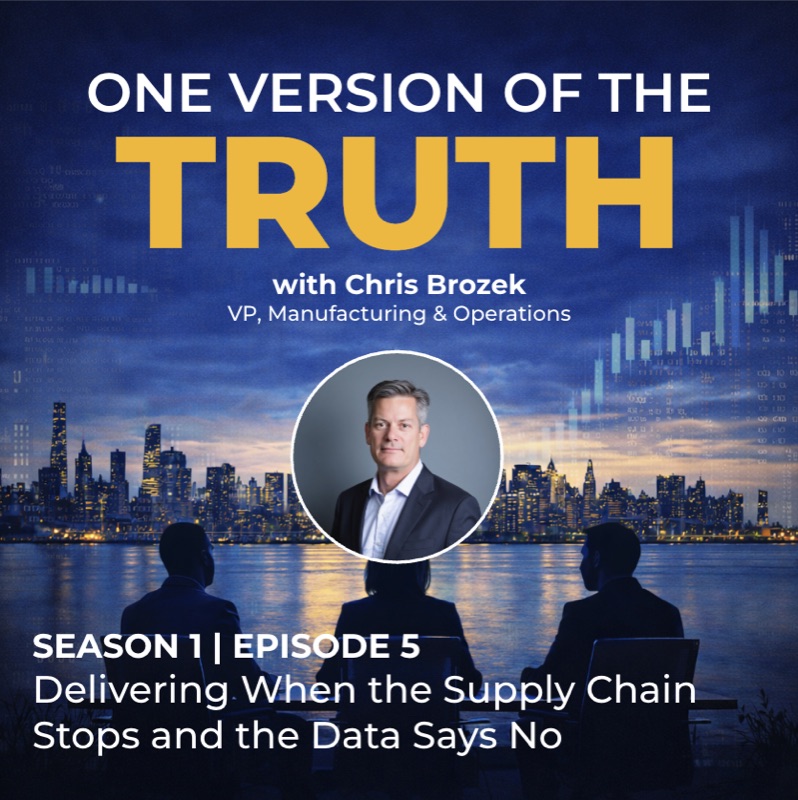
Chris Brozek, a six-time VP of Operations and Manufacturing across Silicon Valley startups, from Velo3D's 3D metal printing to a SPAC-era hypergrowth build, joins Taylor Culver to unpack how physical-goods companies actually run on data. Brozek traces his path from Navy submarine officer to Cisco to a string of startups, describing manufacturing floors that lean on best-in-class systems (ERP, MES, PLM) with no budget or vision to orchestrate them into one coherent picture.
The sharpest insight: data isn't usually wrong or missing, it's latent. Manufacturers learn about problems after they've already happened rather than anticipating them weeks or months out, which is why Brozek argues dashboards are dead and is bullish instead on predictive digital twins and AI agents that can simulate scenarios before committing capital. He also recounts sourcing every unit of a single-source component worldwide during the pandemic chip shortage to keep a SPAC-bound hypergrowth startup alive, a decision no data set could make for him.
“The saying at ThoughtSpot was dashboards are dead, and I think that's right. You don't use your car's dashboard to drive, you use it to occasionally get a check-in.”
“Whether the data is wrong or missing isn't the biggest issue in my judgment. It's that it's latent: even if it's right, I'm learning about an impairment right now, and I'm not able to predict it by weeks or months.”
Taylor Culver: Today we're here with Chris Brozek. Chris Brozek is, what do you know, a six time VP of operations and manufacturing, five time? This is great. Well, welcome. So tell me this, you've got a unique experience where you've been working in manufacturing in Silicon Valley your whole career. Manufacturing isn't what you think about.
Chris Brozek: At least, yeah, yeah. Serial startup guy, yeah.
Taylor Culver: when you start thinking about Silicon Valley, maybe with chips and wafers and stuff like that, but the past couple of decades have been, know, software and AI, you know, how did you end up in manufacturing operations and really what drew you to running some of these complex systems for a lot of these different startups in the Bay?
Chris Brozek: Yeah, cool. Hey, thanks, Taylor. Thanks for having me on. Good catching up with you. guess my start was really in the Navy in the 90s, where I went through the whole nuclear power pipeline and ended up serving as a submarine officer for the better part of the 90s. So got out like in late 99 when the dot com party was booming and everyone saying, come to the valley, come to the valley, come to the valley, came back to the valley where I'd gone to school. and sort of migrated my way into manufacturing at Cisco and learned the trade there a little bit. And then I've popped out from that and stayed in the manufacturing world on the op side for the last, since, we'll just say since about the turn of the century.
Taylor Culver: I love it. With Cloud This and Cloud That, what are they actually making in Silicon Valley?
Chris Brozek: Back in the turn of the century time frame, they were actually making the stuff here. So Cisco literally had manufacturing here in Silicon Valley. And that was the era of the migration to outsource and to contract manufacture everything and not turn any wrenches locally. That was that big, big, big migration. So that all happened and everything more or less left, with the exception of some stuff. So like in the last few years, I did a startup called Velo3D, which was doing 3D metal printing at scale. So you can think like half meter by meter sized parts, rocket engine parts. And we built a factory here in Silicon Valley in Fremont. And so the equation of where do you build it is it's not just a single recipe. It varies. It's good to build stuff in subsystems elsewhere. And then if you've got real hard integration or a hard engineering problems, at least in the early days of a young company, it's easier to put it together locally or relatively locally where you can put your people, both engineering and manufacturing.
Taylor Culver: Okay, yeah, so that's cool. Well, tell me this, you know, this podcast about data, you know, when did data become central to how you manage operations?
Chris Brozek: It's been that way sort of the whole time. think if I, if it go back to the Navy, the data is all was at least at the time was all sort of paper flows and concrete process, right? So the process is really the glue that held the data stream together, which at the time was literally paper. I could probably tell you a story about literally printing emails on behalf of people who were senior than me because they needed the email to be read. But But then that data flow migrating to Cisco was magic, Indistinguishable from magic. The tool sets at the time, the data flows that were supported by those tool sets were really amazing. Sort of didn't really realize that until I jumped off of that boat into the canoe of startup land where there's nothing, right? Where you start with maybe QuickBooks, maybe a more advanced CRP, and then you have to wrap all the systems and process around. So the VP of ops, at least in my experience in those roles, usually gets IT, which is broadly data and making sure email runs and Slack runs and all these other things, right? So, but my personal subject matter expertise there and domain knowledge is not deep. So, you know. figure out how to get those data flows to run off of core systems that are needed for manufacturing has always been a bootstrap effort on my part and my team's part.
Taylor Culver: And when you kind of like, for someone listening, you when you visualize a manufacturing plant, maybe you think, you know, Ford or 3M or something like these, these multi-billion dollar plants that are producing, you know, enormous amounts of products, you know, how does that differ? and more of a startup-based environment for manufacturing. When you walk into some of these manufacturing plants, you are giving the example with the 3D printing. Is it the corner of a warehouse or is it the full warehouse? What does the floor look like?
Chris Brozek: Right. So we were doing large scale industrial systems. I think it's like 600 square foot sort of machine or set of machines that would constitute a single printer. Now stitching that together with, you know, sort of modern factory stack of ERP manufacturing, execution systems, planning systems, product life cycle management. Yeah, we had one of every one of those things. Orchestrating them definitely, I mean, this is an experience I'd say transcends everywhere is in these types of roles or in these types of emerging companies usually have access to get a hold of these best of class systems, but you have no budget or even vision to orchestrate them. Right. So then like take our experience at ThoughtSpot, like a great tool that could potentially orchestrate. a number of disparate systems and put together some coherent picture of what's really happening, that I sort of never get to that in my career, right? I get to the point where I envision that that would be ideal and then next company, let's see, yeah.
Taylor Culver: Yeah, but you're running multi-million dollar processes and operations and if you do something wrong there's significant cost associated with that. How are you running your business without data?
Chris Brozek: Well, you're running absolutely running with data, but what you're relying on is sort of stovepipe systems and trying to stitch together workflow between those systems so that people have a coherent picture of what's happening. So go to a factory and ask, you know, 10 people what the top three priorities are. You'll get 30 answers and they're all right. Now go to like the ideal state, current state factory that's got a
Taylor Culver: You
Chris Brozek: very mature data process, data integration, you maybe get 10 answers that are right, of the top three priorities. But you start to be able to coordinate at a much higher level if you don't end up with systems and few people who become subject matter experts on how to run those systems. You get broader access to data, you get broader access to information that can kind of move the needle.
Taylor Culver: Interesting. That's cool. given these stovepipe systems and kind of having to balance 30 different perspectives against these systems, where does the most valuable operational data come from?
Chris Brozek: It's absolutely still sort of out of system, right? It's people's interpretation of what they're responding to in systems. So it's not like, hey, we're just staring at inventory levels or some other, you know, in the weeds metrics, some quality metric or otherwise. It's really sort of that coordination with people in factory, people supporting operation to figure out what's happening on a day to day. There are sort of two schools here on the larger operation, sort of the network operations center type of view of the world where you've got all the information piped into a little room where you can see the entire operation. And then you've got this distribution of all that information to the edge, which is down to like mobile devices in technicians hands at some station in the factory, right? And there's sort of a balance between both. In startup world, you're sort of more at the device level without the device. So you've just got people on the edge and it's sort of integrating what they know and what they see to try and advance the cause, so to speak. whether, you know, at the end of the day, there's only maybe three things that a factory does. It produces, you know, costs some quality and some product as a deliverable, right? So that cost quality delivery element. figuring out how to optimize that, figuring out how to improve that is the roadmap for manufacturing. It's doing more with the same, ideally not doing more with less, but doing more with the same. And so that operational efficiency is the holy grail. The holy grail of operational metrics is OEE, operational efficiency, operational equipment efficiency with equipment sort of being a misnomer in the equation. But from that top level, you can drill down into you know, any metric and smoke out what the impairments are that are creating drag on your overall efficiency.
Taylor Culver: love it. So you've got this patchwork quilts of basically opinions, systems, data coming in, data coming out. Where's the data usually wrong, incomplete or missing?
Chris Brozek: So I think this is where the future is, so to speak. Whether it's wrong or missing isn't the biggest issue in my judgment. It's that it's latent, right? So even if it's right now, it's latent. I'm learning about something that's an impairment typically right now. I'm not able to predict it. I'm not able to get ahead of it by weeks or months. That's what's running around in gray matter, right? People are anticipating what's gonna happen. You take countermeasures to what's going to happen based on sort of the consensus of what everyone mentally forecasts. But to be able to do that at a systematic level is I think sort of the next phase for manufacturing writ large. So you hear about like digital transformation and digital twinning of a factory. The digital twin concept's been around for a little bit. It's kind of lived in the networking world for a little bit and it's really powerful there, right? So you can simulate some... firmware upgrade and see how your whole network is going to fall apart as a result without actually having to do it. Being able to do that in a physical plant or physical AI type of world is I think what's next, right? To be able to apply that at some scale in your operation and don't tell me what happened, you know, because what happened is important, but then it takes me some cycle to figure out what to do about it. And by me, I mean the we, right? And then we've got to act on it. And now it's really, really latent, right? So the ability to look out into the future, I think is where the now is, so to speak, for production. Anticipate what will happen if, right? So not only running those counterfactual scenarios, but also be able to look at like predictive downtime. All these little point elements have been around for a few years, but having them all integrated into one orchestrated view, I don't think anybody's doing it.
Taylor Culver: I
Chris Brozek: mean, Siemens will claim it, GE will claim all these guys will claim it, but I don't think that they're, I haven't seen it anywhere.
Taylor Culver: The digital twin stuff is huge. I think Nvidia is doing something with like a Google Earth kind of concept of a digital twin of the world. And what they'll be able to do is simulate weather as it goes into different buildings and what's the wear and tear on that. And it's interesting because like data is moving from what happened to your point to testing hypotheses without having to take physical action to test those hypotheses. And that's That's really cool. Well, tell me this, how do you make decisions in a world where you've got stovepipe solutions and conflicting goals and it seems like a recipe to really not make much progress, but when you're running an operations team, you have to be efficient. You have to make sure that the process works efficiently. How do you balance data, opinion? Business, I'm curious.
Chris Brozek: Yeah, you're sort of describing the model of like all things flow to one person and they've got to decide and then distribute that. Yeah. Hey, look, there is, there is some of that. And, especially in a small team, it sort of lends itself to that sort of view. But the, the ideal is that you can push out the decision to the edge so that we can get to strategic decisions, that we're making roadmap type decisions, not reactive tactical type decisions. I mean, that's ideal, right? That's net, like, look, I'm a tactical guy at the end of the day. And we'll, we'll dig in at that level and I love it, right? So it's just fun. But the better model is to be able to look out and say, Hey, look, let's get a roadmap for what we want to go do. So we can figure out how to scale, you know, with, with the business scaling, can figure out how to scale the operation and be able to keep pace or be ahead of what we anticipate. And in the hyper growth, well,
Taylor Culver: Is it?
Chris Brozek: In the ideal state, right, you're at a startup that's growing fast. mean, there's startups to grow fast and there's startups that fail. At the GoFast startup, and this was sort of the last big one that I did, we did a SPAC. Good times. But that was a GoFast startup, right? We had inventing product and IPO-ing with the story about that product concurrently, which is, I've never done something that fast or that, at that pace, especially for the scale of the product. But I guess the point is, I forgot the point. Give me your question again.
Taylor Culver: No, it's all good. It's good. I just got a spitball on here. So you've had the opportunity to work with a ton of different data teams. But also, you've been working for startups. And startups don't always have data teams. In the experiences you've had working with data teams, what do data teams typically misunderstand about manufacturing operations?
Chris Brozek: Yeah, I think it's a good question. So usually they're hired latently, right? So they're coming in after all the bells are rung and we've got to unring some of them. So they're coming in from a paradigm of surely this must be invented and truly it is just not here. So yeah, that was one thing I learned from Ajit at ThoughtSpot. was like, every time we... be discussing something we're going to go do. He's like, look, isn't this a solved problem? It's just not here. And I'm like, it's a very good point. So I guess that's typically where the data folks enter in the manufacturing world, at least in the startup world. They enter kind of after the business starts to mature. And then it's a catch-up game. So we played a big catch-up game with product lifecycle management, which is back to you buy a best-in-class system. We bought an Oracle system. five years prior to when I got there. And you you don't spend any of the money on the implementation or think it through the process, but you get it to run and you get what you need out of it. Now the business is scaling, everything's 10 times harder. And now you've got to make big investment in time and effort to sort out like, now I need to serial track every part that I'm making. And I've never done that. That's really hard to implement post. So it comes to the data people with that type of problem statement. And they're like, you should have thought of that earlier. Indeed.
Taylor Culver: This is the classic, you know, Monday morning quarterback, you
Chris Brozek: A little bit, but like you do things that are at the, the early days that are expedient and you're like, you know, like if this thing's scales, we'll have the resource and effort to go solve that. And then when you get to that point, you know, it's going to be hard and it is. So there's a, there's a company I did like, in the early per two thousands. and it was this classic case of like, were running four quick book instances globally to close the books and we're going to kind of approach a hundred million dollars in sales. So finance was. well over their skis on that. I mean, they did it, but it was brute force. So we implemented Microsoft Dynamics at the time. And I think we had like Siebel systems as a CRM. So hardware, there's like service renewals. And at year five, kind of could manage systems that aren't talking to each other and who are our customer base and send them a, you know, have a little bit of a process around customer success to get out there and make sure that you close the renewal. But then at year 10, when the business is scaled and you've got disparate systems like that, yeah, really hard problem, really hard problem. So it's like, I don't know what the right answer is here. I mean, I'll do another, I don't know, two or three startups here for the rest of my career. And I don't know, honestly, I don't know what I'll do when I get there, whether we'll say, look, we got to solve that problem today because it's really going to burn us down the road. Or, or if we'll do... something very similar to what we've always done. And look, I'm always with people that have seen this problem before, and we all have this discussion. It's not like we do it the same way every time, but you never get the scale answer on day one. So I mean, you've been in the data world forever, and you've been doing the implementation side of it forever. You walk into these problems whether they're in manufacturing or not.
Taylor Culver: Yeah, it's a universal challenge. It's such an easy trap to come in.
Chris Brozek: It'd be great if you had like, you know, the orchestration roadmap were clear on day one of any enterprise. And then you had just a roadmap. could, you could say, here's the trigger when we execute this investment and this effort. Right. And it's clear, it's obvious. It's just like, we have this 10 year roadmap. It's not going to be the same thing in 10 years, but like, we know we're going to implement this integration for orchestration between. ERP and CRM. Yeah, at this time point, that's really wasn't really going to make a strong investment there. That's when it really scale and pay off for us. But in the first two, three years, and we're series B, like, come on, nobody's time for that. Not gonna happen.
Taylor Culver: Yeah. Yeah. No, for me, like my rule of thumb is data is not really a big problem until you eclipse 100 million in revenue. And until then, it's really hard. Yeah. And you've got one person with a finger and electrical socket and another person, you know, and that's what makes all these things hard. So tell me this. And these are kind of two questions is, you know, where have you seen
Chris Brozek: But then it's really hard because you're growing and you don't have time to go deal with that. standing in that saltwater puddle, yeah, yeah.
Taylor Culver: dashboards and tools come in and actually help make better decisions for operators and Where have you seen them fail?
Chris Brozek: So you were at ThoughtSpot with me. I think the saying there was dashboards are dead. And I think that's right. You just take a look at your own vehicle dashboard. Rich, modern cars, very rich, interactive, lots of information, still basics, right? Speed, tack, maybe. Fuel, battery, whatever. But you don't use it, right? You don't use it to drive. You use it to kind of occasionally get a check-in. And I think it's sort of the same thing everywhere. The concept that we could create this knock for manufacturing or any other enterprise and be able to run off a series of dashboards. Doesn't work. In my experience, it doesn't work. I think that this is where the predictive thing will become more powerful than the dashboard, right? Because it won't be, you you see some trend line and it's starting to, you know, some time series data and it's starting to drift towards some boundary. And I want to steer it off of the boundary. I think it'll be way better than that, right? I think the ability to, like you said, simulate scenarios and to be able to extract more without additional capex will be the two major major benefits of those types of systems.
Taylor Culver: That's a huge point is not using CapEx as a source for innovation anymore.
Chris Brozek: Yeah, or just brute forcing scale, right? Like it's like, no, I've got a lot of latent capacity. It's just like, can I use it? Or I've already got a fixed capacity, but I'm only utilizing 65 % of it, right? How do I get to 70, 80?
Taylor Culver: Yeah. Yeah, and the capital efficiency that comes with that is tremendous.
Chris Brozek: Yeah, it's not just I need a second shift. It's literally how do get more output for the same.
Taylor Culver: Yeah, the productivity is going to be enormous as we're already hearing people talk about this.
Chris Brozek: Yeah. So like, where are you seeing dashboards? Are you seeing companies implement dashboard projects? Yeah. On the occasional Salesforce, you know, some rep needs a, needs a view of their pipeline.
Taylor Culver: Yeah, yeah. So the problems I really see are all this stuff exists. Like the past 10 plus years, everyone has a dashboard for everything and a data warehouse for everything. But what I see is people don't know where to look. It's like we live in a world with too much information overload, right? We're in the information age and it's overwhelming. It's no different with analytics inside any other business. Because people are sitting there like, I don't know what to look at. I'm not going to be the one who makes the decision on this. Right. And then you've got people talking past one another on who's right, who's wrong. you know, I, I, I, I'm, I'm a big believer that data really isn't the problem. It's it's fundamentally who's going to raise their hands kind of like the, the VP of operations example you were given, which is like, there's just someone who makes the decision. And people know that that person sourced enough different people and systems and data to where that's credible, right? And then it. Yeah.
Chris Brozek: It's a somewhat informed decision. Yeah. It's data data-centric decision, but yeah, I think that the dashboard concept to run business, it was around for a while, but I don't know that any, I've never seen it in the.
Taylor Culver: No, it lags. Data lags the business. And if you're waiting for data to make a decision, you're going to miss what happens with a customer with a product launch. I think it's old school in a lot of ways, but it's still useful. think more important than dashboards is just getting people to speak the same language. And that's more cultural than technical for what it's worth. So.
Chris Brozek: What I find too is there's a lot of, like you end up with a lot of subject matter experts on systems or sets of data. And then the organization ends up relying on those particular folks for those reports, so to speak. you do, you don't get the broad dashboard where everybody's kind of just going to go in. mean, this was the dream of ThoughtSquad, right? Where it was search-based analytics. You didn't need, you know, tool subject matter experts to go run and...
Taylor Culver: What?
Chris Brozek: run a query, you could ask, what are my sales? And it would tell you what your sales were. Now it's even better with, with, LLM type of models or SLM type of models. But I still don't think anybody's doing that. Like, I don't think that's the way enterprises are going to run or do run. it's really going to be able to like, how do I use these models to, you know, offset that capex decision? Like we were talking about.
Taylor Culver: Yeah, more productivity. in a simple example, write this email, you know, that adds up across a million people. And before you know it, it becomes pretty abundant. tell me this, you know, kind of shifting it towards data professionals. And we were talking about this earlier in the conversation, but if a data person wants to actually help an operational leader, where should they start?
Chris Brozek: Yeah. mean, my first sense there is let's build a plan for the next, like, there's this tactical stuff. We're just burning a hole in the ground. We've to deal with it, but let's build a plan for the next N years. and sort of, let's get to share a mind on the roadmap, right? the collective, whatever we want to call it, the IT, the CDO, the CIO roadmap for the business, like for the operation. Yeah. Let, let's build that together.
Taylor Culver: What's the strategy?
Chris Brozek: kind of consensus on what moves the needle for the business collectively. So this is across the executive team. And then it's back to that, like, ideally that would rewind, we could rewind in time and have that start on, you know, at day founding, but here's where we're at. So this is where I think we pick up.
Taylor Culver: you Yeah, so meeting the business where it is and then all.
Chris Brozek: Exactly. And then it's like, yes, we've got this, maybe it's 60-40 at the moment, right? There's 60 % acute issues that we need to go resolve. And then 40 % is the planning. Now that'd be generous, right? It's probably more like 90-10. But, or at least that's where everyone likes to focus, right? But try and push it to the 60-40 or, you know, invert it. So like, when we've got a handle on the day in and day out, let's look out to the future where we want to really map where we're to be. And even at Scaled Enterprises, you see them.
Taylor Culver: it.
Chris Brozek: doing this right now, right? So I did an engagement with a large disk drive manufacturer, sort of consulting thing. This is what they're talking about, right? They're talking about this digital transformation stuff. This is a few years old in terms of that concept, but it's still a thing. People are still trying to get their arms around it. How are we going to get more from the same? And all these guys are booked for three years because of the AI demand for product. But they're looking like, hey, how do I survive that three years and scale beyond that, beyond the CapEx investment?
Taylor Culver: It's cool. So, so, so what you're looking for is basically a partner to come in and say, Hey, help me shape and craft this plan for my business. Right. And, and, you know, that's great because, you know, it's one of these things where it's like, wow, what a great partner in the business. They want to work with me. Right. And, data people find it very difficult sometimes to build that bridge.
Chris Brozek: Exactly.
Taylor Culver: But if I came to you, Chris, and I've known you for quite some time, so there's a lot of trust. But if it's the first time we meet and you say, hey, I'd want to build data into digital, into my manufacturing roadmap. And I say, hey, well, we'll just build you a Power BI dashboard, right? Like nothing against Power BI.
Chris Brozek: I would, one, would take it. yeah, yeah. I was like, yes, and, yeah.
Taylor Culver: That's what I'm saying. Where are we going next? What's next? Who's driving the innovation? Who's changing the business? I think that waiting around for a report request, where a lot of data teams become glorified reporting desk, like ticketing engines. That sucks. They're too smart. They're too smart to be doing that kind of work.
Chris Brozek: Yeah, yeah, yeah. And they don't want to do that either, right? So, yeah.
Taylor Culver: So how do they build that? I mean, you're unique in the sense that you're pretty open-minded to people partnering with you, but how...
Chris Brozek: Well, mean, everybody's asking the AI question. It's top of the list, right? So I think this is absolutely, I've been trying to answer this question for myself personally for the last couple of years. So I think that the machine learning, which has been around for a minute, but could truly scale with AI is definitely a thing for manufacturing, right? We can look at patterns of data that we're getting off of plants data or factory data.
Taylor Culver: Yeah.
Chris Brozek: product data, product quality data, product field operational data, right? And really do some pretty cool stuff with that data, throwing machine learning algorithms at it at scale, which would require in the past, like a super subject matter expert, right? But now you can throw literally subject matter expert equals agent at that problem, right? And like, is still a little bit, it still feels a little bit awkward and weird, cause I'm a, you know.
Taylor Culver: Right. Right.
Chris Brozek: I'm a wrench turning screw turning type of guy, not a software guy, but like I've learned a lot on this in the last couple of years. And I really think this is. I'm using agents myself personally. Right. So like for personal project work, I think this is hugely powerful. And I think it's going to be, we're just at the edge of what it's going to transform for data professionals for. people producing physical goods in factories globally.
Taylor Culver: It's going to be cool. I really like where.
Chris Brozek: It is cool and it's going to be even cooler. I use the way I frame it. Yeah.
Taylor Culver: Yeah, I love it. Well, tell me this. I'm put you in the hot seat a little bit. Obviously, don't share anything embarrassing or confidential or anything like that. But can you give me a real operational decision where the data wasn't perfect, but you still had to make the call and it ended up being a great result?
Chris Brozek: Okay, under questions, let's Yeah, let's see. you got me on the hot seat. Let me think about the... I mean, I kind of went back to this, and this one sticks out in my career, but it's aged, right? So this is this problem we're talking about with the CRM ERP renewals problem. So that was at the time, it was a hire for that problem and he dialed for dollars, right? Here's the list, go. But he was super smart and figured out like, hey, this is what we need systems wise to go do this problem. So that was really...
Taylor Culver: I warned you. did. Yeah. Okay.
Chris Brozek: a lot more earlier career and I learned a lot from that and it sticks in my head to this day. Like the dearth of data problem, so here's a good one. So like the pandemic to 2020, 2021, okay, the whole world supply chain was drying up and we were in this about to IPO spec, building this pretty complicated machine, like 3000 line item, bill of material type of thing, right? So it was a big machine, a lot of stuff. And we had some system on module boards that were part of our laser control system. And these types of devices are sort of reference designs from like a Xilinx or otherwise, right? But only one company, one distributor will actually end up making these things. So they're single source globally. And they expose the entire bill of materials and the reference design, all this stuff. And in theory, you could go make this yourself, but in practice at low scale, no one does. The lead time on these things went to like 999 or whatever it was in the system that tells you you're never going to get it. So like the decision that I made with the team at the time was, look, I don't know how we're going to solve this problem. We're going to run out of these things in six months. And there's really no end point in sight when we're going to be able to see production of these. mean, everyone's telling us this is not coming back in six months. So we went out and searched the world and bought up every component on that bill of material. And then Evan ended up having a discussion and then
Taylor Culver: You
Chris Brozek: able to get source at all as a discrete part. And then we coordinated with the distributor that was making these boards. And it's one of the big guys with the A in their name, right? So there's a couple of them. But the net is, they said, OK, if you can get us the parts, we can actually run it in our factory in Arizona and build this board for you. So it's like, OK, so there's no data here that tells us how we're going to solve this problem other than
Taylor Culver: That's pretty.
Chris Brozek: The data signal was, you're not solving this problem. So we had to, we had to set a come up with a different approach. And our approach was a DIY approach, right? We've got to figure out how to solve this problem ourselves. There's no way in that timeframe, we could have designed that board slash module ourselves or designed ourselves out of that. was just, that was existential for the company.
Taylor Culver: It's pretty cool. And it was pivotal probably to the company's success, but all you did.
Chris Brozek: That and a thousand and one other things, right? But it was like, like that was just like, that was one of the hard, that was a super hard problem. Like the data signals were many, right? And they weren't all internal. But you know, globally everyone knew like Silicon supply chain was a big problem. had friends that still at Cisco and they were telling us like, Hey, we can't get allocation of these parts from pick your favorite big guy. And we're doing $20 million a year with them, right? Or whatever, right? They're doing substantial spend on that one given thing. it doesn't exist. This isn't happening. Like cars weren't getting made, you all sorts of, you were there, right? So it was, I don't know, super hard problem. So I don't know if we'll ever see a problem like that again. Hopefully not, but, or maybe currently with the Middle East, we'll see. But, but the ability to kind of take all those signals in and then it's still gray matter processing. And what I'm hoping for is that there's, not because I want to offload the mental load, but that'd be nice, but that there'd be like, there's truly a computer on the other side of that that can think through that problem with you and then throw out options, right? And then maybe solve some of those.
Taylor Culver: It's back to the hypotheticals. And you bring up a really big point. And we've talked about manufacturing, but we haven't talked about supply chain, right? And in today's global supply chain, and like you saw what happened with the Boeing 787 a few years ago, you know, who's on base, right? Like who owns what, you know, it's coming from 3000 different places assembled in a couple hundred. You never know what's up, what's down, but. I was talking to someone and they're at a toy company and it's a big manufacturing outfit. And for them, I asked him, go, what's your biggest issue? And he goes, political risk, right? And it's the political risk of navigating, hey, what does this tariff do to the relationship with this country? And therefore their manufacturing operations to your point about what's going on in the middle East right now. We're in a position where. Hey, what's going to happen tomorrow? Right? So what's the backup? What's the plan? So you don't end up in these 9999 delivery days, you know, who covers, how do you order? How do you become efficient with working capital? And to your point, we're not talking about what happened yesterday. This is a new frontier. We're talking about what could happen tomorrow where it could be up and it could be down. Or it could be, you never know, right? And I think that comes back to where we kind of started on the digital twin stuff is that I think we're moving from a world where information isn't about being more disciplined and proactive and what happened in the past. That's important, but it's more about making the best decision that will inevitably improve the data anyway, without having to take the risk, putting capital at risk or putting the business at risk in a lot of different ways. mean, you know, putting a bow on this one, Chris, and I really, really appreciate your time. You know, everyone's talking about AI transforming operations. What's real? What's hype?
Chris Brozek: Yeah. so the, the fear is people displacement. I per I mean, that's sort of the zeitgeist of like in the workplace and then beyond the workplace. I talked to friends and, it's going to be this mass, mass, displacement of people as a result. I really think it's like, maybe, I don't know, but like, I think that, the power of the tools is so amazing that the ability to scale beyond where we're at is absolutely the frontier right now. So let me think concretely. what's fiction is predicted. mean, predictive factory twin is still a vision. It's not real yet. Or at least it's not deployed at any scale. But it's super close. It's super close. And then this wide scale displacement of labor forces. I don't see that yet. I mean, I you see the whole humanoid robotics thing. I don't see it yet. I don't see that. I mean, it's maybe it's three years out. Maybe it's 30. I don't know.
Taylor Culver: Yeah, do you see people coming in and going through an inventory list as a robot? Imagine putting that list in the chat GPT, right? yeah.
Chris Brozek: Well, it's the orchestration problem, right? So you've been tipping out professionally for your career. I've been. party to it, right, for my career, it just hasn't happened. And it's because it's not because people don't know what they want to go do. It's because it's like not easy, right? And it's expensive. So does the new technologies make that any easier? Nope. Like they make it more powerful for sure, but they don't make that orchestration problem any easier. And all that glue logic is still running around in gray matter. And then the physical, you know, the whole concept of
Taylor Culver: I can't know.
Chris Brozek: pick and place has been around since the seventies. that's not like, like automation of repetitive labor task. That's sure. That's going to happen and continue to happen. That's not a big deal. Maybe the highly dexterous robot that can do agile things that only human can do today. Cause that's the way we design factories. There's not like a handoff between, there's not like some continuous handoff of product throughout the factory. There's people in between that are doing some, trained operation on top of that work in progress to add value to it, both intellectual value and then labor value. I think that's not at the forefront of transformation with humanoid robots, right? Can it pick something up and put it on a shelf? Sure. But there's 62 ways to do that already. And the lowest level way is to hire somebody to do it. You don't need any capex and you don't need any... You know, coordinated programming, sensors, lighter, all these systems that you would need to support that. So I think that that, you know, in an Amazon warehouse, sure. Get out of the way. Cause I'm sure that automation is there and it's coming. in the broader, my broader experience in manufacturing, even in high tech manufacturing at scale. I don't see that as an immediate future. Now you have me on the podcast next year when I'm hooked up to the matrix and say, what do you think now, dude? Maybe, Robot overlord told you to say that.
Taylor Culver: I mean, I work a lot in data, right? But have dashboards really changed much since the 1990s? No, they're still doing the same thing. It's copy data into a database and present it. Technology, yeah, it's faster and cheaper and the business is still telling you the data is wrong. this has been a tea party going on for a very long time, but it's also billions and billions of dollar industry.
Chris Brozek: It's frozen columns. Yeah.
Taylor Culver: I think we'll see the same thing with AI because at the end of the day, things need to be adopted and things won't be adopted unless they're delivering value and they need to deliver value for a person who's making decisions that matter, right? And yeah.
Chris Brozek: I'll give you, I'll give you one more where I think it's, it's going to be, it's real. Like it's product development life cycle. Right. So you hand off a complicated, product design from engineering to supply chain. There's a continuous engagement. There's a partnership, but there's, there's sort of always a step where the final design or the near final design goes over the wall. And then that design goes over the wall to the next year and to the next year and the next year. Tons of latency in that process, right? And tons of lossiness in that process. There's always a loss of information that flows down the line and there's huge delays. So like, I think that time compresses massively with current tech, right? With the implementation of current tech. So I'll give you an example. So my current sort of W2 job today is... selling digital manufacturing, which is to say, US customers access to global supply chains, but we don't make anything in particular ourselves. So we partner with partners who make the stuff and we kind of make the market there. There's value add in there with people in the loop, but at end of the day, we're not the factory. You get like a... in a mechanical part, you'll get like a literal PDF, 2D print, and you'll get some 3D CAD file. You have to put eyeballs on the 2D print. Now the big tech of five years ago was maybe OCR. So I can parse this document if I have the right mapping of, and the documents, whatever, vector, raster, I don't know what the difference is, but it's the right format. And I can pull the information off of this thing somewhat programmatically, but it's still sort of an OCR read. And then sometimes you get a scan document that's all out the window. But the net is eyeballs go on to that problem to pull information off of there. And they come off from us and they come off from other manufacturers and then they've got to enter those into their programs to go make the thing. And you run a cycle on this to say, is this the thing what you said it was going to be? And you compare it for a circle. Yes, it is. Okay. It's conforming. Good. That never happens on the first pass. I think, Oh, it goes away, man. Like you can load these documents into AI at scaling, get the metadata out of them instantly. And then you can just say, well, why don't I even need to do this scan operation? Can I just go straight without this intermediate loop? Yes. I mean, it's been the dream forever, but I think it's real right now. And I think it's super compresses. time to revenue, right? So the time the thing is invented, can actually be, you know, the same day I could be shipping it.
Taylor Culver: So using digital product to accelerate physical product development.
Chris Brozek: Yeah, I just think that the product development lifecycle for physical component, physical goods, it impresses in time naturally. You just strip a bunch of latency out of the problem. Even as you're flowing it down all these layers in the supply chain, because of the current tech, because of AI.
Taylor Culver: That's cool. Because not only are you running better hypotheses with digital twins, but at the same time, you're getting, you're getting, get the prototype. I love it. Well, Chris, this has been awesome. And I appreciate you sharing your wisdom on the podcast. If people want to get.
Chris Brozek: Yale Analytics, just get me the information I need quickly. Yeah, yeah, yeah. Yeah. I appreciate you asking me if I have some ways to share. Thank you.
Taylor Culver: Well, if people want to get in touch with you and they like what they heard here, what's the best way to get a hold of you?
Chris Brozek: stamp in a mail. No, no digital technology, man. Go to link, go, go LinkedIn. That'll definitely work. probably the best way to reach me or my little side hustle thing that I'm trying to develop here is called, GSD ops, GSD operations. So I've got a, one of the things, I mean, a little shameless plug at the end here for the, same concept, whereas I think we can shrink down that.
Taylor Culver: Yeah.
Chris Brozek: that product, physical product. time to market cycle, forget about how long it takes to invent it, just from the point at which it's invented to the point at which it can get expressed. So try to work solutions in that.
Taylor Culver: Cool. So for folks looking to improve the speed at which they iterate on new product development, physical product development, give Chris a shout out on LinkedIn. I love it. Well, Chris, thank you so much and have a great day.
Chris Brozek: With the power of the internet, We'll see if we can figure it out, yeah. Good stuff, Taylor. Yeah, take care. Hey, and then catch me offline. We'll talk some more. Yeah. See you,
Taylor Culver: I love it.
The only data leader in the room?
Have conversations like this with peers who live it. Free and private, for data leaders in the seat only.
One Version of the Truth