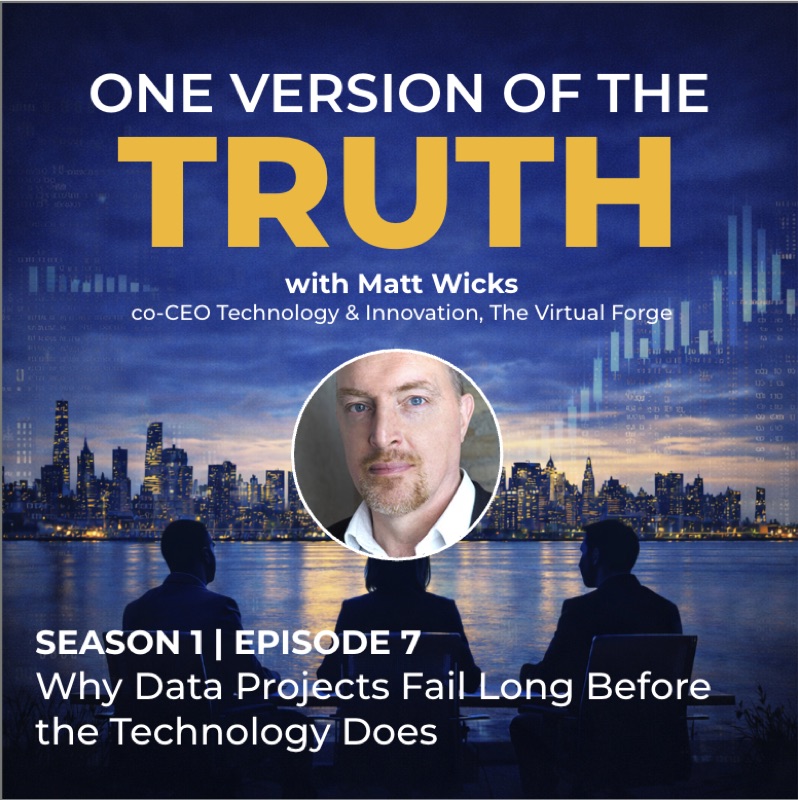
In this episode, Taylor Culver talks with Matt Wicks, co-CEO of The Virtual Forge, about why so many data and AI projects stall well before the technology itself becomes the problem. Wicks traces how AI has shifted from a technologist's black box to a business-driven tool, argues that AI's biggest weaknesses trace back to data quality rather than the models themselves, and points to underrated use cases, like AI-powered medical triage in remote parts of Africa, that get far less attention than hyped-up reasoning claims.
The conversation turns to the human side of data leadership: how office politics, executive turnover, and misaligned incentives shape outcomes as much as strategy does. Wicks's sharpest insight is blunt: roughly 85 percent of failed initiatives he's seen trace back to over-promising or poor scoping at the outset. Leaders who stay transparent about tradeoffs and manage expectations early keep their sponsors' trust. Those who don't rarely recover it.
“I would say 85 percent of the reasons I've seen that happen is because things have been over-promised, or what they're trying to achieve hasn't been properly scoped at the beginning, or it's been misunderstood.”
“There is a little bit of, wow, it's magic, it does all of this stuff. And that blinds you sometimes to the fact that it isn't magic, that there is a process and there's crunching of numbers that happens under the hood.”
Taylor Culver: Today we're here with Matt Wicks, co-CEO of the Virtual Forge, a global consulting organization that spans multiple countries and continents, employs hundreds of people, and solves some of the most complex data and AI challenges that you see around large enterprises today. Matt, pleasure to have you here.
Matt Wicks: Great to, yeah, it's fantastic to be here, Taylor. Thank you. Looking forward to it.
Taylor Culver: Yeah. Could before we get started, could you tell me a little bit about yourself and kinda how you got to where you are?
Matt Wicks: Yeah, sure, sure. So I've kind of gone through a slightly unconventional path, if there is such a thing as a conventional path. I actually studied theatre originally, and when I realised that I was not going to be able to make any money out of that, I kind of diversified and I spent quite a lot of time living in Portugal. And then at that point, I set up, I started working as a technical evangelist for Adobe for a while. And then I met my current business partner, Garrett Doyle, who's the other CEO. who handles the commercial arm of the business. And together we've run the Virtual Forge for 17 years now. We're based in the UK, we have development offices in Portugal, and we have a data arm in the US as well, doing lots of interesting things. And over time, we've incubated various other companies. So kind of quite a broad spread of small, medium, large customers as well. But it's been a strange journey for sure.
Taylor Culver: Well, tell me this. I you've you've been in the business for for almost two decades. this business changes a lot fast and a lot can happen in ten years. I in the past ten years the changes have been radical to say the least. But what do you think we're gonna be laughing about in ten years that seems very important today?
Matt Wicks: So I think. It's an interesting question. I mean, I think I think you're right in terms of the changes the changes are massive and I kind of you know I can remember getting my very first computer and all of that that sort of slightly cliched stuff and I think if you try to look forward and project It's really hard harder now than it's ever been before because the pace of change is so extraordinary but I think apart from kind of fashion and and and things like that, which of course will laugh about I think some of the some of the assumptions that we're making about about how our systems work. So, you know, we, a long time, we've kind of made the assumption that everything has to be an app or everything has to be a webpage or something like that. And already you start to see that kind of fading away now into things like Claude code or, you know, various other tools where you're now moving to an interface where you're just talking to things or everything is all done through one interface. So I think we'll be laughing. about how quaint all of those apps were and how quaint all of those those websites were and and how I suspect we'll be looking at it going wow imagine five years ago if we or 10 years ago if we thought this was possible just like we do now if we think back to what we thought 10 years ago and so on as well
Taylor Culver: be we'll we'll be looking at the the the modern SaaS applications today no different than we probably look at Napster or or Netscape. Which were transformative at the time.
Matt Wicks: Yeah, NAFTA Yeah, exactly. you look at it and you think, know, those are... And I don't think it's just about the... know, it's a very... SaaS is hugely crowded kind of environment, but I think it's about the way in which we think about things and we work with things. It's kind of like the same as when Steve Jobs bought out the iPhone and suddenly everybody, their conception of what a phone was changed. I think our conception of what software is, is changing as well in that way, for sure.
Taylor Culver: The user experience is radically different. You you know what's interesting is when we first met, we were talking about AI. Before AI was really AI. You know, what what's different about data and AI in 2026 than 2016?
Matt Wicks: Yeah. So I think a lot of the... underpinnings are the same, but I think the fact that it's so accessible to so many people. And I think, you know, I can remember 10, 12 years ago doing events where I'd stand up and I kind of show doing some using machine learning to do some predictive text and say, you know, it's amazing using this. can actually get, if you run it for 54 hours, you can get a prediction of what the football result is going to be or something like that. And now it's still the same thing, but it's, you know, 54 seconds or less than that to be able to get to those same things. So think there's that the barrier to entry is way, way, way lower than it was then as well. Obviously the hardware is so much more capable of being able to deliver results. But I think also as business people, our kind of... understanding of what's possible, even though it's all hyped up and everything, you know, our understanding of what's possible is so much greater. And that's driving a lot of those things. Whereas previously, 12, 14 years ago, it tended to be technologists who saying, hey, this is great. You if you give me a hundred thousand pound budget, I can, I can predict something. Whereas now it's actually driven by the business a lot of the time, which is, which is great, I think.
Taylor Culver: Yeah, it's the foundational transformation, which I think is so cool, is that putting technology in the hands of the business is really what drives innovation. And and and I think AI moves that so much further down down the path. Well t well tell me this. It so a lot of people are new to AI because of that, because in the past it was like, it's a data scientist who creates some algorithm that predicts the future. it probably seems more of a black box.
Matt Wicks: Yeah.
Taylor Culver: you know, w what kind of learnings have business people missed out on the past fifteen years when it comes to AI that they they they may have like skip steps w without even realizing it. What what are they missing out on? What are what are perspectives that they could benefit as as they kind of put their toe in the water?
Matt Wicks: Sure. Yeah. So, you know, one of the things that I think is, and this astonishes me to be perfectly honest nowadays, is the speed at which things are being built and deployed. In some cases, you see things going into large enterprises even, as well as SMEs and so on, that kind of haven't gone through the processes that you would have had for previous things. I mean, and I don't just mean technical processes and security governance and all of that. mean just business processes actually understanding what's the return you're going to get on it. What are the realistic expectations of what you can do with it? How can you build something that is capable of changing quickly? Because whatever decisions you're making today, you've kind of almost got to build change into those decisions in a way that you didn't have to make previously. I think not understanding where it all came from means that people are making sometimes quite blind assumptions about how tools are working, know, what kind of, how rigorous the analysis of those tools has been when they get put into places and so on. So I think that's different. I think also there is a little bit of, and I don't know if this is just me being an old, old whatever, but I think... There is a little bit of, wow, it's magic. It does all of this stuff. And that blinds you sometimes to the fact that it isn't magic, that there is a process and there's crunching of numbers and stuff that happens under the hood. So when there are problems, when there's hallucinations or it misses out information, or it makes an assumption that you think is wrong, it's not because, you know, somebody's kind of, it's gone off the rails or gone mad or something. There's a technical reason why that's happened. And I think if you don't have the grounding in that, sometimes you can just end up misunderstanding how AI works as well.
Taylor Culver: I I I hear that all the time, which is AI is not magic, it's math. And and and for a lot of people it's like, Well, I put in this and I get that. Wow. Like it it it and I I mean it's a reflection of the value for sure. but at the end of the day it's it's bits and bites, right? It's
Matt Wicks: Yep. Yes. Yes. Yeah, it's exactly that. Yeah. And it is. Wow. mean, I still kind of go, my God, you know, but but at the same time, it is essentially kind of predicting based on human knowledge. Effectively, it's and I I think that in itself.
Taylor Culver: Yeah.
Matt Wicks: as we all know, well as, you know, obviously, if you're involved in looking at the data that makes up human knowledge in a lot of places, you know, it has some challenges in terms of being able to generate the correct response as well in those circumstances.
Taylor Culver: Yeah, well the the problems with AI are the problems with data and and a lot of data executives would say, Yeah, yes, thank you, thank you. It's it and it's nice to hear a CEO say that because a lot of times when when people say, the AI doesn't work because of the data, you get eye rolls and it's like you gotta understand that that it's only as good as what's going into it in a lot of ways. And now it can extract context much easier. You don't need to model the data probably as ri richly and it can work with
Matt Wicks: Yeah.
Taylor Culver: Unstructured data in ways that have been unforeseen, right? Imagine what it's done to search alone, right? And
Matt Wicks: And I think also, again, like that's an evolving point. you know, the AI models have a context window, which is the amount of information you give to them to explain a problem. And that's expanded massively in the last 18 months from sort of 400 words to 3 million words.
Taylor Culver: Yeah, four months. Yeah.
Matt Wicks: you know, is three million words enough or is it too much? And suddenly if you're giving it all of this content, it's like if somebody sits down and feeds you a meeting for 24 hours and then says, what's the answer to this question? You're kind of going, you know, maybe it could be this or maybe, and sometimes you get those really verbose answers from the AI and it's because, because it's kind of, it's working like the, like the human brain in that way, I think.
Taylor Culver: Yeah. I you you were just describing a meeting you had the other day and it kind of reminds me of that is all this information. It's like, so what's the answer? And it's like, good question. Yeah, exactly. it well tell me this, is that th and this is kind of two questions is where do you think AI isn't very good despite all the hype? And where do you think it's not getting the attention it deserves?
Matt Wicks: Yeah, yeah, that's right. I can't remember. What was your name? So to take the second one first, think, so, you know, working technology company, there's loads and loads of examples of us using it for building software and things like that. And I think that's where it is brilliant. It does a really good job and it does almost live up to the hype. But if you then take that to, One of the I saw a really, really interesting article about medical triage being used in Africa recently. And so people are actually able to go out in the field where there are, you know, there's there's no there's no doctors or nurses around for a very for, you know, a massive, a massive error. They're covering a massive area and they're able to do kind of first line medical triage using AI in a way that all the local people are able to do first line medical triage in a way that they they would never have been able to before. And then it's connected to all of the databases that give you information about, you know, symptoms and causes. and actions and priorities. So they're able then to decide, you this person who doesn't look so ill actually is a priority and so on. Obviously there's a massive area just in terms of deployment for that to cover, but the power that it has to revolutionize lives in those sorts of environments, you know, is astonishing and is really, really powerful. And I don't think that gets anything like enough bandwidth and time as other things. where it's overrated. So I think sometimes some of the reasoning claims are slightly overrated because at the moment anyway and obviously with Fable 5 and so on that was kind of going up another level although not right now. Yes, let's talk about that one. But you know essentially it can appear to do really good reasoning.
Taylor Culver: What once not illegal.
Matt Wicks: they can appear to do really good reasoning, but they are still doing it based upon pattern matching and so on of previous pieces of information. So so I think sometimes you do get you do get And we've all done it. I've definitely done it. I've kind of put something in and go, Wow, that's amazing. And then you kind of going back through it with with a with client or a colleague and you're going, Yeah, actually, it's not really reasoning stuff out. It hasn't really got that depth that I would have thought of edge cases, for example, or for for nuance sometimes. And I think also, it's a bit like I always kind of think about it. We used to have somebody who worked for us who would always say, yes, but it should be this way. It should be this way. It should be this way. And it doesn't necessarily always understand the various nuances that are pressured. So it reminds me a little bit like that. So I think, you know, it's still absolutely incredible. But I don't think it's quite as good as you believe when you first see a reasoned argument or something coming out.
Taylor Culver: Well and I think you point on something particularly interesting is is it should be, it should be, it should be, when there are truths that aren't rational in today's world, right? And and you'll be you'll be in an organization where an organization should have great data quality, but
Matt Wicks: True, that's very interesting.
Taylor Culver: The truth is, is the cost of having great data quality probably exceeds the benefit. on once you get into the brass tacks of how that works. and it and it's interesting how AI kind of mirrors that, which is based on the context, it should be this. However, sometimes people just don't get along. And politics shape organizations more than strategy. And I
Matt Wicks: Yeah. Yeah.
Taylor Culver: I'm I'm curious in your own experience because you've worked on the customer side and you run a company and it's a global company, so people are different and clients can be different. You know, how much does politics shape outcomes versus solutions?
Matt Wicks: I would, that's a really, really interesting question. I mean, and I don't think it's even just different countries. think, you know, in the same office, it's the same thing. You know, everybody has different things that drive them. Everybody has different agendas. I think also when you're part of any organization for a long time, you begin to build up views of yourself and that organization. And, you know, those might be good views or they might be bad views or they might be views of like, well, we're never going to do this. Or they might, you know, all of those things happen. And I think
Taylor Culver: Yeah.
Matt Wicks: we see that in all organizations that we work with. And it doesn't necessarily mean that people are competing with each other, although sometimes they are. But essentially it means that their primary goal is very often not to deliver whatever it is you're trying to deliver. They have whatever else is going on in the mix as well. And I think that is... that's very difficult for AI to understand or it's very difficult for people to understand because, you know, we have, we all have a certain level of empathy, but there are people who we all find it really difficult to be empathic with. And I think that in itself is almost impossible in this current state to transfer to AI. So, you know, it is very much like having that person in the room who, who is kind of completely emotionally separated from everything else that's happening and doesn't have that. they're just like, exactly as you say that. So and I think politics does drive a lot of decision-making And I think that's just I think that's impossible I used to when I started out I used to kind of think Yeah If we could just find the client or just have the the piece of work where we could just get on with the work and be done But I just think that's impossible. I don't I don't think human nature and myself included It's not it's not like I'm suddenly you know But but I think that's and that's quite interesting where AI is like AI is almost this window on what if you did? have all this stuff you could do this but it's it's just not the reality on the ground.
Taylor Culver: It's it's interesting in in in the software language, there's a word I like called truthy. and and I it's interesting how we pursue truthiness in organizations to drive value and impact change. Tell tell me this, and and something I've always enjoyed about working with you is that you believe that every product starts with a great story, and you're a phenomenal storyteller. Why do you lead with that principle?
Matt Wicks: Thank you. Because ultimately, whether you're looking at metrics or whether you're looking at raw data or whether you're looking at a product, the fundamental thing is it's all about communication and how you communicate something. I mean, that's why Apple has been so successful, because what they do and what what their tools do communicates really easily Google, like what does that search box do, you don't need to understand all of the stuff behind it there. And so I think when you're when you're developing a product, you need to make sure first of all, that you understand the story behind what people want to do. But also to make sure that you can kind of take people on that journey with you. It's like, you know, if you are this person in this scenario, you know, what is it that you're gonna gonna get from it? What are you what are you what is the experience going to be like that you have when this product arrives? And how could we make that experience better for you? And that doesn't just mean the user experience, although that's a really important part of it. But but it's part of the whole the whole the whole journey that they that people go on and telling them that story at the beginning is part of getting their buy-in to it but it's also part of making sure that you you're setting out on the journey with them in the same boat if you like down the river and you know everybody knows that we've all got to pull the sail up together to make it work and the destination is this little island over here and we're just all going the right way and I think sometimes that just helps frame things as well in that way.
Taylor Culver: I love it. You know, I think something that's funny is I think the human brain is attracted to complexity. and we avoid simplicity because oftentimes simplicity is very, very hard. Why do some great products that are so simple in nature succeed while some of the most sophisticated technologies fail within organizations?
Matt Wicks: of exactly that because because I think so So we have a product that we've developed called My Content Scout, is an AI search tool. And I was very determined from the beginning of that that it would be really, simple to use and really, simple. And I swear to God, first 40 meetings we had with various people, I was saying, no, take it out. No, take it out. No, take it out. It's got to be. And then I found myself about six months ago sitting in a meeting and kind of looking at the features for that particular sprint. And I was like, I've just fallen into the trap. of adding in complexity and building in additional bloat into it. And I think the reason why that happened a little bit was because obviously taking a product to market, you're keen to get. people purchasing it. And often you come up against that thing of like, this is fantastic. We love it. If it just did this, we definitely go for it. So you kind of build in that little bit of extra and then somebody in the team, you know, and building a product with a team is important that they all have a voice and that you listen to their ideas. Somebody will come up and they say, yeah, we could do this. And other people in the team say, yeah, this would be good. This would be good. And gradually kind of features get added by, the way. And that doesn't mean they're bad features, but it does mean that you're constantly adding, adding things on. And I think in organizations, it's the same thing. It's in big organizations especially, you have something that starts out for one purpose. Somebody comes along and says, actually, know, what? could use this for this other purpose if we just added this extra bit onto it. Or you have another situation which happens a lot in large organizations that people move around quite a lot. So you have, you know, somebody is a stakeholder for two years, they'll deliver their project, they'll move on to the next thing, somebody else will come in, they have to make their mark in the two years. And this will be left to kind of go fallow. And then there'll be cost cutting. So somebody comes in and says, Okay, well, we've got this, let's use this, this is good enough, but we can put this on the top of it. And those just naturally kind of grow organically and I think and I think the reason why simplicity going back to your question the reason why simplicity works is you know people essentially
Taylor Culver: Yeah.
Matt Wicks: Unless you're a technologist, you probably don't love the system or love the data or love the process of building it. What you probably love is being able to get the answer quickly so you can get to your next promotion or get home or whatever. And that's it. Anything that delivers that. And that's why I think AI has been really successful. It's partly because it is magic, but it's also partly because you don't need to know anything to use it. You just speak to it or type and it's there.
Taylor Culver: It it it it can turn a amateur into an expert very quickly. and I I which is for better or worse. But the problem it it's like sure it can redline a complicated government contract and give you a rebuttal, now sit in the room with a lawyer and try to have a meaningful conversation with them. So it it'll it's it's why people give vibe coders so much trouble. It's like, you know, sure you can get something
Matt Wicks: For good luck, yeah.
Taylor Culver: built on your computer, but you you you have a to-do app with 500 tables and a database and and probably ninety percent more code than you need. By the way, good luck deploying it to the cloud. You know, and and I I I think it I think it's it's it's one of the challenges is it it raises people's beyond their level of competency to incredibly complex complex skills that take decades to learn. It's like
Matt Wicks: Yeah.
Taylor Culver: Now you're a security expert, but like until you've been through four breaches, you don't know what it's like to be an expert and and and you the apprenticeship without the experience is i it's gonna be interesting.
Matt Wicks: Yeah, that's, that's really interesting. And I think that kind of that goes back to what I said at the beginning, where I look around, I see people doing these things, you know, in enterprises, they're letting people go loose to build all of these, all these things. And you know, what they're building is amazing. But at the same time, if somebody had come in a few years ago and said, Oh, our interns just gonna just gonna do a security audit of all of our reports, don't worry about it, they'll just build it. it would never have happened. So it is quite interesting.
Taylor Culver: So tell me this, is is you have a unique perspective because you're on the leadership side with clients and you're on the leadership side with your own organization. How do you run data and technology initiatives internally versus externally with your customers? Do you have the same standards? Or do you find that large organizations demand different solutions than smaller organizations? But where does your philosophy differ between those two types of work?
Matt Wicks: So I think... I think... Everybody starts a project, I think, internally or externally, large or small, I think everybody starts a project with the aim of getting whatever the data is or whatever the metrics are they want to have reported on. They want them to be accurate. They want them to be timely. They want them to be comprehensive and secure, all of those things. And I think that's the same. And I think the truth that is the same across the board is there are compromises that are made. And if we're doing something internal, We've just been rebuilding all of our internal sales pipeline reporting and you know the compromise we always have to make in those processes is You know, we obviously take the client work first and we do that first So something gets pushed back or we have a free resource here who will then slot in and somebody else will be Who has done it previously will be on a paid work. So I think there are compromises there in larger organizations. The compromise is usually one of cost Sometimes it's one of access You know, we're working with a huge organization at the moment and our stakeholder wants access to all of this data. They're happy to pay for it, but unfortunately they can't have access because of internal processes and policies and so on. So I think somewhere, and then gradually the scope gets whittled down and so on. I think trying to stay true to... what is the thing that they are trying to produce at the end, you know, whether that's a report or whether it's an interactive AI bot querying the data or whether it's just a presentation or video about the kind of status, whatever the end product is, I think the the You have to be willing and capable, which are two different things of understanding where the compromises are that you can make in that journey. does every single data point have to be absolutely clean and perfect? Is that really what's going to drive it? Do you have to understand the tolerances in there? Do you want to make sure that you have proper stewardship over the data? Do you want to make sure that you're delivering it in an absolutely nanosecond up to date?
Taylor Culver: Okay.
Matt Wicks: or are you willing to trade one for the other? What about resiliency, etc.? What about auditability and all of those things as well? And I think, you know, wherever the project is... it's always got to be focused like the story thing. It's like you're taking people to this journey, whether you go down the rapids or whether you go down the light little side canal or whether you stop overnight and camp. All of those things are part of the journey in there as well. And we all know that the Nirvana is, you know, timely, secure, up to date, perfect, no data quality issues. But the reality on all of those, I think, is the reality.
Taylor Culver: So so tell me tell me this. You you have a unique leadership situation in your organization, which I see more and more, which is co-CEOs, where you lead the the delivery and technology side, and your partner, Garrett, he runs the commercial side. What's interesting about that is in your engagements, he may end up working with the customer, and you may be working with the user.
Matt Wicks: Yes.
Taylor Culver: oftentimes they're both leaders within the company, and you end up in between the executive sponsor and the champion for the initiative. What happens when they get disconnected? How do you close that gap? And even if both parts parties are right, sometimes you end up in, like I was saying earlier, truthy situation. How do you navigate that divide?
Matt Wicks: Yeah. Yeah, yeah, it's really tricky and it depends on each different client as well. mean, you know, I think also... The way that we've divided our company, we both understand our roles and where those kind of lines are really well. And I think my case is always championing the user and the product that's being built, essentially. But at the same time, I also have, and have evolved over time, a much closer kind of commercial awareness of the consequences of things and the political awareness of keeping the customer happy. as well and I think you know I certainly couldn't and wouldn't want to manage both sides of that equation. you know, I think I speak fairly for Garrett, so he wouldn't want to manage both sides of those equations either. So I think it's really good that we have the ability to have those two different sides to us. You know, we're very different people, and I think that also helps as well. But I think above and beyond anything else, in both cases, it is all about taking the stakeholders, all the stakeholders, along with you on the journey and just kind of making sure at the beginning, everyone knows where they're going, everyone understands and aligns on what are the expectations of each other party, even if they're internal to an organization. Because one of the things that we have, I think, is a great advantage. There are pros and cons of doing things internally in an organization, but bringing in external specialists into an organization gives them the ability to kind of be the neutral arbiter. And some of the history that sometimes is there in the middle gets lost because you have these neutral arbiters in there as well. And also having somebody who is on the customer side, somebody who is on the user side, you know, gets a sense of balance and nobody feels like they're underrepresented or unrepresented in general. Yeah.
Taylor Culver: But the the The politics are inevitable, right? And and I I think there's a fantasy amongst executives as like, if I go to the consulting route, that goes away. And it's like, no, you're you're held hostage to it. And in addition to that, you often become the collateral in the political exchange and and it impacts a a lot more. So it it can at times be quite worse, in in in a lot of ways. So so something that I I kind of wrestle with and it's hard for me personally, is I see a lot of customers struggle. Because I'm privy to their growth journey. And growth is great until you have to grow. and because it's quite painful. I mean, no one does it in stride. So, how do you help your customers navigate those challenges without setting them up for political ramifications and and losing their sponsors?
Matt Wicks: Yeah, yeah, yeah. So that's a really interesting question. So I think because we've been through our own growth process as well, we've kind of walked the walk a little bit, which I think helps. But also because we've been doing it so long, we've kind of seen lots and lots of different circumstances as well. I think, you know, I don't know that we truly help people avoid political ramifications. I think the best that we can say we do is... we deliver the product, whatever that is that they want to, and we try in the process to make sure that they understand. why we're doing the things we do and what the consequences of each choice that they're making is in there. Because growing an organization of any size, once you go beyond two, three, four people, suddenly going up to 20 and then going up to 60, each time you do that, essentially what you're making is a bunch of choices about the consequences of your actions. So I'm going to employ 20 people, suddenly I'm responsible for all of those people. And each one of those people is not going to get on with each other. So therefore you suddenly have to have the kind of management in order to organize that and then suddenly the systems that you built in place Which worked fine for five of you is suddenly not good for 20 not good for 60 and then you've got to have a project that manages to move all of that stuff across and then Suddenly you've got to have that you're dealing with bit, you know bigger bigger situations You've got to have more governance over it because people might want to track you could become certified There's a whole bunch of things that happen sequentially as part of that and some of those are purely systemic And some of those are purely process. But a lot of them are just interpersonal. And a lot of them are just about listening to people and making sure you've got the right people in the right positions. And that also goes for working with clients. Like, you know, I can have And I have lots and lots of really talented people who work for me. But there are some people I cannot put into particular clients just because personality types would not work. And you have to be able to make those judgments as well. And likewise, if you're kind of working with a client to set up success, you've got to be at least a little bit aware of the... the emotions in the room and how things will work to stop a project versus the actual technical delivery part of it as well, I think.
Taylor Culver: It and I I think that's why it requires really, really high EQ to lead data and AI initiatives. Weird as that sounds. And and and and it's why I kind of started this podcast is because I think that there's ample material out there on how to do governance, how to do architecture. And I think there are ample technology solutions out there that are wonderful and and great. But
Matt Wicks: Yeah, yeah, yeah. Yeah, that's it. Yeah, it's true. Yeah.
Taylor Culver: Traction is lost when the internal champion loses trust. And I'm curious, what does that usually look like? And what are the symptoms within an organization that the data leader or whoever's sponsoring the technology change is losing trust with their executive sponsor?
Matt Wicks: Yeah. I think it depends on the executive sponsor. Sometimes I think it can be as simple as the executive sponsor just not turning up to the meetings and kind of silently voting with their feet effectively. I think it can also be, you detect the change in the tone of voice in the room when people are talking to them. I think often at the beginning of a project when a data leader is in a good place, they're given a lot free of remit. If things start to go wrong, start to be questioned the whole time. And you know, we've been in situations where we've been asked to effectively validate things that the data leader has been saying in the room. And that's a sure sign that things are going and a very uncomfortable sure sign that things are going wrong as well. You know, but I do think the way in which different organizations and some organizations just handle it really publicly. And some organizations you kind of find that it just gets swept under the carpet and the project gets either stopped or delayed.
Taylor Culver: Yeah, that's tough.
Matt Wicks: or somebody new is bought on the project just to keep an eye on it or something like that. And I think that then becomes difficult because you have disenfranchised people, you have people who are trying to kind of move forward and so on. And ultimately the one thing nobody's focused on is actually solving the data problem that you're trying to solve at that point.
Taylor Culver: And and and and this is normal, like this is normal in organizations large and small. you're you're you're you're on your heels, you're you're on the defense. have you seen any tactics in your experience when to overcome some of these challenges, or when these red flags start appearing, is the leader just doomed?
Matt Wicks: Yeah. Yeah. I think it's very difficult to roll it back, if I'm honest. I think the reasons for that happening are usually visible long before that happening. And I think if there is a tactic, the tactic is... helping them be transparent with what's happening on the project, making sure that at the beginning, they're not setting up unreasonable expectations. Because I would say 85 % of the reasons I've seen that is because things have been over promised or what what they're what they're trying to achieve has been not properly scoped at the beginning or misunderstood. therefore, and they might get lucky and it might, but you know, and I think one of the things that we always pride ourselves on really trying to do is to make sure that whatever we're proposing is something that's achievable and manageable, even if it's not the gold standard of what they ultimately want. You know, I think you have to try and help them see that this is not achievable within their budget or their organisation and so on. once it's gone beyond that and people and you've maybe you've called out a few times listen this is a problem this is a problem and if they sweep that under the carpet and don't highlight that or don't take steps to remedy it I think it's really difficult to get back from that stage because yeah.
Taylor Culver: I I I think those are two clear pearls of wisdom, which is managing expectations before you even get started. And then two, bringing transparency to the operating model to deliver that value. Because if that's not there, you lose people on the journey. And and I I think that's a a huge area of improvement for people. And I I I see this often very similarly. Tell tell me this. You you you started in theater and kind of reading between the lines, maybe you earlier in your career were very principled on right and wrong as it comes to technology. You know, how has your leadership style changed over the years as technology has changed and as you've gotten towards the the truthiness of how people work versus the constraints of system thinking?
Matt Wicks: So it's interesting because I think there are two sides to leadership. And I think there's the publicly facing leadership. which is the co-sio of a company going into the clients very visibly there. And I don't think my style has changed on that piece. Internally, I think one of the things that I've always believed very strongly is that you need to make sure that you have very solid successors in place in order to facilitate the actual work happening, but also to eventually take over from you and that. And I think while I've always believed that, it's probably taken 10 years to get those people in the right places with the right skills, with the right confidence levels to be able to really take that. you know, I can focus on being the client facing the piece and not have to worry too much about the internal processes of the company. And I think too often leaders either are nervous about having solid people behind them, or leave it too late, or don't give enough time for that process to happen. Because it's not just a question of finding the right people. It's also a question of making sure you are aligned in mindset as well. And I guess if there's one change in my if there's one change in my day-to-day stuff, it's more about letting them do more of it and me kind of just kind of be bit lazier. Because I think the truth is... You're not helping yourself if you do everything and you're not actually helping the client if you do everything. You're not also helping the company if you do everything. You know, so having those people who can take the weight of stuff, I think is really, important. But it takes a bit. And it takes a confidence to do that that you don't have when you're starting out because you just think, oh my God, these people are better than me. What am I going to do now?
Taylor Culver: Yeah that's Well tell me this and and kind of putting a bow on this. you've been doing this for a while. For any kind of aspiring entrepreneur who wants to be a technical c CEO and and there's lots of what wisdom would you give them so they can skip a few steps that you didn't have to learn the hard way?
Matt Wicks: I actually think if you don't learn the hard way, you don't learn. So to a certain extent, they have to do it. I think, you know, probably just trust yourself and don't be afraid to take kind of big decisions because at the end of the day, If you don't take big decisions, what's the point of being a CEO really? And I think if they're wrong, as long as you've got the right people around you, you can usually work it out and get through. people do look to you for leadership and decision making and those things. And if you don't make those decisions and you don't drive forward, then you're probably fooling yourself as well as them. trust the around you would be my number one choice.
Taylor Culver: I mean trust is the currency of business, it's not money. And and and I'm a hundred percent with you. Well, Matt, this was fantastic fantastic. It's always a pleasure to if if people want to get in touch with you or the virtual forge, what's the best way to do that?
Matt Wicks: Yeah. Likewise, really enjoyed it, Taylor. Thank you. Well, we're on X probably the best way is to add the Virtual Forge and or they can drop me a direct email. I'm always happy to respond, matt.wicks, matt.wicks, at thevirtualforge.com.
Taylor Culver: Pleasure. Well thanks for joining me today and have a wonderful week.
Matt Wicks: Fantastic YouTube. Thanks, Taylor.
The only data leader in the room?
Have conversations like this with peers who live it. Free and private, for data leaders in the seat only.
One Version of the Truth