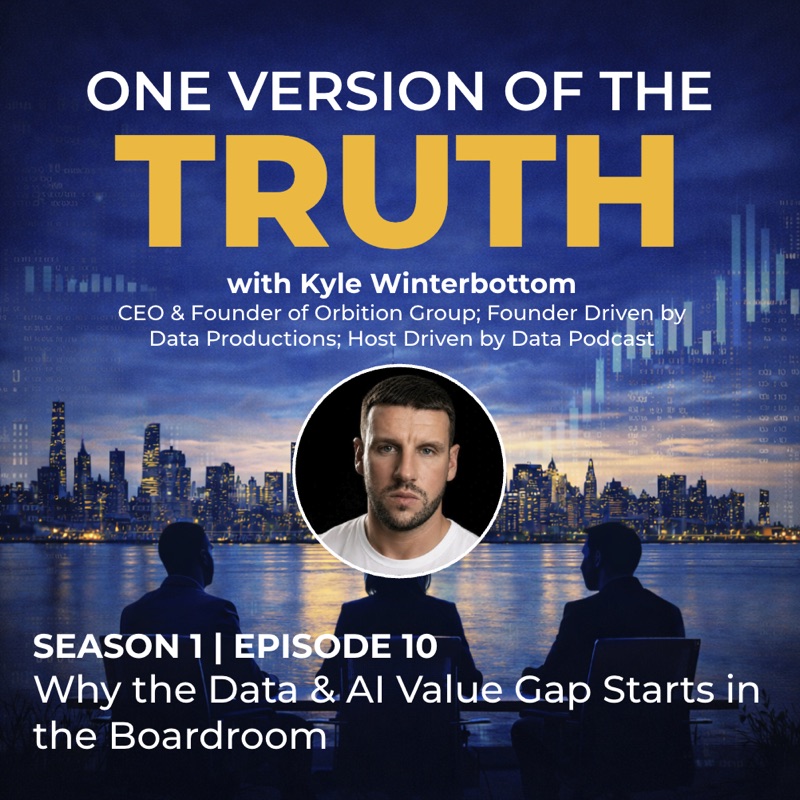
Kyle Winterbottom, CEO and founder of Orbition Group, joins Taylor Culver to unpack why so many data leaders get hired to fail. Winterbottom argues most CDO mandates are still built around technical capability, platforms, governance, data quality, rather than a clear commercial outcome, so the person filling the seat can deliver everything asked and still generate zero business impact. He and Culver trace this to an accountability gap: business units make the decisions data is supposed to inform, but nobody owns the benefit, so the data function absorbs the blame when nothing changes.
The conversation lands on a hard reframe: given the choice between a technically brilliant data leader and a commercially sharp operator who knows just enough about data, Winterbottom says he picks the commercial hire every time. For data professionals, the lesson is blunt: data and AI are skills, not careers, and the leaders who thrive next will be the ones who align technical work to what the board actually measures.
“Data is still seen as a nice to have. And when you don't see the benefit from it, nice to haves don't last.”
“We've built the best data platforms and architectures, we've built the best governance frameworks, and yet still nothing has changed.”
Taylor Culver: So today we're here with Kyle Winterbottom. He's one of the probably hotter influencers on LinkedIn right now, speaking the business value and the office of data and where data leaders can drive business value within their organization. You know, Kyle, for for th those of you the people who don't know you, could you introduce yourself and tell us a little bit about what or orbit and orbition does? Sorry.
Kyle Winterbottom: Yeah, First of all, Taylor, thank you for having me your show. Secondly, I don't think anybody's ever described me as an influencer before, so there's a first time for everything. yeah, my name's Kyle Winterbottom. I'm the CEO and founder of Orbition Group. Really simple in terms of what we do. Effectively, we're an executive search firm that operates exclusively right slap bang in the middle of the data analytics and AI ecosystem. So data analytics, AI leadership search mandates.
Taylor Culver: Ha ha ha.
Kyle Winterbottom: is primarily what we deliver as a business. Primarily there are two layers to that. So we do a lot of work with boards to help them to kind of shape and identify the CDO mandate and who they need to hire for that role. And then obviously the layer beneath that, is usually the senior leadership team of the CDO. that is, know, heads, directors, VPs of the different kind of data vertical disciplines. So it could be data governance, data architecture, data engineering. yada yada yada across that value stream and then there are a couple of auxiliary services that wrap around that kind of talent and search ecosystem so a lot of kind of market and talent intelligence and then we do quite a lot in the advisory space which is more related to kind of skills if you want to call it that so probably more akin to what people would recognise as HR consulting which is more effectively in the realms of kind of competency frameworks, skill matrices, career paths, learning pathways, skills assessment assessments and all of that type of stuff and usually helping businesses to build their own infrastructure in that space to deliver those things.
Taylor Culver: Cool. Well, first and foremost, you you if you know some people may know us and you and I often go back and forth on on LinkedIn and and and both of us have pretty strong opinions on on data and data leadership and where it's headed. but before we jump into any of that. You know, tell me a little bit about your story. I I how did you get in it? Why data? Like why what did you wake up one morning and say, Hey, I'm gonna start one of the most listened to podcasts around data leadership? Was that like a aspiration from young childhood or
Kyle Winterbottom: Well there's two things that are for sure in life I'm pretty certain of Taylor and one is nobody kind of wakes up wanting to work in executive search right and I think the same is true for working in data so I've kind of yeah I've double barrelled that quite well but I guess my background many people probably don't know this I got a degree at University in Journalism.
Taylor Culver: Yeah.
Kyle Winterbottom: very quickly found out that without a lot of work experience you're not going to get employed. It's funny I was actually only having this conversation recently but you know when I came out of university was right in the midst of the kind of the financial crisis and at the time I didn't really put two and two together it's only now I look back at the timing and think well no wonder I couldn't get hired. So I then went over to the States on a scholarship I got an MBA I played for two years in exchange for an MBA and then worked in sales for a little bit and then as most people do in the kind of executive search industry fell into it. I think I was very fortunate that at that time, were going back quite a long time now, so kind of 15, 16 years ago and obviously when you join a business they put you into a certain industry and a vertical right and at the time I was probably very fortunate to be put in what was then labelled as business intelligence right and it's kind of just I've practically spent my whole career in this space. I've been fortunate to travel, so lived in the Middle East, in Dubai. Obviously I've played soccer in the US and then came back to the UK and then I went back out to the US, lived in New York for a couple of years. And obviously we've got a fairly big presence out in the States, so our business is headquartered in the UK. But we're primarily UK and US, probably 60-40 split in terms of the work that we we deliver across those two countries really.
Taylor Culver: It's cool. I I didn't you were you in MLS or were you
Kyle Winterbottom: No, no, no, just on a soccer scholarship. So yeah, it was a small D2 school. Really, the driver for me was to go out and get a degree that could actually get me a job after trying once and evidently failing. So yeah, no, was a... But it was good, good experience.
Taylor Culver: So it's almost like you built the foundation in executive recruiting and with a specialty in business intelligence, and then your passion for journalism and meeting people kind of blossom from that. Is that a
Kyle Winterbottom: Yeah, well I think obviously the way that we... I say we as a collective for our vision, obviously my approach and style is probably quite different to most executive search firms in terms of how they operate. We are 100 % very much more marketing brand content led and obviously the wraparound of that then has become this kind of huge collective community where we do a ton of events and there's an executive mentorship program that we do. You can probably see a magazine over my shoulder. So I think the journalism degree that I ever thought would become useful has probably become useful more day to day in terms of my rants on LinkedIn really.
Taylor Culver: It's good. I well what what I love is i is did you ever anticipate getting as far as you've gotten in social media when you were first starting this venture? Did you did you ever think you'd have tens of thousands of followers be cited and quoted by data executives around the world? Was is that just like like a whoa kind of?
Kyle Winterbottom: Yeah, it's wild to be honest. Definitely wasn't intentional. I get asked about this about the podcast all the time. The podcast, for me, was really a tool for us to learn really what's going on. Because obviously, as most people know, there's only a small pool of people that are very active in sharing their thoughts and opinions on platforms like LinkedIn. So the podcast for me was how do you get the people that aren't into a medium by which they can share those thoughts.
Taylor Culver: Yeah.
Kyle Winterbottom: It's been a huge learning experience for me personally to understand what's going on inside different businesses and what the challenges and opportunities are of the industry and so on and so forth really. I think like anything with that stuff, the more you do and the more consistent you are with it, it just snowballs. The podcast wasn't designed to be listened to in 180 plus countries around the world for sure. The posts were never really designed to attract followers of any kind it was more just kind of here's what I'm seeing I hope this is of value and let's exchange thoughts you know and I guess yeah I guess that the more you do it the more confident you become at doing it the more you are not afraid of sharing what you see and what your you know what your opinions are I guess and that then also snowballs right because the more opinionated you are usually the more people engage with you to either agree or disagree so yeah I guess that's what the platforms like this
Taylor Culver: Mm-hmm.
Kyle Winterbottom: are built for.
Taylor Culver: Yeah, it's been fantastic watching. And and it's funny, I mean, you I I I feel inspired by some of the work that you're doing. It's actually what led me to start this podcast. And it's kind of fun because I started probably my first real podcast was with you in 2023, where you were interviewing me. And now I think it's fun because I get to turn the table a little bit. And when we first spoke, I was saying I I think something along the lines that
Kyle Winterbottom: you
Taylor Culver: So I so so I have a CEO mentor that I work with quite a bit, and I was talking to them and and they they always saw business value as a nice to have. Like it was never like the the tip of the spear. If if if anything, they wanted clarity. So we spent a lot of time talking about ROI, IRR, enterprise value. What's changed since we first spoke in 2023?
Kyle Winterbottom: Yeah, think it was an interesting conversation because I think if you fast forward to today, I think the views and opinions of most boardrooms are maybe a little bit more pointed now than they maybe were back then. I think a lot of businesses and CEOs, founders, et cetera, definitely invested into data as a capability. I think a of the perception around it at the time was let's bring these people in. to build a team that can develop the capability that we need to use data more effectively and yes, yes we want insights and yes yada yada yada. And I think as with anything, there's probably a bit of a shelf life to how long a business is willing to keep investing in those things without them being able to put kind of a pinpoint to some kind of tangible benefit or return. And I think we, over the last couple of years, we've seen the screw really be turned in the industry, you know, for a lot of businesses that just haven't unfortunately seen that. So yes, they might have clarity, you know, yes, they might have the capability to move data around their business and use data more effectively than they did. five years ago but that doesn't always translate to the fact that the right type of action is happening that you know improves the performance of their business or increases shareholder value as an example etc etc so yeah I think I think it's that bit that's probably got a little bit more pointed to the point now where businesses are kind of like well that's great we've done a lot of investment like that the time for talking is now done and you know the time for results is is now basically so yeah
Taylor Culver: We're we're we're seeing the same thing in AI too. I I I was I was at a conference at MIT earlier this year and and one of the guy who runs Peter Thiel's family office s you know, put out a controversial statement and he said basically, Hey guys, This is the year to prove that AI is valuable. And then other people were chiming in that AI is going to be a hundred, ten times bigger than the internet bottle bubble, given the amount of money that's going into it. So there's going to be a lot of losses. which is normal for big investment because there will be some big winners too. but one of the things that I kind of wonder about myself is Is data a sunk cost for organizations? Is is it just an acceptable expense or does there need to be ROI? Does the I I mean, I I I think in my work, one of the things that I always run into is the business never wants to be accountable for a benefit. So the data team absorbs the cost and no one will advocate for the benefit. So it looks like the data team is incompetent. But at the same time, they don't get the partnership from their stakeholders or executive leadership. I mean, where where's the the balance in all this?
Kyle Winterbottom: It's really tough and I find myself having this conversation on a daily basis. think... Data over the years has often been compared to marketing, right? You know, there's always this comparison of, well, know, marketing doesn't always prove ROI or marketing has a lot of investment and doesn't always generate a return. And I think the point that I've always tried to make is that that is by and large probably true. However, what marketing has tended to do over the years is kind of have one big win that pays for itself and then all of the failed projects. And I don't think necessarily that data has ever gone
Taylor Culver: That's right.
Kyle Winterbottom: to that level right you look at other functions HR finance even IT they're often considered to be a cost of doing business right rightly or wrongly data isn't that still I think data is still seen as a nice to have And then when you don't see the benefit from it, nice to haves unfortunately don't last, right? So your point about kind of advocating for the benefit, I mean, I think you're absolutely on the nose with that because it's the same thing we see, right? If you look at most CDO search mandates, again, even now today, they are still very much designed around to come and build the capability, build the foundations, all of those usual buzzwords that you hear. And then when you start to dig into, okay, well, what you're expecting from this person, you know, the kind of the people in the boardroom will start to regurgitate the job descriptions here. Well, we want them to build a platform. We want them to have a, build a governance framework. And I'm going, okay, so they will do that. They will do what you ask. They will deliver exactly what you ask for. And then what? Because at that point, still nothing is going to have changed, right? So, and to your point then, there's an accountability gap because obviously the people in the business either don't want to aren't being asked to be accountable for using data more effectively to improve the business performance of the units that they run and operate, right? So a lot of work and lot of activity, but no one owns the result or the potential benefit of kind of what the work you're supposed to deliver. And fundamentally for me, I think that is still arguably the biggest challenge in the industry, you know, and therefore I think what tends to happen is if you look at some of the CDOs that have delivered a lot of value and can pinpoint a tangible benefit that has, especially in commercial settings, has kind of generated bottom line impact, as an example. They've kind of taken it upon themselves. They've gone, right, okay, well, it's my job then, in this situation, to go and influence the people within the business to make decisions or change decisions or something in that remit so that Therefore the work that we're doing does become of value to the organization, does hold a benefit. But again, it takes a certain type of person with a certain type of experience and a certain type of skill set to not only be able to do it, but to be willing to do it in the first place, right? And I think that's the big thing. And for one reason or another, most don't want to, or probably just don't have the experience to fall back on of kind of changing it. me on platforms like LinkedIn talk so much about know kind of commerciality and kind of influencing skills and none of the hard data related skills because really at that level that if you want to you want to generate an ROI whether we agree with that sentiment or not that's the part of the job that you have to be really good at.
Taylor Culver: Yeah, yeah. It it was eye-opening for me because I I I was head of data or a data leader, you know, 10 years ago in my career. And I went out and I went to the marketplace and I bought the best tools, I hired the best consultants, I brought in really smart people and they brought all these ideas and frameworks and I went to go apply them and people just kind of laughed at me. And and I I think that there's all this like tall talk in the space that it's like, if you have a a data mesh or if you have a governance framework or if you have this tool, all your problems go away. And I'm not a data person or a technical person by trade. I just ended up in this role because I opened my big fat mouth and I said it can't be that hard. And and you know that's how life teaches you. and and and what I what I I kind of took from it is like none of this shit works. Like none of it works. So I just said, you know what? I'm just gonna start talking to people and be like, what do you want? You know, okay, I don't get it. Help me understand
Kyle Winterbottom: you
Taylor Culver: I I will yell and scream for you and and and that customer mindset is so hard to To shift people to and like you're an entrepreneur, so like you get it. Because if you're not customer focused, you're gonna end up broke. And and and it's the end, but you still stay employed if you're not customer focused as a data person. You can hide behind risk, you can hide behind, someone needs to administer this, you can hide behind tribal knowledge. But like, what kind of career is that? Like you're you're you're sitting there taking the glory of, hey, we're advocating for this new technology, but at the end of the day, you're sitting there hiding behind a data warehouse. House. It's like I always kind of joke around about like the data strategy. It's like it's almost like watching Wiley Coyote try to catch Bugs Bunny. It's like we're gonna put our data in a big box, right? And then we're gonna put something on top of it that pulls our data out. But the joke is is all of it's gonna be wrong and no one's gonna want to use that. But that's the data's problem. And I just like sit here and I I just like watch this play out in organization after organization. And then to your point about like this remit where where people come in.
Kyle Winterbottom: You
Taylor Culver: And they're like, hey, we need to build a new data strategy, or the last one failed. You know what that results in? A second data warehouse. And then all of a sudden you have parallel architectures causing eight figures, and everyone's like, Well, no one wants to use it. And then the data leaders sitting there being like, Well, data quality and semantic layer. And it's like, guys, someone needs to put clarity into this, someone needs to give direction. There needs to be better executive leadership on this. And then executive leaders aren't always that data savvy, like, or AI savvy for that matter. So, like, there's this presumption that executive leadership is making the decision, but they're really just punching. It to the data leader. I mean, at what point? Because I I think a big part of leadership is who you are. Like it can definitely be learned, but like you you have to have the disposition to want to work with people and solve their problems and do it with a little bit of service and and self-sacrifice. And that doesn't play well to people who don't want to do that or have a little bit of an ego, right? But how how do you get this generation? Because it's our generation. But our generation of data leaders to make this massive pivot to executive leadership before they realize that, like, hey, if I'm gonna become this person, why not just become a CEO? Like, why bother with this data and AI and become the whipping boy of my organization? Like, how do you coach people to to make that leap? I mean, I
Kyle Winterbottom: It's really difficult and to your point I think you're right, most people that sit around a board room are, you know, they're... that they're probably not data savvy enough to really understand the complexities of kind of what they're asking. And to be honest with you then, if you even strip it back a little bit further than that, you know, when I go into conversations, really the driving force behind why most organizations will hire a CDO is that it's as broad as there must be some value in here. Like they know that they have all of this data, you know, that is just sat around the business and they know if they got the right, you that they kind of concocted that in the right direction and leveraged it properly that it could do something for them as it relates to the performance of their business but what that looks like in reality they have absolutely no idea right so to your point they then punk that off to the CDO but again this is where in my opinion there is a gap because the mandate is still very much determined by the building of the capability. And I think, look, people sometimes get my, I guess my views on this slightly mixed up. I'm not against technology at all, and I'm not against data at all, but we've proven time and time and time again that those things are not the issue. We've improved data quality tenfold across probably every organization on the planet, right? We've built the best data platforms and architectures. We've built the best governance framework. and yet still nothing has changed, right? So I think that we're at a moment in time now and we've seen a lot of these people like the persona of the CDO or the executive data leader has started to suffer because of it because a lot of the roles are starting to be cut or the scope reduced or whatever the case may be. this is very much a moment in time where we need to kind of collectively have a look at this thing right, know, that fundamentally the skill set needs to change because yes, the technology and yes, data component of the job are very important. You can't execute without those things of course but they are, table stakes. they're table stakes.
Taylor Culver: 100% their table stakes. And and I think yeah, you know, I'm gonna come with a strong opinion here is is that I think the coming and going of the CDO is done. Like that, but I wanna tell you is that at the same time, data leadership, and I think we share this viewpoint is more important than ever. I think technology savvy, business leadership, whether it comes to AI, data. Whatever is so in demand. That that is the future. Like, I think the notion of career progression being like, well, I'm gonna, you know, run BI, become the director of governance, run architecture, now be the CDO. Forget about that. Just say, hey, I'm really, really good at deploying AI-enabled analytical solutions in the business. And guess what? I'm a domain expert in finance in healthcare, right? That person is going to go to the stratosphere and success. And and I think what we're looking at is the gap is leadership, right? It's not technical capabilities and and whether that's Aspiring CDOs that want to be more impactful, maybe it's time to consider like, hey, look, stop pushing dashboards on the business. Try to figure out where you can build, you know, business applications with LLM, sit with your partners, go grab coffee with business stakeholders, go build those relationships, you know, go. That's I I feel like that's the future is and and I think an executive leader it would be receptive to that. Like when I when I talk to my client, most of my clients are executives, they're not data leaders. Data leaders consistently rebuff me is I don't need your help. I'm doing great. And it's like, well, the statistics would show otherwise, and I understand that you don't need help. but I it it's it's it's absolutely wild to me. So like If I go to an executive leader and say, hey, just take the most ambitious person in your business that's, you know, 20 to 30 years old and they really just want to have an impact, let them loose, right? And that person is going to radically shape their career by pursuing this. So, like, how do we cultivate leadership amongst these aspiring data professionals, probably in you know, millennials and below? You know, how do how do we speak to them?
Kyle Winterbottom: You know what, Taylor, I think this is almost a million dollar question, right? Because for me, if you flip, not necessarily flip the skill set, but if you've got people to focus on the part of the job that they either don't want to do or feel that they don't have the skills to do or they're just not interested in it. everything else is kind of downstream from that, right? I think, you know, I think it's easy for us to sit here and say, you know, it's on the data leader to go and fix this. I actually, by the way, just for clarity, it absolutely is like, it's the job, right? It is the job. So if you can't do it, you need to figure out, yeah, you've got to figure out, you've got to go and figure that out, right? And kind of get help and do whatever you need to do. And obviously some people are great at that in terms of work.
Taylor Culver: Yeah. It's the unspoken job. It is an unspoken contract.
Kyle Winterbottom: I'm self aware enough to know that there are skill gaps here and you know there's programs out there whether it's kind of professional coaching or whatever it is like they go and try to do things that help them in certain kind of regard but I do think that we are at a point where almost I am unsure as to have we gone too far? Are we too down the track on the things that maybe at the time felt like they were the right career paths to pursue, but in hindsight sitting here now, we can kind of say, well maybe that's been a waste of 10 years, right? And it's probably paid very well and so on and so forth, but if you still look at where the gap is between what data was expected to do as a function for a business and what it's delivered, that gap is still pretty wide. However, most, in my opinion, is most organizations and the way that they hired around, specifically for data skills and to build data teams, especially at the leadership level, they've kind of created this skills gap because 99.9 % of them, even today, a lot of them still hire for technical skill sets first because they still believe, it's almost in the mind of a lot of executives, and obviously you speak to executives as I do, but there's still this kind under, relying feeling that well data is just a technical discipline right it's kind of something that needs to be fixed it's a technical problem to be fixed it's not an asset that we can leverage for performance and there's there's still that kind of notion that sits around it which then fundamentally leads into how they think about it and then that leads into how they hire for it and as I've said a gazillion times on LinkedIn like what did we expect to happen if somebody is more more employable because they can you know write Python code as opposed to generate revenue or reduce cost or improve churn or whatever blah blah blah blah blah for a business then what did we think was going to happen like we've incentivized certain behaviors to the point now where they're kind of ingrained in us and the skills gap now is very wide in my opinion and trying to kind of you know climb back up the mountain after you've just abseiled off it is a tough thing to do for many of them it's not impossible by any stretch and as I said there's lot of people out there that kind of trying to know plug some of those skills gaps but yeah I think the fundamentally just the We focus so much on the technicalities of data and the infrastructure and the governance and the quality and so on and so forth. And as you'd expect me to say, I have this conversation on a daily basis, right? Like I've interviewed literally hundreds of thousands of CDOs or data executives and I'm having a conversation with them and the amount of prodding and poking to get to talking about, what's the benefit of all of this work? You you look at most resumes, it's they describe the work that they've done. Okay, well what was the benefit of that work? well the benefit was X, Y, and Z. Okay, well that's an output. improving data quality, yeah, great. But if you ask the CEO, is improving data quality a business benefit? They'll probably laugh at you. So like.
Taylor Culver: Yeah. Yeah. it's good.
Kyle Winterbottom: It's the next step and then the step after that is quantifying that benefit, right? so there's a whole thing there that's just, it's very much, know, commerciality on one side of the coin, on the other side of that very same coin is the ability to go and talk in a commercial business-facing setting to kind of, you know, people that care about certain things and not get dragged into the technical jargon and describing the work around platforms and models and all of this type the stuff you know so it's I think this I think we've realized maybe too late unfortunately but the skill set that we thought was important actually is just That's just the bottom of the table, right? Like that's just table stakes. Like yes, you need to know data and yes, you need to know technologies and blah, blah, blah, blah. But the bit that actually moves the needle is all the bit further up the value chain. And we've just neglected that for so long that I am worried that, you know, I don't think the upskilling is possible at the scale we probably need it to be.
Taylor Culver: It it it w which is a very, very scary point. And and I just wanna share with something and and it so I what I think's interesting is you're doing the the Lord's work up front with hey, let's get the right person in the door so they get successful. Don't get me wrong, once they get in the door, it's still improbable to be successful. I'm usually dealing with people who are failing towards the end, right? I'm working with data leaders who are struggling and the best data product manager I know. The best, so value-oriented, all the things that you would expect. He said to me the other day, he goes, Taylor, I think my job is facing obsolescence. And and and so here's the caution to earlier data professionals: don't listen to what's on the resume, because that's gonna set you up for a career that's gonna become obsolete in a time of AI, right? If you are an ambitious young professional, you need to build those skills. But don't make that your job. And and and you're you're you're a talent guy. So like I I I I data is a skill. It's not a career and it's a very valuable skill. So is AI, right? I think people mixing up those two get into trouble. If you want to be a CTO, awesome. CIO, that's gonna be around for a while, right? Because just the nature that capital budgets get allocated for innovation to your CIO, CTO, that's gonna go on for as long as technology is technology, right? So if that's your ambition, wonderful. I actually spent a lot of time coaching data leaders to become CIOs or CTOs, not CDOs, because there's a a a more rich career path for them. in a variety of different reasons and bolster up other skills like security and stuff like that. But I I think one thing that drew me to data, right? Is an and and you got your MBA, so they they talk about things like internal consultants or entrepreneurs for lack of a better word. That's what People need to be to be in the role, right? And that takes a certain type of person to want to go in there, selflessly solve a problem for someone else, and deliver a capability that helps make their day-to-day, you know, 1% better. how do we get executives to start asking better questions so that they're like, hey, you don't want a data person. You know what you want? You want someone. who isn't afraid to ruffle some feathers, isn't afraid to do the right thing, they just need your your air cover when people go complain about because they're gonna piss a lot of people off along the way. So are you willing to put your reputation on the line to make that person successful? There's tons of people like that insides organizations, whether it's for you know mergers and acquisitions or technology related change. How do you how do you how do you foster those connections with executives early on so you don't end up with this disconnect between data leaders and executive sponsors?
Kyle Winterbottom: Well, honestly, this is kind of where I live. This conversation is literally where I live almost on a daily, weekly basis. And I think...
Taylor Culver: Yeah.
Kyle Winterbottom: That part of it is very much trying to get them to think differently about kind of why they're making this investment in the first place. Because as I've said a couple of times now, most of them go, yeah, there must be some value in this data. I tell you what, we need a CDO. They'll come and tell us what to do. And what does a CDO do? Well, a CDO will probably oversee, we'll probably need a platform and we'll definitely need to improve data quality. And so very much straight away, you get sucked straight to tactical kind of delivery stuff. And I think a lot of the conversations that I have, I'm trying to get them to zoom out, right out. And then you can start to piece this back together and the end result is, you know, you thought that you needed somebody that come from an engineering background or, you know, we get this all the time. We want a CDO, but we want a CDO that's got, you know, come from a data science background. Why? nine times out of 10 they can't answer it, right? Because it's like, I don't know, someone at a big strategy house has told them that that's the cool thing to do or whatever the case may be, right? There's a lot of this stuff. There's so many kind of external factors that create kind of these biases that come up, you know, in these conversations. So as an example, some of these conversations that we have are, you know, start right at the very top. Okay, tell me what your top three priorities are as a CEO for the next 18 to 24 months. What I always find hilarious at this point, you know, when you have this conversation with data leaders you get into a conversation like well you know there is no business strategy or the business strategy is not clear like spoiler alert I've never asked a CEO of a business what their goals or objectives are over any period of time and they've not be able to tell me so all it really tells me is they've not written it down somewhere for you to read right you're just not asking the right questions
Taylor Culver: The the the amount of data leaders who I've worked with who've gone to the CEO or executive sponsor and told them they're wrong about their strategy. I'm just like, Are you crazy? Like are you crazy? Like this is the captain of the ship telling you to go in a direction and you're saying no. And then not only that, are you saying no, but your objection is for something intangible. It's like like like Hello social skills, like it it it like right or wrong, they're in charge of the organization. Like it it's it that's that blows my mind. It's like, okay, Mr. or Mrs. CEO, what do you want? Profitable growth, great. That's what our strategy is gonna be. Everything we do at data is profitable growth, you know, the end
Kyle Winterbottom: Yeah. And that is exactly it, right? Like there is... Like you can count on less than one hand what these people are going to say because by and large it's all the same thing. It's either as you say profitable growth or it's EBIT improvement or it's increase in revenue or sales. It's bottom line improvement, it's cost reduction, it's operational efficiency, it's risk mitigation, it's improving churn, improving margin. It's something that's always around that. And then from there, the next set of questions we normally ask is okay well how do you measure how successful you're gonna be against those goals. And again, they can always tell you, it's primarily these KPIs or these metrics. Okay, and who in the business, the next layer is who in the business makes decisions that are most influential against those metrics? And again, they can pretty much always answer that question. So therefore then, you get to a point where you go, okay, right, you thought that you needed, like, for some weird reason, like data science skills and advanced analytics skills and NL skills and all of this type of stuff, when actually what you need is somebody that's got experience of using data to drive performance against metrics that are going to improve margin or churn or EBIT or whatever. Now, that immediately opens up the talent pool, right? Because you're no longer talking about data governance or data quality or data architecture. Yes, this person, to a certain extent, will need to have enough knowledge and understanding that there's things that need to be done behind them
Taylor Culver: anyone. To to anyone.
Kyle Winterbottom: for data work to be able to go and improve those metrics, like in terms of how the decisions are made and how they improve that stuff, but. they don't need to be the person doing that. you know what I mean? So often what you find is how businesses hire is they go and get someone really technical to sit in the top seat who are obviously really good at the technicalities and they can direct technically very well. But the bit that I've just mentioned to you and kind of, you know, as the example at the start, that stuff is never done from the outset. So, you know, there's a lot of stuff built and a lot of capability built and foundations delivered and blah, blah, blah, blah. But it's never in a direction of alignment with anything that anyone in the business
Taylor Culver: I I I
Kyle Winterbottom: business cares about.
Taylor Culver: Yeah, it it it it's I I I think kind of what we're getting at is that business leaders can be data leaders and they can come in and close that gap. And I I was talking to a a v a senior exec who's who's a friend of mine and and she called me up and she's like, What do think about our data strategy? And I go, just make sure it's oriented the and she's like, Well, what about all the data stuff? I go, Don't don't pay attention to that. That's just gonna sidetrack you. That like that it it's it's great. It's
Kyle Winterbottom: So.
Taylor Culver: Theoretical, it's wonderful, like, but really, what the best thing you can do for your organization is just give them a clear problem statement. And then you can make it about data, you can make it about AI, but just say here are the constraints, this is what we need, and then everything's gonna be made within those constraints. And they were worried like they needed to know SQL or Python or stuff like that. Like none of that stuff matters. And and and the other thing, you know, we've talked about SQL and Python quite a bit. Well, guess what? With generative AI, anyone can become a SQL expert or a Python expert overnight. Like so those skills are getting commoditized. And in fact, people are able to do things with SQL and Python with out even realizing they're using SQL and Python. Don't get me wrong, the accuracy isn't where it needs to be and and things are gonna improve over time. But like you don't think that's gonna improve over time and and rapidly for that matter. The difference between AI agents' coding ability in the past six months is radically different. So if you're still thinking about this as a multi-year thing, this is going to be a rapid change. And and you you know, you're a sports guy. So like you you like you like soccer. If the ball's sitting in the middle of the field and no one's going after the ball, that's kind of where we're at right now. It like who's gonna go get the ball and score the goal? And and the opportunity for that person.
Kyle Winterbottom: Yeah.
Taylor Culver: is enormous and and I just do not know why we're all standing around talking about it, not just like, hey, I've got an idea. This is the use case. This is gonna deliver. I got the business on board. Let's just get this done. Slam dunk. No, it's gonna be hard, but we got it like the world is so hungry for that leadership right now. Why is everyone hesitating?
Kyle Winterbottom: Yeah, well, I think this is the thing, right? There's definitely a conversation to be had there about willingness to begin with and obviously comfort. That, for many people, have come up through a traditional data or technology track into data, which, let's be honest, that's where the majority of people that now sit at the kind of leadership level across the data analytics ecosystem, that's the path that they followed, right? Again, back to my comment before, because they are the type of people and the personas and skills that businesses have hired into those roles. for them then to be going having a very commercial conversation kind of goes against everything that they probably stand for, right? Because it's just not, that's just not their skill set. They've never had that experience. It's not their background, et cetera, et cetera. You know, I've said this publicly and got a lot of scrutiny for it. And there is definitely an argument to say like, yes, like the... even at the board level, they need to be more technical or have more technical savviness around it. That is definitely a thing. However, to our point here, if someone put a gun to my head and said, look, you've got one chance to make the right decision, are you hiring a technical data leader or are you hiring a commercial person that just happens to know enough about data to deliver something? a benefit to a business and every time I'm choosing the business person.
Taylor Culver: Me too. Every time.
Kyle Winterbottom: Because it's just an alignment thing. We talked about the accountability gap earlier of if the CDO's not given the mandate to be accountable for the benefit and the outcomes, but the business unit leaders who make the decisions aren't accountable for them either, then nobody's accountable for them and therefore we can't be surprised when nothing happens, right? It's the same with the alignment piece up front. Somebody has got to own that and I think the problem is the very zoomed out version of this problem is, as I said before, the CEO looks at this and thinks there's got to be opportunity in here. Somewhere, let's hire a CDO, they'll tell us what skills does a CDO have, what do we need to advertise. I I say this publicly, a CDO doesn't even need a job description, doesn't need an advert. It'd be two sentences, really. So what then is written on an advert is usually a load of bump just to fill it out so it doesn't look pathetic. It's like, you need to have all of these skills. I'm like, well, no, you don't. You need to figure out what the business cares about, the decisions they make around those goals and objectives, and then what work you need to do to improve the decisions that ultimately improves the performance. That is that alignment bit up front that almost never happens. And don't get me wrong, that's not to say that if you do the alignment bit that everything else is easy, because we all know that that's not the case. You've still got to be able to go and get these people onside and build relationships and build trust and take people for cake and co- and probably bribe them and whatever else you need to do, right? But there's, to our point earlier, it's gotta be pointed at the right thing to begin with. And it still baffles me that organizations are investing multi-millions, sometimes billions into all of this work that isn't really pointed at anything. And then they look shocked and surprised when they don't get anything from it. And it's like, well, you were never gonna get anything from that because it wasn't set up to get anything from, like you've built a capability, you've now got the capability, now you need to use it, you know, so it's, I think most people do it the wrong way around, right, they build the capability and then think, okay, now we've spent a load of money and realised we've not got anything from it, now we need to start going for looking for opportunity, but again, you've got to the right people with the right skill set and the right, I guess, commercial nows to kind of pull all of that together for you.
Taylor Culver: Y you know, we were talking about this before I started recording and one of the greatest ironies to me starting my business, and I started my business so data leaders never had to feel kind of the pain that I felt when I was running data. And I I've sold the data leaders and time and time and I I I think I said this earlier, I get rebuffed with I'm already doing this, I don't need help here. What what would other people think of me if I asked for help externally to solve the problem I was hired to do? Now After a while I realized I'm like, okay, I can't help them directly, but then I'll go to the executive and I'll be like, how's your data leader going? They're like, well, they don't listen to me and it's always an argument about something I don't understand. You know, I don't understand how the works connected to business value. So one of the biggest things I've done with my own business to help data leaders is when we're going through a sales cycle, I qualify the executive to where what's your problem? What are the roles and responsibility? Who's owning this? And that just gets settled out first. Otherwise I end up with a customer that it that doesn't want to work with me or it f it falls apart because no one knows who's on first and it's easy to blame the third party. And it's just been eye opening to me. And and something I wish data leaders did better is ask for help. They they have such a hard problem. They they have such improbable odds of being successful. They they have so many people attacking them indirectly, usually behind closed doors and behind their back. So it's indefensible. And all they're trying to do is the right thing for their business. So one of the things that you know in this time, right? Maybe it's too late, maybe it's maybe it's not, but we're also in a transitional moment, right, where AI has taken more focus than potentially data. So things maybe have slowed, maybe the data team's getting bypassed. So maybe there's time, maybe there's headspace, maybe there's opportunity to reflect. Do you think this is the right time to ask for help? Or is it just the right time to to make some hard decisions and and change the trajectory of your career?
Kyle Winterbottom: Well, there's never a bad time to ask for help, right? so the next best time, if it wasn't yesterday, it's today. And if it's not today, it's tomorrow. It's as simple as that really, isn't it? I do think, you you talked about AI there. I do think it, what AI has definitely done is shone the spotlight quite firmly back on data. You know, if you think about some of the less, less sexy part components of the data value chain, things like data governance and data management, you know, all of a sudden they've They're getting their time again a little bit, right? You know, there's quite a lot of investment going into there because obviously there's a lot of businesses now that, you know, they kind of looked at it and thought, I don't really get that, don't, whatever, you know. And now all of a sudden it's, oh, this is the thing that underpins how good our AI will be, right, fine, okay, let's throw a lot of money at it. So I do think there is a moment in time here where the opportunity is there, it's probably as strong as it's ever been, you know, since it's since all of the hype and the excitement around using data as an asset and all of those buzzwords that we kind of frame. I do think now is the moment, but yeah, I think it's almost imperative that these people go and find help, really, wherever they can get it. And I think, yeah, just understanding if their skill gaps... going plug them. It's hard to give a definitive answer on this stuff but I do understand why some of are reluctant because optics can matter inside an organisation for sure but equally we know how the story plays out so it's kind of like well...
Taylor Culver: A hundred percent.
Kyle Winterbottom: What are you more bothered about? The perception of what people might think of you because you've got a mentor or you've asked for help or you've brought in some external support or whatever the case may be or getting fired in 12 months. What's the biggest pain there? Do you know what I mean? think it's, yeah, people just need to make a decision around that. And the other thing to note here, you talked about the of the conversations that I had. There's a massive opportunity in interviews. I tell people this all the time, an interview is a two-way street. If you're interviewing with a board member, which if you're interviewing for the type of roles that we're talking about, you absolutely will be. There's so many questions that you can ask in those interviews across a number of different people that tells you, all these people on the same page? Are they all talking about the same thing? Can they all frame the problem in the same way? Are they all talking about what the goals of the business are in the same way? Are they all identifying together type of thing? under the skin of that. And again, like often the problem is most of the people that they're talking to, they're being hired against a mandate, which is delivery of some kind of data, technical thing. And therefore that's the job that they look at and go, yeah, I can do that job, not a problem, right? So they come in and do the job and then get fired for doing the thing that they've been asked to do, right? So it's a tough conversation. think what you see, we talk, go back to the point I made earlier about the conversation that I have with CEOs to try and get them to zoom out look at this purely from like a business standpoint it becomes really obvious to see the companies that have got to that point right because they when they hire they rarely talk about skills or kind of technology there they're often framing the problem around value leavers so as an example you know that yes there is all you know that the usual stuff that you need to be a kind of a good CDO right or whatever the title is but it'll be quite it'll be it'll be framed very clearly so usually they'll want to go and get somebody that's got experience in a particular domain or with a particular subset of a domain so it might be like you know we want somebody that's got really good exposure delivering machine learning solutions into pricing optimization as an example because they know that's the value lever that's that's where we win that's where we get competitive advantage so having someone that's done that that's a big plus right the more generic the job description is probably tells you that they don't really no one haven't thought about it.
Taylor Culver: It it really just comes down to starting on the right foot. It's it's what is that alignment, what is that charter, what is that goal? and and being clear and not being afraid to push back and saying like, Hey, I'm not here to deliver technology. I'm here to deliver change and I need your air cover on that. And if you can't give me that air cover and the political conditions don't I can't be successful. You know, it's it's one of those things every once in a while I'll get a knock on the door for a a CDO job and I'll say no one can be successful in that role, including myself. and eventually they'll hire someone and usually that person isn't successful. But the the the the that upfront agreement needs to be clear and you need a very strong executive sponsor to be successful. and if you don't have that, it's it's it's you know, tread and water without a life vest.
Kyle Winterbottom: The crazy thing is, Taylor, last thing on this, but you look around the industry and there are many organisations now that are on their third, fourth, fifth iteration of CDO practically with almost an identical mandate, right? And every time they think it's the person, they think, we've just hired a bad person. It's never the person. Very rarely is it the person. It's that that person was never gonna be successful. They were never set up to be successful.
Taylor Culver: It's not the person. Yeah.
Kyle Winterbottom: always set up to fail based on what you were asking them to do because fundamentally what you wanted them to deliver was never going to change anything as it relates to the performance of the business and the goals and objectives of the board. But you still see that cycle happening all the time where someone gets fired, they bring somebody else in to do exactly the same job, almost exactly the same profile, same thing happens and they wait 18 months, they have another go, try again, blah blah blah. a crazy old world.
Taylor Culver: It's interesting. We we're we're in an interesting time where data and AI couldn't be more important. The data leader is in question and there's no one stepping in to fill the void. I think the opportunity here is tremendous, for for ambitious data professionals to just jump in there, get their hands dirty, pick a couple of bullets along the way, but but the the opportunity I think is enormous. But I also think gravitating towards that CDO role might not be what success looks like in the future. But if you're an a executive who delivers a data solution with business value for a a finance organization and in healthcare, you become a very compelling candidate for CFO or, you know, a business unit president to to run a brand or something like that if you continue to build upon those. So so I I I I always encourage data leaders to think bigger than the CDO. But to your point, not straying away from some of those principles that we've kind of gone over and over again on this call in terms of oriented to business value and working with their colleagues more effectively.
Kyle Winterbottom: Yeah, and there's been many examples of of, know, CDOs that have obviously done very well and then gone on to getting bigger roles, you know, outside of the data remit. So a COO role or, you know, we work with a client, a very large organization here in the UK where their CDO has now been promoted into a CEO role of one of their sister brands, basically. know, so, but again, if you look at that person and that business in particular,
Taylor Culver: Awesome.
Kyle Winterbottom: It's just steeped in everything they do with data is about commercial performance and how it helps the business to be better at what it does and get competitive advantage. know, those things often live together, right? You know, good people who get better jobs because they're in an environment where they've, you know, and probably had to foster that environment, don't get me wrong, but that those, kind of the culture, the environment and the person are one, as it were.
Taylor Culver: I love it. I love it. Kyle, thank you so much for your time. If people want to get in touch with you personally or learn more about abration, what's the best way to get a hold of you?
Kyle Winterbottom: LinkedIn is probably the easiest way to get hold of me unless the algorithm keeps trying to suppress me which I'm starting to fear it might. LinkedIn is the easiest way if you want to look at anything that we do. Orbitiongroup.com is the website with loads of stuff on there all about our community and different media stuff that we do.
Taylor Culver: Yeah. Well, I appreciate your time today. Thank you for everything that you do for the data community. It's always fun to listen to what you have to say about hiring the right talent at the right organization at the right time.
Kyle Winterbottom: I appreciate you having me the show table.
Taylor Culver: All right, bye.
The only data leader in the room?
Have conversations like this with peers who live it. Free and private, for data leaders in the seat only.
One Version of the Truth